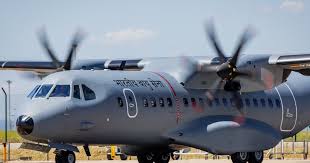
The Indian Air Force will receive its first Made-in-India C295 tactical transport aircraft in late September in Vadodara. Assembled by Tata Advanced Systems and Airbus, this marks the first time a private company has built a military plane in India, advancing national defense self-reliance and forward border logistics.
VADODARA, India — The Indian Air Force (IAF) is structurally positioned to receive its first domestically manufactured C295 tactical military transport aircraft between September 22 and September 23. Government and defense officials confirmed on Tuesday that the medium-lift aircraft, which successfully completed its maiden test flight from the Vadodara final assembly line earlier this month, is undergoing advanced post-production flight evaluations. The delivery represents a historic structural shift, marking the first time a complete military aircraft has been built and rolled out in India by a private-sector enterprise.
The upcoming handover highlights the progress of the ₹21,935-crore aviation contract signed by the Ministry of Defence in September 2021 to replace the air force's aging transport fleet. Jointly executed by Airbus Defence and Space and Tata Advanced Systems Limited (TASL), the joint aerospace program is designed to deliver a total of 56 transport aircraft to the IAF. With the first 16 units already delivered in flyaway condition from Seville, Spain, the impending September delivery initiates the domestic phase of the procurement timeline.
Strategic Shift and Private Sector Industrial Lineage
The integration of the first domestically manufactured C295 into active military service marks a major industrial departure from the state-led production monopolies traditionally managed by Hindustan Aeronautics Limited (HAL). The Final Assembly Line (FAL) at the Tata Aircraft Complex in Vadodara, Gujarat—co-inaugurated by Prime Minister Narendra Modi and Spanish Prime Minister Pedro Sánchez—serves as the foundational hub for the local manufacturing ecosystem.
According to technical specifications released by industrial partners, the indigenization roadmap for the 40 locally built aircraft is structured to scale up labor hours and materials progressively. While the initial batch incorporates a baseline of 48% indigenous content, the volume of domestic manufacturing is slated to scale to 75% across subsequent production runs. By the rollout of the 32nd aircraft, the localized assembly framework is scheduled to touch 98% indigenization.
The localized supply chain requires the manufacturing of more than 13,000 detailed parts and 4,600 sub-assemblies inside India from raw metal inputs. Over 37 specialized domestic supply firms, including 33 Micro, Small, and Medium Enterprises (MSMEs), have been integrated into the production lifecycle. However, core specialized assemblies, including the dual Pratt & Whitney PW127G turboprop engines and advanced digital avionics systems, continue to be sourced directly from global original equipment manufacturers for integration at the Vadodara site.
Operational Capabilities and Forward Deployment Focus
From an operational standpoint, the C295 fleet is designated to entirely phase out the Cold War-era Hawker Siddeley HS-748 Avro transport fleet, which entered active frontline service with the IAF in the early 1960s. The new tactical airlifter plugs a vital operational capability gap positioned between the lighter Dornier 228 platforms and the heavy-lift C-130J Super Hercules assets.
| C295 Operational Performance Metric | Verified Technical Value |
| Maximum Payload Capacity | 9.5 Tonnes (9,000 kg) |
| Troop Transport Volume | Up to 71 Personnel / 45 Paratroopers |
| Maximum Cruise Speed | 480 kilometers per hour (kmph) |
| Powerplant Configuration | 2x Pratt & Whitney PW127G Turboprops |
The tactical utility of the C295 centers heavily on its Short Take-Off and Landing (STOL) design parameters. The twin-engine airlifter is capable of executing operations from rugged, unpaved, and short mountain airstrips. Armed with a built-in rear ramp door for rapid tactical paradropping of equipment and troops, the aircraft will be deployed directly to bolster logistical support lines along India’s contested northern borders, remote North-Eastern outposts, and the island territories of Andaman and Nicobar.
Official Sources Section
The production metrics, operational timelines, delivery dates, and sub-assembly frameworks presented in this report have been sourced directly from official press releases compiled by the Press Information Bureau (PIB), regulatory status statements issued by the Ministry of Defence, and post-flight testing data published by Airbus Defence and Space.
Quote Section
"According to officials familiar with the defense program, the successful execution of post-production flight tests in Gujarat confirms that the domestic private-sector assembly line has attained the rigorous manufacturing tolerances required for modern military aviation, paving the way for a sustainable production rhythm of 12 aircraft per year."
Why It Matters
The delivery of the first Made-in-India military transport aircraft yields structural outcomes for various sectors:
For the Military: The IAF secures an immediate operational upgrade for forward logistics near contested borders, deploying its first two C295 squadrons at Vadodara and Agra while preparing to raise a third squadron next year.
For Domestic Businesses and MSMEs: The certification of 21 specialized manufacturing processes within India establishes advanced industrial capabilities that can be leveraged for future commercial and military aerospace tenders.
For the Economy: The project generates over 42.5 lakh man-hours of high-skilled industrial work, creating 600 direct engineering roles and over 6,000 indirect employment opportunities across the domestic engineering supply chain.
Key Facts at a Glance
Imminent Handover: The Indian Air Force expects delivery of its first locally built C295 aircraft in Vadodara on September 22-23.
Private Aviation Milestone: This represents the first military aircraft manufactured entirely within the private sector in Indian history.
Comprehensive Procurement: The ₹21,935-crore contract covers 56 aircraft, with 16 flyaway units delivered from Spain and 40 being assembled by TASL.
Frontline Upgrades: The C295 replaces the aging 1960s Avro-748 fleet and features a 9.5-tonne payload capacity tailored for short, unpaved airstrips.
Defense Indigenization: All 56 aircraft will feature an indigenous electronic warfare suite manufactured by Bharat Electronics Limited (BEL) and Bharat Dynamics Limited (BDL).
FAQ Section
Where will the first Made-in-India C295 aircraft be stationed?
The aircraft is expected to join one of the Indian Air Force's active C295 squadrons based out of the military stations in Vadodara or Agra to begin operational familiarization.
When will the remaining India-built C295 aircraft be delivered?
Following the first delivery in September, the remaining 39 aircraft under assembly at the Tata Aircraft Complex are scheduled to be handed over to the IAF progressively by August 2031.
What indigenous sub-systems are integrated into the Indian C295 fleet?
All aircraft are fitted with a specialized, locally designed self-protection electronic warfare suite developed and manufactured by state-run defense units BEL and BDL.
Source: Press Information Bureau (PIB) Government Releases, Ministry of Defence, Government of India