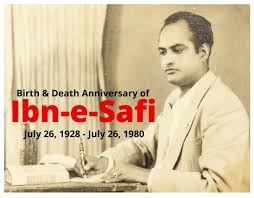
The 98th birth and 45th death anniversary of legendary Urdu novelist Ibn-e-Safi was observed on July 26, 2025, with tributes pouring in from literary circles across South Asia. Known for revolutionising Urdu detective fiction, Ibn-e-Safi’s legacy continues to captivate readers decades after...
The 98th birth and 45th death anniversary of legendary Urdu novelist Ibn-e-Safi was observed on July 26, 2025, with tributes pouring in from literary circles across South Asia. Known for revolutionising Urdu detective fiction, Ibn-e-Safi’s legacy continues to captivate readers decades after his passing.
Early Life And Literary Journey
Born as Asrar Ahmad on July 26, 1928, in Nara village of Allahabad district in British India, Ibn-e-Safi began writing poetry and satire in his youth. After Partition, he migrated to Karachi in 1952 and launched his own publishing house, Asrar Publications. His early works included humorous columns and short stories, but it was detective fiction that earned him widespread acclaim.
Key highlights from his career:
-
Authored 125 novels in the Jasoosi Dunya series and 120 in the Imran Series
-
Created iconic characters like Colonel Faridi, Sajid Hameed, and Ali Imran
-
Blended suspense, comedy, romance, and action in a uniquely South Asian style
His novels were known for imaginative settings, fast-paced plots, and unforgettable character names, influencing generations of writers and filmmakers.
Cultural Impact And Popularity
Ibn-e-Safi’s books were published simultaneously in India and Pakistan, making him a rare literary figure with cross-border appeal. His writing style, inspired by authors like Agatha Christie and Arthur Conan Doyle, was adapted to local sensibilities, creating a genre that was both thrilling and culturally resonant.
Public sentiment and influence:
-
His novels were widely read by youth and adults alike, often passed around in families
-
Bollywood screenwriter Javed Akhtar credited Ibn-e-Safi’s characterisation as inspiration for iconic villains like Gabbar Singh and Mogambo
-
Venues across South Asia were named after fictional locations from his books, such as Tip Top, Niagara, and High Circle
His work also inspired translations and adaptations, with English versions of his novels appearing from 2010 onwards, expanding his reach to global audiences.
Personal Struggles And Resilience
Despite his success, Ibn-e-Safi faced personal challenges. Between 1960 and 1963, he suffered from severe depression, reportedly due to the pressure of producing multiple novels each month. After a brief hiatus, he returned with renewed creativity, writing dozens of new titles in both series.
Notable personal milestones:
-
Married Umme Salma Khatoon in 1953
-
Advised Pakistan’s intelligence agencies informally in the 1970s
-
Wrote and voiced parts for the film Dhamaka, based on his own novel
His resilience and prolific output earned him admiration not just as a writer but as a cultural icon who shaped modern Urdu literature.
Tributes And Observances
On his 98th birth and 45th death anniversary, literary forums, universities, and fans across Pakistan and India paid homage to Ibn-e-Safi’s contributions. Online platforms shared excerpts from his novels and poetry, while scholars revisited his influence on South Asian storytelling.
Commemorative activities included:
-
Public readings of Jasoosi Dunya and Imran Series novels
-
Discussions on his narrative style and genre-defining impact
-
Social media campaigns celebrating his characters and quotes
His grave in Karachi’s Paposhnagar cemetery was visited by admirers, and several Urdu publications released special editions in his memory.
Legacy Of The Pen
Ibn-e-Safi’s legacy is not just in the number of books he wrote but in the worlds he created—worlds that continue to live in the imagination of readers. His ability to blend humour with suspense, and realism with fantasy, remains unmatched in Urdu fiction. As South Asia’s literary landscape evolves, his work stands as a timeless reminder of the power of storytelling.
Sources: UrduPoint, Wikipedia, Lokmat News, WN.com, MSN India, PTI, Daily Pioneer