ICAR-National Dairy Research Institute Scholar Wins Pune Agri Hackathon
Nikita Gupta - Kolkata Bureau Jun 14, 2026 1,500 Views
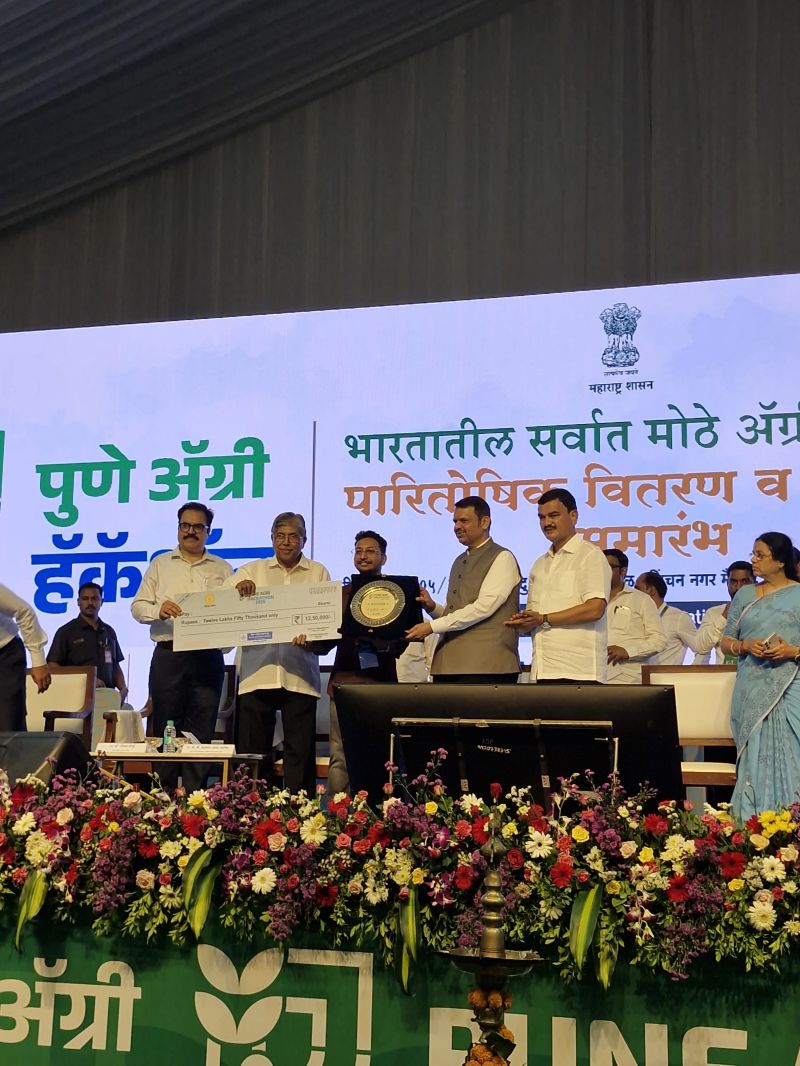
Yash Sonawane, a PhD scholar at ICAR-NDRI, won the National Pune Agri Hackathon 2026 for his "ProtoFeeds" project. The automated system uses insect larvae to convert farm waste into high-protein animal feed, earning a Rs 25 lakh commercialization grant from the jury for its potential to transform waste into wealth.
PUNE, June 14, 2026 — A research scholar from the ICAR-National Dairy Research Institute (NDRI) has won the National Pune Agri Hackathon 2026, marking a major milestone in sustainable agricultural technology. Yash Sonawane, a first-year PhD scholar at the premier institute, secured the coveted top position against a nationwide pool of researchers, innovators, and agri-tech entrepreneurs.
The national jury honored Sonawane for his breakthrough bio-circular project named "ProtoFeeds." Alongside the winner's trophy, the young scientist has been awarded a research commercialization grant of Rs 25 lakh to scale up his innovative farm waste management model into a commercial enterprise.
"ProtoFeeds" Tackles Livestock Feed and Waste Crisis
Developed under the Division of Livestock Production Management (LPM) at ICAR-NDRI, the winning project focuses specifically on the theme of "Innovations in Renewable Energy in Agriculture and Farm Waste Management." The ProtoFeeds system designs a highly efficient, automated bio-circular mechanism that utilizes Black Soldier Fly Larvae (BSFL) to aggressively convert municipal and agricultural organic waste into high-value protein meals, lipids, and organic fertilizers.
According to institutional project portfolios, the solution targets two critical pain points in Indian agriculture: the mounting problem of unmanaged organic farm residue and the escalating cost of high-protein animal feed components.
Rigorous Livestock Feeding Trials Validate Model
The technical evaluation went beyond theoretical modeling. Rigorous livestock feeding trials validated under the study proved that substituting standard concentrate feed with 10% to 15% dried larvae significantly enhances body weight gain, nutrient digestibility, and blood hemoglobin levels in animals. Crucially, the trials demonstrated these enhancements without causing any adverse physiological or health effects in the test groups.
The techno-economic viability of ProtoFeeds was highly lauded by the national selection committee for its potential to revolutionize India's active "Waste to Wealth" initiatives. Compared to conventional industrial composting or large-scale Bio-CNG setups, this automated BSFL bioconversion model slashes necessary land requirements down to just 1 to 2 acres per 100 tonnes per day. Furthermore, it compresses organic waste processing times to just 12 to 15 days while projecting a rapid commercial payback period of 1 to 3 years for adopting operators.
Impact on Dairy Farmers and the Agri-Tech Sector
High feed costs have consistently squeezed the profit margins of smallholder dairy farmers across India. By presenting an alternative, insect-based protein stream derived entirely from recovered farm waste, the ProtoFeeds model provides an avenue to lower input costs while maintaining or improving milk yield and livestock health.
For municipal bodies and corporate agricultural supply chains, the scalability of this model suggests a lower-footprint alternative to managing urban organic food waste and agricultural residues, providing clear economic alignment between environmental sanitation and livestock feed industries.
Official Sources Section
The details concerning the award, technical specifications, and institutional validation of the project have been confirmed via:
ICAR-National Dairy Research Institute: Official statements from Director Dr. Dheer Singh detailing the research parameters and the Division of Livestock Production Management logs.
National Pune Agri Hackathon 2026 Organizing Committee: Joint declarations by the Department of Agriculture (Government of Maharashtra), the Collector Office Pune, and Mahatma Phule Krishi Vidyapeeth (MPKV) College of Agriculture, Pune.
Quote Section
Commenting on the national recognition, Dr. Dheer Singh, Director of ICAR-NDRI, stated to media representatives:
"The breakthrough project developed by our scholar addresses a vital link in the agricultural economy. The national jury recognized ProtoFeeds for its scalability and its alignment with zero-waste goals. This Rs 25 lakh grant will facilitate the transition of laboratory-scale insect bioconversion into automated, field-ready systems capable of helping rural communities."
Why It Matters
As global agricultural networks face structural resource constraints, traditional feed sources like soybean meal face volatile pricing and high land footprints. The success of the ProtoFeeds model demonstrates that biotechnology can turn localized farm waste into high-quality protein feed. Providing a massive commercialization grant ensures that university-born research moves out of academic papers and enters active manufacturing markets, establishing a blueprint for decentralized circular economies across India.
Key Facts at a Glance
The Winner: Yash Sonawane, 1st-year PhD research scholar at ICAR-NDRI.
The Innovation: "ProtoFeeds" — an automated Black Soldier Fly Larvae bioconversion system.
The Reward: Winner's trophy and a national research commercialization grant of Rs 25 lakh.
Performance Metrics: Compresses waste processing to 12–15 days; requires only 1–2 acres per 100 tonnes of daily processing.
Livestock Benefits: Proven to optimize weight gain and nutrient digestibility when replacing 10% to 15% of standard feed concentrates.
FAQ Section
What is the National Pune Agri Hackathon?
The National Pune Agri Hackathon is an elite competitive event jointly organized by the Department of Agriculture of Maharashtra, the Pune Collector Office, and MPKV College of Agriculture to identify, fund, and accelerate high-impact, scalable technologies addressing pressing agricultural challenges.
How does the ProtoFeeds technology work?
The system utilizes Black Soldier Fly Larvae (BSFL) inside an automated environment. The larvae consume organic food and agricultural waste at an accelerated rate, converting the biomass into nutrient-rich larval protein (for animal feed), lipids, and a residual organic fertilizer called frass.
Can insect-based feed safely replace traditional livestock feed?
Yes. Validated feeding trials conducted by the scholar at ICAR-NDRI confirmed that replacing 10% to 15% of conventional concentrate feed with dried larvae safely improves body weight, nutrient digestion, and hemoglobin levels without any negative health indicators.
Source:ICAR-National Dairy Research Institute Directorate Media Release, Department of Agriculture (Maharashtra) Hackathon Post-Event Logs, and the Division of Livestock Production Management Research Archive.