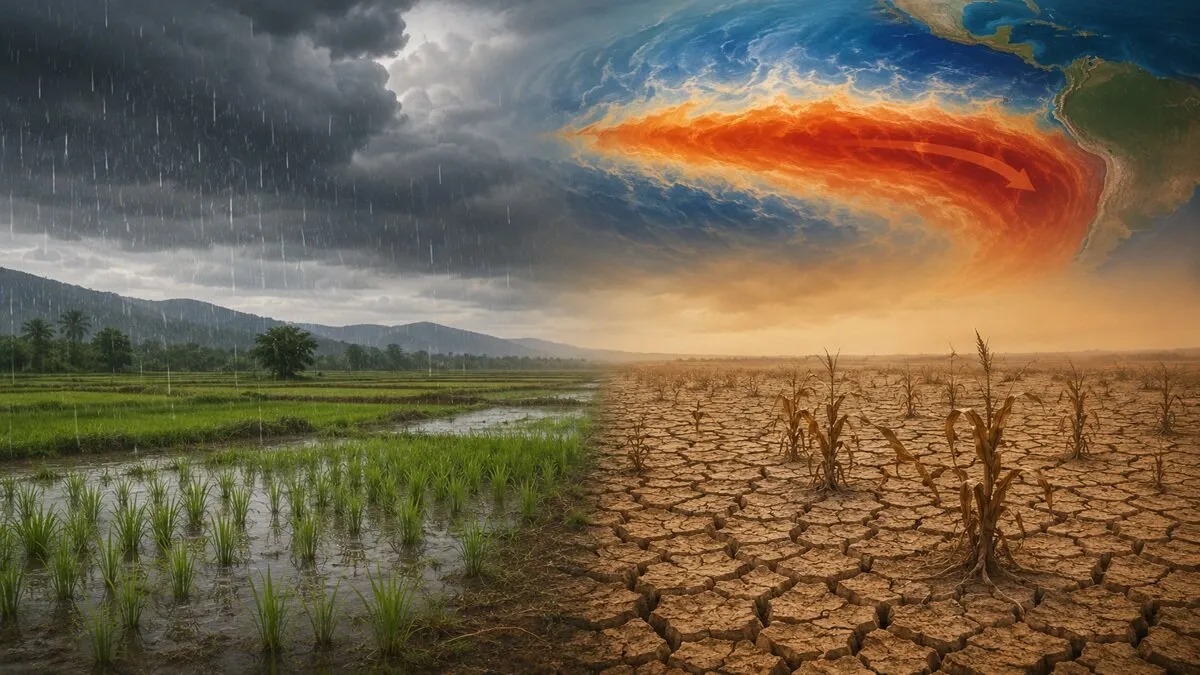
The India Meteorological Department (IMD) has forecast below-normal rainfall for July 2026, estimating precipitation will drop below 94 percent of the long-period average. Driven by strengthening El Niño conditions, this shortage follows a 39.8 percent deficit in June, threatening to delay summer crop sowing and increase regional water stress.
NEW DELHI — The India Meteorological Department (IMD) announced on Tuesday, June 30, 2026, that India is highly likely to experience below-normal rainfall during July. According to the state weather agency's official monthly outlook briefing, precipitation across the country as a whole is expected to fall below 94 percent of the Long Period Average (LPA). The structural alert comes immediately after a highly subdued June, which recorded a severe 39.8 percent rainfall deficit nationwide.
The updated July projection introduces substantial risk factors for Asia’s third-largest economy, which depends heavily on the southwest monsoon to sustain its agricultural output. Because July historically stands as the rainiest month of the four-month monsoon season contributing roughly 32 percent of the total seasonal precipitation the forecasted shortage threatens to severely complicate summer crop sowing, strain rural incomes, and intensify water management challenges across several states.
The Meteorological Metrics of the July Shortfall
Statistical parameters released by the India Meteorological Department (IMD) establish that the baseline LPA for July stands at 280.4 mm, calculated using historical precipitation records compiled between 1971 and 2020. Falling below the 94 percent boundary classifies the upcoming month's performance within the "below-normal" category, signaling a prolonged stalling of monsoon systems.
IMD Director General of Meteorology Mrutyunjay Mohapatra clarified that the precipitation deficit will display sharp regional disparities. Large swaths of central, western, and northern farming belts are projected to receive severely reduced rainfall volumes. Conversely, isolated packets within northwest India, east-central India, the eastern peninsular region, and sections of northeast India are bucking the national trend, with models showing a high probability of receiving normal to above-normal precipitation bands.
June Anomalies and the El Niño Factor
The troubling July outlook follows the fifth-driest June recorded in India since systematic climate record-keeping commenced in 1901. During June, the country received a mere 99.5 mm of water against the historical monthly normal of 165.3 mm. Forecasters attributed this initial structural failure to a two-week delay in the monsoon’s advancement across the western agricultural corridors, combined with a total absence of low-pressure cyclonic systems over the Bay of Bengal.
According to climate model tracking updates issued by the Ministry of Earth Sciences, the overriding catalyst behind the disrupted rainfall distribution is the steady strengthening of El Niño conditions over the equatorial Pacific Ocean. The warming of these oceanic currents has actively weakened the southwest monsoon by altering atmospheric circulation cells and preventing standard maritime moisture transport from penetrating deep into the Indian mainland.
Furthermore, an unfavorable placement of the Madden-Julian Oscillation (MJO) a massive atmospheric wave moving across the Indian Ocean has systematically suppressed cloud formation throughout the early phases of the summer calendar.
Socio-Economic Realities and Agricultural Sowing Deficits
The practical impact of consecutive dry spells is already materializing across the agricultural sector. Statutory data compiled by the Ministry of Agriculture and Farmers Welfare indicates that overall Kharif (summer-sown) crop planting has lagged by nearly 23 percent compared to the same operational window last fiscal year. Soil moisture profiles in key agrarian states like Maharashtra, Madhya Pradesh, and Karnataka have dropped significantly, delaying the traditional planting of critical commodities including rice, corn, cotton, and soybeans.
Beyond primary agricultural concerns, the IMD issued concurrent structural warnings predicting above-normal maximum and minimum temperatures over a majority of the country throughout July. Combined with elevated ambient humidity, the persistent thermal load is expected to trigger increased peak electricity demand across urban municipal grids, testing the capacity limits of public energy utilities.
Official Sources Section
The meteorological forecasts, structural percentages, historical data comparisons, and regional weather maps are authenticated via the official climate summary press releases published by the India Meteorological Department (IMD) HQ and the administrative bulletins managed by the Press Information Bureau (PIB) under Ministry of Earth Sciences docket filings.
Quote Section
"According to officials at the weather department, while the first seven to ten days of July will bring scattered showers that could assist pending field preparation, the second half of the month shows signs of a significant break in monsoon activity. Farmers are strongly advised to utilize water conservation mechanisms and adopt short-duration crop varieties where feasible."
Why It Matters
The practical implication of the IMD's July warning rests on its economic ripple effects. A deficient July directly translates to lowered crop yields and higher retail food inflation, which could force the Reserve Bank of India to maintain elevated interest rates. Additionally, dropping water reservoir levels could pressure manufacturing operations, rural consumer spending power, and national economic growth projections for the second half of the year.
Key Facts at a Glance
Volumetric Limit: July precipitation is forecast to drop below 94 percent of the long-period average of 280.4 mm.
Historical Deficit: The projection follows a heavily deficient June, which marked a 39.8 percent rainfall shortage and ranked as the fifth-driest since 1901.
Climate Inhibitors: Persistent equatorial El Niño warming and an unfavorable Madden-Julian Oscillation phase are blocking core moisture delivery.
Thermal Stress: The IMD warns of above-normal day and night temperatures, increasing the risk of widespread heat and humidity stress.
FAQ
Does a dry June and July mean the entire monsoon season will fail?
Not necessarily. Historical IMD data since 1951 shows that out of 26 years with below-normal June rainfall, only eight years concluded with a below-normal overall season, as late-stage recoveries in August and September frequently offset early shortages.
Which specific states are most vulnerable to the July rainfall deficit?
Agricultural zones across central, western, and northern India including parts of Maharashtra, Gujarat, Rajasthan, and Madhya Pradesh face the highest probability of below-normal precipitation.
What measures should farmers take in response to this forecast?
Agricultural extension boards advise farmers to employ micro-irrigation tools, maximize rainwater harvesting techniques, and prioritize less water-intensive crop varieties to navigate the moisture shortage.
Source: India Meteorological Department (IMD), Press Information Bureau (PIB) Government of India, Ministry of Earth Sciences