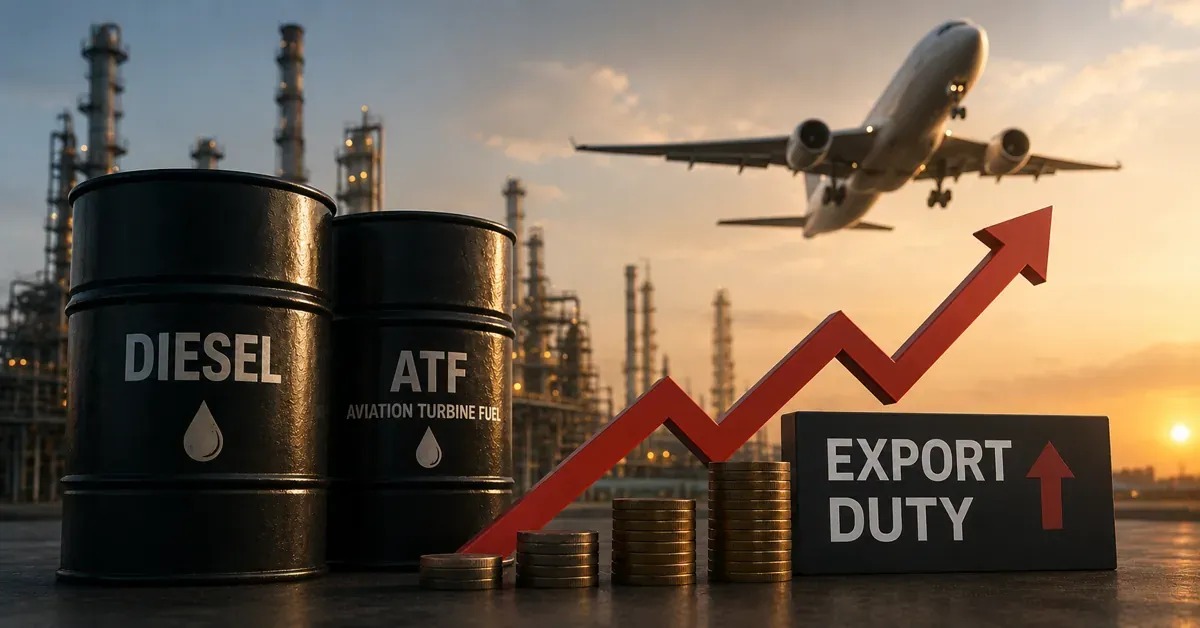
The Indian government has adjusted its fuel windfall tax, raising the export duty on petrol to ₹4 per litre to secure local supplies. Concurrently, export duties on diesel and ATF were cut to ₹8.5 and ₹7.5 per litre respectively, aligning with lower global crude prices, while expanding shipping tax exemptions to Mauritius and the Maldives.
NEW DELHI — The Union Ministry of Finance announced a targeted overhaul of its Special Additional Excise Duty (SAED) framework on Tuesday, June 30, 2026, increasing the tariff on petrol exports while reducing the export levies on diesel and aviation turbine fuel (ATF). The revised rates, formalized through a statutory gazette notification, will come into effect at midnight on July 1, 2026.
The structural policy recalibration arrives as international crude oil benchmarks begin to drop below recent historical peaks. The move highlights the central government's ongoing effort to balance domestic supply buffers with changing international refining margins, ensuring local fuel availability remains insulated against wider global market fluctuations.
The New Export Duty Multipliers
According to the official schedules released by the Ministry of Finance, the special additional excise duty on petrol exports has been increased to ₹4 per litre, up from the previous baseline of ₹1.5 per litre. Government planners authorized this increase to disincentivize excessive outbound fuel shipments and guarantee that local retail networks remain fully supplied as domestic summer transport demands reach seasonal peaks.
Conversely, softening international refining margins prompted the government to lower its windfall taxes elsewhere. The export duty on diesel has been cut to ₹8.5 per litre, down significantly from the ₹14 per litre rate established during the mid-June review cycle. Similarly, the tax on ATF exports was reduced to ₹7.5 per litre from its prior level of ₹12.5 per litre.
Market Context and Geopolitical Adjustments
The domestic tax revision coincides with a downward trend in global energy benchmarks. Brent crude futures, which peaked above $126 per barrel earlier this year due to persistent shipping security concerns in the West Asian corridors, have steadily cooled. Maritime cargo streams moving through the Strait of Hormuz have stabilized, easing supply anxiety across the broader Asian refining ecosystem. Independent market analysts now project Brent crude to average approximately $84.50 per barrel over the next two quarters.
Furthermore, the government has revised its list of international geographic exemptions. Initially, state-owned oil marketing companies were granted complete exemptions from the export levy for fuel supplies shipped to landlocked or close neighbor nations, including Nepal, Bhutan, Bangladesh, and Sri Lanka. The newly updated Finance Ministry guidelines have formally expanded this regional exemption framework to include outbound fuel shipments bound for Mauritius and the Maldives.
Impact on Domestic Refiners and Consumers
For large-scale domestic refiners, including public sector units and private operators like Reliance Industries Limited, the lower duties on diesel and ATF will alleviate pressure on refining margins. High export duties typically absorb a substantial portion of the profits generated from overseas shipments. The current reduction allows refiners to retain a higher share of their international processing margins, enhancing their competitiveness in European and regional Asian fuel hubs.
Crucially, the government confirmed that there is absolutely no change to the base excise duty structures applied to petrol and diesel cleared for domestic consumption. As a result, domestic retail consumers, local commercial logistics firms, and general motorists will not experience price changes at retail fuel stations due to this specific policy adjustment.
Official Sources Section
The operational tax rates, commodity exemptions, and structural enforcement directives are verified through official gazette notifications issued by the Department of Revenue under the Ministry of Finance and administrative briefings published by the Press Information Bureau (PIB) under the late-night legislative review docket for June 30, 2026.
Quote Section
"According to officials familiar with the development, the fortnightly revisions remain an essential mechanism to prevent structural deficits within the domestic market. The increase in the petrol export duty acts as a protective shield for local pumps, while the lowering of diesel and ATF taxes aligns India’s export economics with changing international crude pricing realities."
Why It Matters
The practical implication of this fiscal fine-tuning is two-fold. First, it demonstrates the government's capacity to protect local retail supply chains without completely penalizing industrial refining profits. Second, by dynamically linking export taxes to real-time global oil values, policymakers can protect India's energy security while preserving its standing as an international refining powerhouse.
Key Facts at a Glance
Petrol Duty Increase: The export levy on petrol rose to ₹4 per litre from the previous ₹1.5 per litre to safeguard local inventories.
Diesel and ATF Relief: Diesel export duty dropped by ₹5.5 to ₹8.5 per litre, while the ATF tariff fell by ₹5 to ₹7.5 per litre.
Exemption Expansion: Public sector fuel shipments bound for Mauritius and the Maldives are now exempt from the windfall tax framework.
No Domestic Retail Impact: Base domestic excise structures remain unchanged, meaning local fuel prices will not change at the pump.
FAQ
Why does the government change these export duties so frequently?
The Ministry of Finance reviews these duties every fortnight to keep pace with volatile movements in international crude oil prices and global refining margins, adjusting the tax rate to match global shifts.
Will this change affect the retail price of petrol or diesel in Indian cities?
No. The adjustment is strictly confined to fuel products destined for international export markets. The excise duties governing domestic consumption remain unchanged.
Which companies are most affected by these changes?
Large-scale standalone refiners that export refined products to international markets such as Reliance Industries and public sector oil marketing firms are the primary entities affected by these shifting export tax margins.
Source: Ministry of Finance, Government of India, Press Information Bureau (PIB)