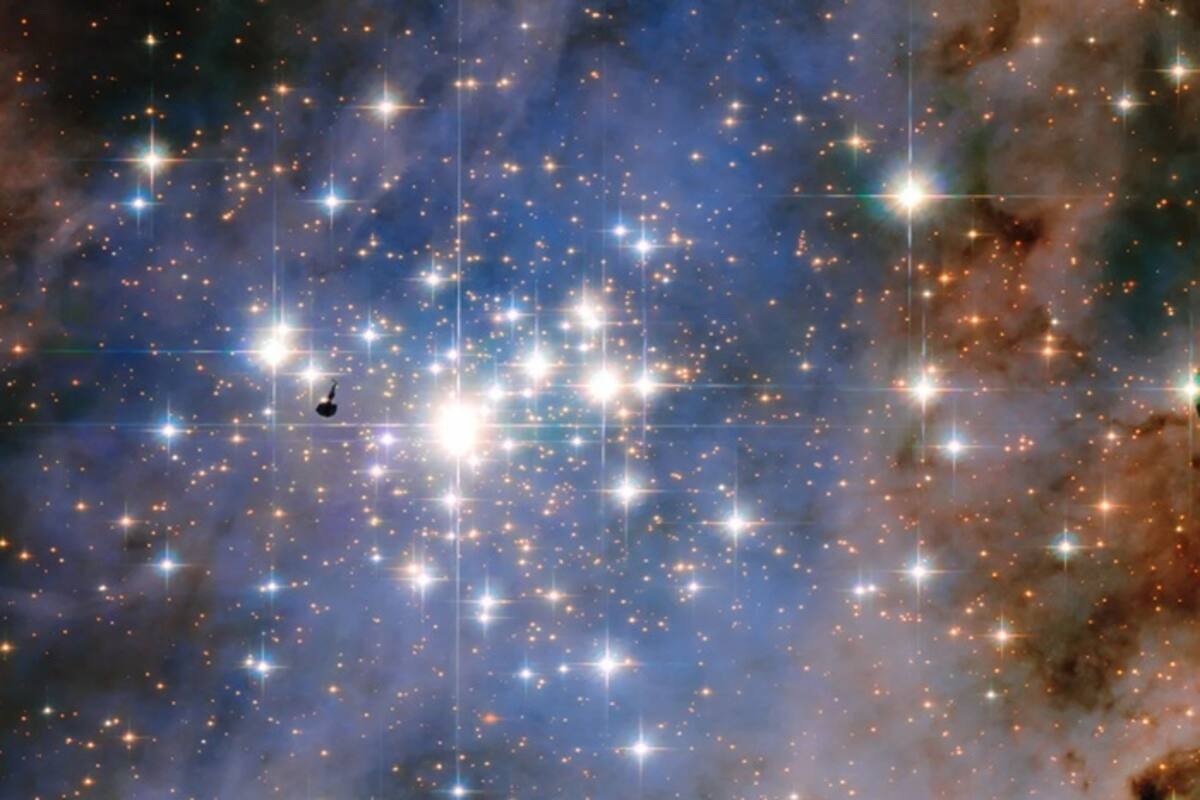
NASA has released a high-resolution image of the "Chandelier" star cluster, a dense cosmic formation featuring stars that are 10 billion years old. Captured using specialized infrared technology, the image offers critical spectroscopic data that assists global astronomers in analyzing the structural evolution and chemical components of the early universe.
WASHINGTON — The National Aeronautics and Space Administration (NASA) published a detailed cosmic photograph capturing a dense stellar formation known colloquially as the "Chandelier" cluster on June 30, 2026. According to astrophysics teams managing the agency's space telescope programs, the cluster houses ancient cosmic bodies, with certain stars verified to be up to 10 billion years old.
The image release provides contemporary astronomers with an unobstructed window into the foundational eras of the universe. By analyzing the light signatures from this tightly packed population, researchers are actively attempting to reconstruct the chemical environments present shortly after the Big Bang, making this dataset a vital asset for ongoing astrophysics programs.
Technical Analysis of the Chandelier Cluster
Data provided by the NASA Goddard Space Flight Center reveals that the structural framework of the cluster features a distinct hanging arrangement reminiscent of a grand light fixture, which prompted its initial classification. Spectroscopic analysis conducted by ground-based validation teams confirms that a significant portion of the inner stellar system consists of low-metallicity population II stars.
These 10-billion-year-old stars serve as cosmic time capsules. Because they formed before successive generations of exploding supernovas enriched the interstellar medium with heavier elements, their atmospheres consist almost entirely of primordial hydrogen and helium.
The image was compiled using a combination of near-infrared and visible light data channels. The utilization of infrared imaging allows the space telescope instruments to cut through thick blankets of interstellar dust that traditionally obscure dense star clusters from standard optical observation equipment.
Academic Context and Observational Infrastructure
The observation of the Chandelier cluster aligns with a series of deep-space documentation projects coordinated by NASA in tandem with the European Space Agency (ESA). Over the last several fiscal years, space agencies have systematically shifted their focus toward mapping high-density globular systems that occupy the outer halos of nearby galaxies.
According to research notes published via the Space Telescope Science Institute (STScI), tracking the gravitational interactions inside these 10-billion-year-old star systems helps refine mathematical models regarding dark matter distribution. The intense gravitational bound within the cluster keeps these ancient stellar bodies locked in precise orbital paths, preventing them from scattering into the broader voids of space over billions of years.
Impact on Space Science and the Public Sector
For the global scientific community and institutional investors funding aerospace research, the successful capture of the Chandelier cluster validates the continued capital expenditure allocated to high-aperture space instrumentation. The clarity of the data proves that modern sensor stabilization technology can successfully isolate individual star signals within hyper-congested cosmic fields.
For educators, students, and space enthusiasts, the distribution of the image provides a tangible educational tool that illustrates the lifecycle of stellar nurseries. The publication of high-definition cosmic imagery has historically driven public engagement metrics and encouraged academic enrollment within STEM (Science, Technology, Engineering, and Mathematics) fields globally.
Official Sources Section
The telemetry coordinates, imaging parameters, and structural analyses of the star cluster are documented under the official astronomical catalog registries maintained by the NASA Exoplanet Science Institute and public image release logs coordinated by the mission operations desk at NASA Headquarters in Washington, D.C.
Quote Section
"According to officials managing the imaging pipeline, the sheer density of the stellar population within this specific structure required multiple processing passes to separate overlapping light spectrums. The presence of stars dating back 10 billion years provides an invaluable baseline for stellar aging models."
Why It Matters
The practical implication of this discovery lies in the calibration of astronomical measuring tools. By establishing the exact age and elemental composition of the ancient stars within the Chandelier cluster, astronomers can fine-tune the mathematical algorithms used to measure distances across the deep universe, ensuring that future deep-space navigation and exploration missions rely on highly accurate spatial frameworks.
Key Facts at a Glance
Stellar Maturity: The Chandelier cluster contains validated population II stars calculated to be approximately 10 billion years old.
Visual Spectrum: The composite image was generated using high-resolution near-infrared sensors capable of bypassing dense cosmic dust barriers.
Structural Shape: The system earned its colloquial moniker due to the unique, gravity-driven alignment of its central stellar streams.
Chemical Profile: Spectroscopic data confirms low metallicity across the inner core, signifying that the stars originated in an early, unrefined universe.
FAQ
How do scientists determine that these stars are 10 billion years old? Astrophysicists determine age by evaluating the mass and elemental composition of the stars via spectroscopy. Stars with very low concentrations of heavy metals are known to have formed in the early stages of the universe.
Can the Chandelier cluster be seen with a standard backyard telescope? No. Due to the extreme distance and intervening cosmic dust, this specific stellar cluster requires high-aperture space telescopes equipped with advanced infrared sensors to resolve clearly.
What keeps the cluster from separating over time? The structure is held together by a high concentration of mutual gravitational forces. This binding force ensures that the thousands of stars within the cluster remain organized in a distinct structural shape for billions of years.
Source: NASA Goddard Space Flight Center, Space Telescope Science Institute (STScI), NASA Exoplanet Science Institute