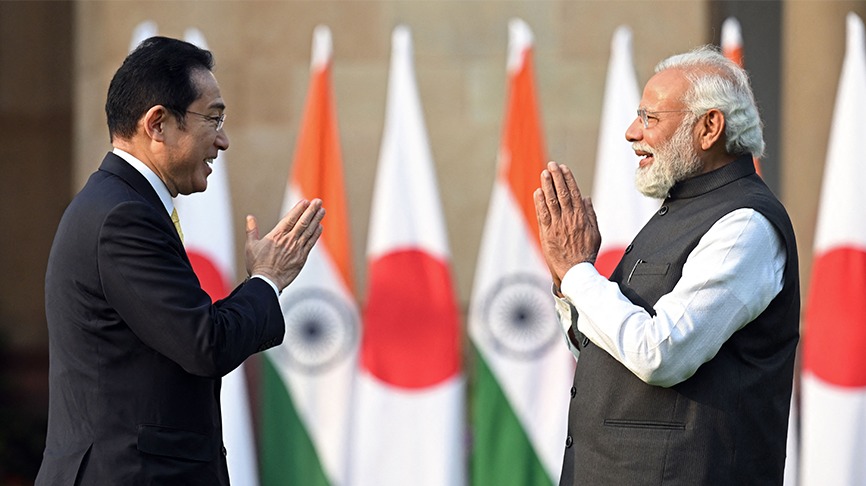
In a landmark announcement during Prime Minister Narendra Modi's visit to Japan, India and Japan have pledged to facilitate a human resources exchange program involving 500,000 people over the next five years. This ambitious goal marks a deepening of bilateral relations and represents a mutua...
In a landmark announcement during Prime Minister Narendra Modi's visit to Japan, India and Japan have pledged to facilitate a human resources exchange program involving 500,000 people over the next five years. This ambitious goal marks a deepening of bilateral relations and represents a mutual commitment to harnessing the strengths of their respective workforces. The initiative forms part of a broader strategic partnership aimed at bolstering economic growth, innovation, and cultural ties between the two nations.
Key Highlights Of The Human Resource Exchange Agreement
The governments of India and Japan plan to enable the exchange of over 500,000 individuals in sectors including government, industry, academia, and more within five years.
Japan aims to welcome approximately 50,000 highly skilled Indian professionals, particularly in science, engineering, and technology fields, to address its labor shortages.
Both countries are committed to enhancing language training and creating supportive environments to enable Indian workers to integrate smoothly into the Japanese workforce.
Educational exchanges will increase, with greater facilitation for Indian students and researchers to study in Japan and for Japanese students in India.
Collaborative research initiatives will be promoted between universities of both nations to foster innovation and knowledge sharing.
Strengthening India-Japan People-to-People Ties
This human resources exchange builds on the existing foundation of economic and cultural cooperation. With India’s rapidly growing skilled workforce and Japan’s advanced technological landscape, the partnership leverages complementary strengths.
-
India’s young and talent-rich population represents a crucial resource for Japan, which faces an aging demographic and workforce shortages.
-
Japan’s advanced industries in semiconductors, green energy, artificial intelligence, and biotechnology stand to benefit from India’s expertise.
-
The partnership includes plans for enhanced Japanese language education in India to prepare Indian professionals for successful careers in Japan.
Economic And Technological Collaboration Drive The Exchange
The announced exchange ties closely with broader economic and technological cooperation between the nations.
-
PM Modi emphasized the synergy between Japan’s technology prowess and India’s talent powerhouse as vital for leading the global tech revolution.
-
Both countries are advancing initiatives in AI, semiconductors, quantum computing, and renewable energy, supported by manpower exchanges.
-
The collaboration also extends to joint ventures in space exploration, clean energy, and semiconductor supply chain resilience.
Educational And Research Exchange To Foster Innovation
-
Beyond workforce mobility, academic exchanges aim to deepen scientific collaboration.
-
Indian students and researchers will receive streamlined access to Japanese universities and research facilities.
-
Reciprocal support for Japanese students studying in India will enhance cross-cultural understanding.
-
Joint research ventures will enable breakthroughs in cutting-edge fields, advancing both countries’ innovation agendas.
Implications For Regional And Global Partnerships
-
India and Japan’s enhanced human resource mobility strengthens their strategic and economic positioning in the Indo-Pacific.
-
The collaboration supports regional stability by promoting shared prosperity and inclusive growth.
-
It complements existing partnerships like the Quad, fostering a free and open Indo-Pacific.
-
People-to-people contacts underpin long-term diplomatic and commercial relationships.
Looking Ahead: Towards A Robust, Skilled, And Collaborative Future
-
The ambitious target of exchanging 500,000 people underscores the visionary approach of the India-Japan partnership.
-
Continued policy talks between ministries in both countries are expected to finalize frameworks supporting this mobility.
-
Private sector engagement will be critical to integrating skilled workers and enabling practical opportunities.
-
Enhanced infrastructure for language training and cultural orientation will smooth transitions for workers and students.
In conclusion, the agreement between India and Japan represents a transformative step in bilateral relations. Leveraging demographic strengths and technological ambitions, the two nations are poised to create one of the largest and most dynamic human resource exchange programs in modern times. This initiative promises profound economic, cultural, and strategic benefits for both countries over the coming years.
Sources: NHK, NDTV, Republic World, Japan News, Economic Times