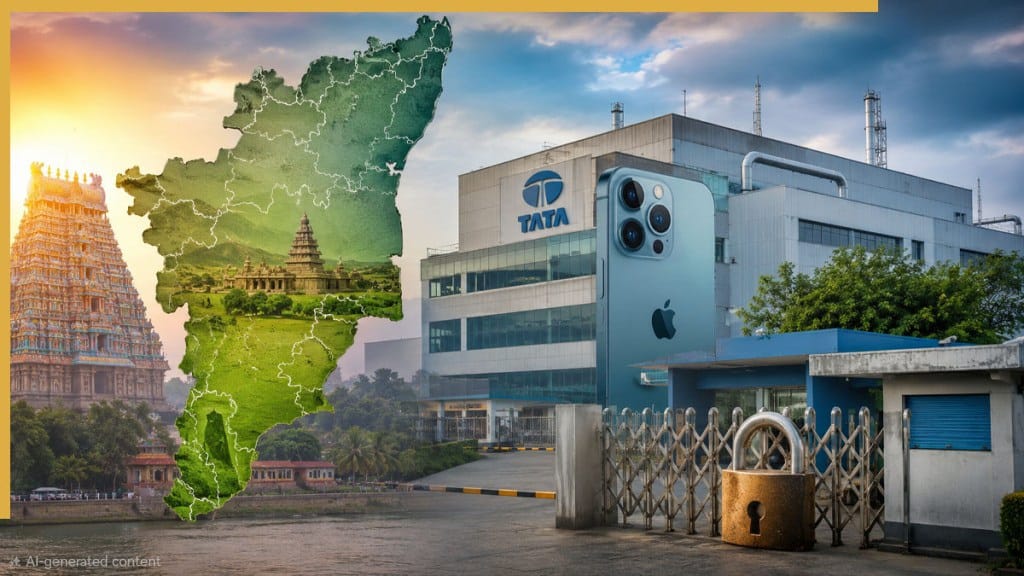
The Tamil Nadu Pollution Control Board has issued a show-cause notice to Tata Electronics over alleged wastewater leaks at its iPhone component plant in Hosur. Regulators reported elevated waste levels in an internal pond that overflowed into local farmlands. Tata denies any violations, stating independent lab tests confirm complete regulatory compliance.
HOSUR, India — The Tamil Nadu Pollution Control Board (TNPCB) has issued a formal show-cause notice to Tata Electronics Private Ltd. over alleged industrial wastewater discharge from its Apple iPhone components plant in Hosur, Tamil Nadu. The regulatory directive, issued under Section 24 of India's Water (Prevention and Control of Pollution) Act, 1974, follows months of persistent complaints from local agriculturalists who report that overflowing effluent has contaminated surrounding open wells and farmland. State officials have granted the supplier 15 days to answer the environmental allegations or potentially face infrastructure power disconnections and an administrative shutdown of the facility.
State Inspections Document Heightened Waste Levels
According to the official state regulatory notice, the TNPCB conducted five site inspections at the manufacturing complex between December 2025 and May 2026. The environmental protection agency alleged that industrial wastewater from the facility had been improperly directed into internal rainwater harvesting ponds. These collection bodies subsequently overflowed, introducing chemical residues into the groundwater tables of adjacent private agrarian properties.
Water sampling data documented by the state board showed stark anomalies inside the plant's internal rainwater reserve:
Biochemical Oxygen Demand (BOD): Logged between 12 mg/L and 78 mg/L, exceeding the standard baseline threshold of less than 8 mg/L.
Chemical Oxygen Demand (COD): Measured in the range of 48 mg/L to 160 mg/L, far above the typical standard of under 15 mg/L.
Total Dissolved Solids (TDS): Peaked at 2,450 mg/L, contrasted against baseline natural rainwater parameters which average under 50 parts per million (PPM).
Tata Submits Compliance Defense Following Audits
Tata Electronics has explicitly rejected the state board's allegations of environmental violations. The organization confirmed it received the administrative notice and dispatched an official, comprehensive brief within the allocated legal response window.
Company executives stated that third-party testing showed no legal deviations. A corporate spokesperson stated that immediately upon notification, the firm commissioned an independent, accredited laboratory to perform comprehensive diagnostic analyses. According to corporate assessments, the industrial infrastructure functions entirely within established legal thresholds.
While the legal verbiage of a standard Indian show-cause notice includes structural provisions to disconnect factory electricity grids or order a cessation of manufacturing, regional government administrators clarified that extreme interventions are reserved for deliberate non-compliance. Local authorities confirmed that standard industrial operations are continuing normally while the state evaluates Tata’s detailed analytical brief.
Contextualizing India's Tech Supply Chain Shift
The regulatory investigation arrives as Apple aggressively expands its South Asian component ecosystem to mitigate logistical reliance on traditional Chinese lines. Market data from research agency Counterpoint projects that India will manufacture 26% of all global iPhones by the end of 2026, accelerating upward from a marginal 6% output recorded four years prior.
The Hosur facility, which specializes in producing complex structural back panels, forms a cornerstone of this supply chain transition. However, the ecosystem has faced successive localized disruptions:
September 2024: A structural fire inside the Hosur plant temporarily stalled component workflows.
September 2023: A fire at a separate regional assembly plant operated by Pegatron halted production for several days.
Compliance audits remain tight across India. Recent data provided by the Union Environment Ministry to the Indian Parliament indicated that roughly 4.4% of over 544,000 industrial units inspected over a five-year window were found non-compliant with standard environmental criteria, resulting in approximately 3,600 regulatory closures nationwide.
Official Sources Section
Information for this report has been sourced from official regulatory documents issued by the Tamil Nadu Pollution Control Board (TNPCB), formal corporate statements from Tata Electronics Private Ltd., field reports verified by the District Administration of Krishnagiri, and corporate compliance metrics recorded by the Union Ministry of Environment, Forest and Climate Change.
Quote Section
"Immediately after hearing from the Tamil Nadu Pollution Control Board, we commissioned an independent analysis through an accredited laboratory. The independent study determined that we are in full compliance with all regulatory norms. We have conveyed our response to the TNPCB in a timely manner. Tata Electronics remains committed to responsible business practices and protection of the environment and local communities."
— Official Statement, Tata Electronics Spokesperson
Why It Matters
For global technology investors, this case highlights the structural environmental hurdles facing major multinationals as they rapidly scale up hardware manufacturing footprints within emerging markets. For local communities, it underscores the critical balance between regional economic industrialization and the preservation of vital water security for agriculture.
Key Facts at a Glance
Location: Tata Electronics iPhone component facility in Hosur, Tamil Nadu.
The Issue: Alleged industrial wastewater runoff leaking into farmland rainwater harvesting ponds.
Regulatory Action: A formal show-cause notice carrying a 15-day window for response.
Water Deviations: State samples recorded Total Dissolved Solids as high as 2,450 mg/L against standard rainwater targets of under 50 PPM.
Ecosystem Scale: India is projected to fulfill 26% of global iPhone manufacturing requirements by the end of 2026.
FAQ Section
Q1: Will the Tata Electronics Hosur plant close down immediately?
A1: No. Government administrators have verified that the factory is continuing normal production workflows. The show-cause framework is an administrative step requiring the company to clarify standard data discrepancies before any punitive action is considered.
Q2: What specific components are manufactured at this particular site?
A2: The specialized industrial unit in Hosur produces high-end structural enclosures, back panels, and mechanical metallic sub-components utilized across global Apple iPhone assembly lines.
Q3: How were the environmental anomalies originally discovered?
A3: Local landowners and farmers submitted official complaints to regional environmental overseers concerning unusual odors and altered crop yields, triggering five subsequent on-site inspections by state environmental technicians.
Source: Tamil Nadu Pollution Control Board, Tata Electronics Corporate Communications, Ministry of Environment, Forest and Climate Change.