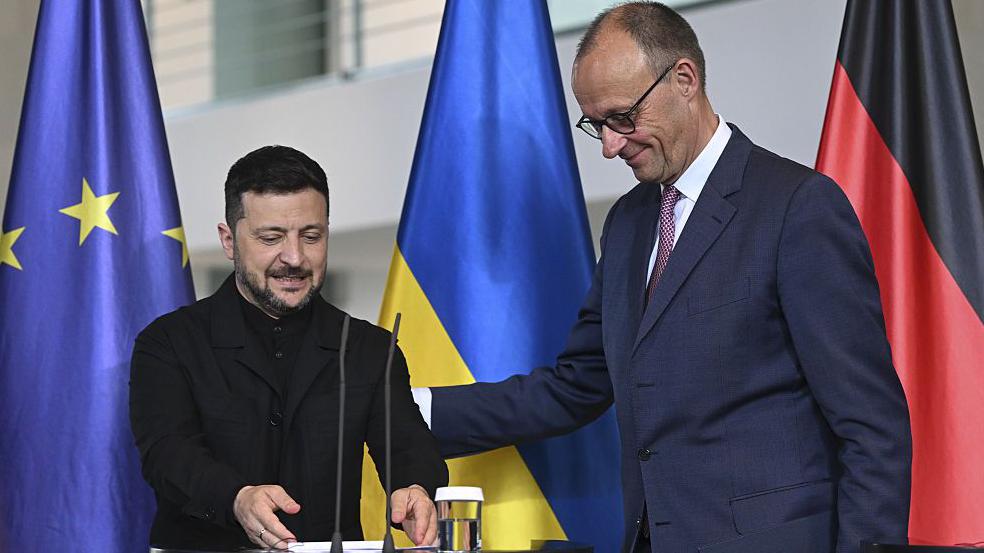
At the G7 Summit in France, German Chancellor Friedrich Merz stated that U.S. military superiority forced Iran to accept a ceasefire. Merz communicated to President Trump that this outcome serves as a direct blueprint for Ukraine, demonstrating that peace can be successfully achieved through overwhelming military and economic strength.
ÉVIAN-LES-BAINS, France — German Chancellor Friedrich Merz stated at the G7 Leaders' Summit that the overwhelming military superiority of the United States successfully forced Iran into a ceasefire agreement, arguing this strategy should serve as the direct blueprint for concluding the war in Ukraine. Speaking during the high-stakes economic and defense summit in Évian-les-Bains, Merz revealed he personally communicated this assessment to U.S. President Donald Trump. The Chancellor asserted that demonstrated military resolve, rather than open-ended concession, remains the most viable vehicle to compel adversarial nations toward binding diplomatic solutions.
Iran Accord Proves Deterrence Works, Merz Asserts
Addressing reporters on the first full day of multilateral working sessions, Chancellor Merz took a firm stance on the preliminary U.S.-Iran memorandum of understanding designed to halt a three-and-a-half-month military conflict and reopen the blockaded Strait of Hormuz. Merz argued that Tehran was left with no real strategic alternative but to accept Western terms, citing the immense asymmetry of American armed forces deployed in the region.
The Chancellor confirmed Germany's readiness to actively assist in post-conflict stabilization efforts, expressing complete confidence that the international agreement will hold because Iran has been left with no other viable path forward. Merz underlined that this shift in the Middle East validates the foundational concept of "peace through strength."
Application of Deterrence to the Russia-Ukraine War
The German head of government explicitly tied the tactical outcome of the Iranian conflict to the ongoing war between Russia and Ukraine, which has entered its fifth year. Merz indicated that a similar architecture of unified, unyielding Western military leverage must be maintained to push Russian President Vladimir Putin to the negotiating table.
Following multi-hour discussions with allied leaders, Merz highlighted key developments in the diplomatic consensus:
European Inclusion: The Chancellor confirmed it was at no time controversial that European nations must remain primary, active participants in any final territorial negotiations.
Transatlantic Optimism: After holding face-to-face talks with President Trump, Merz expressed a guarded optimism that Washington and European capitals are fully aligned on doing everything necessary to decisively conclude the war.
Sanctions Continuity: Dialogue touched heavily on maintaining or expanding structural economic penalties against Moscow to prevent any industrial circumvention.
Shifting Alliances and the G7 Landscape
The assertions mark a notable tactical recalibration for Chancellor Merz, who had previously criticized the White House’s handling of Middle Eastern negotiations earlier in the year. The current tone in Évian-les-Bains emphasizes broad Western alignment as Ukrainian President Volodymyr Zelenskyy attends the summit at the explicit invitation of French President Emmanuel Macron.
Economic and industrial stakeholders are closely monitoring these defense deliberations. According to macroeconomic data tracked by the German Federal Ministry for Economic Affairs and Climate Action (BMWK), ongoing global trade disruptions, volatile oil prices linked to the Hormuz blockade, and defense industrial allocations continue to heavily impact European corporate balance sheets.
Official Sources Section
The factual material presented in this news report is gathered from on-the-record press pool briefings at the G7 Summit, official administrative updates distributed by the German Federal Government (Bundesregierung), corporate transcripts from the Group of Seven communications desk, and compliance archives from the European Council.
Quote Section
"I told Donald Trump that this is an example that military strength could lead to a diplomatic solution. That could serve as an example for Ukraine. The United States' military superiority does not give Iran a choice. We are ready to participate, and I am confident that the agreement works—that Iran accepts the conditions because it has to."
— Friedrich Merz, Chancellor of Germany
Why It Matters
For international defense investors and global markets, Merz's remarks signal that European leadership is increasingly embracing a high-deterrence military posture. This position suggests that long-term asset stability and trade corridor protections in Eastern Europe will depend heavily on robust, proactive Western defense spending rather than rapid diplomatic concessions.
Key Facts at a Glance
The Position: Chancellor Merz argues American military pressure on Iran sets the precise precedent needed to resolve the Ukraine conflict.
The Venue: Diplomatic strategy finalized during the annual G7 Summit in Évian-les-Bains, France.
European Autonomy: G7 leaders verified unanimously that European nations will remain central to any Russia-Ukraine peace talks.
Economic Undercurrent: Western allies aim to utilize this diplomatic leverage to stabilize global energy supply lines and lower high maritime shipping costs.
FAQ Section
Q1: What is the current status of the U.S.-Iran agreement mentioned by Merz?
A1: The U.S. and Iran have established a preliminary memorandum of understanding to halt active hostilities and lift the naval blockade on the Strait of Hormuz, with formal signing and technical implementation phases expected to proceed over the coming weeks.
Q2: How does Germany plan to participate in the Middle East settlement?
A2: According to federal statements, Germany, alongside European allies like France and Britain, is prepared to offer logistical and maritime asset assistance, including mine-clearing vessels, to safely reopen international shipping corridors.
Q3: Did U.S. President Trump agree with Merz's assessment on Ukraine?
A3: While specific transcripts remain classified, Chancellor Merz described the U.S. President as being in a highly cooperative and receptive mood regarding unified Western actions to end the war.
Source: German Federal Government (Bundesregierung), German Federal Ministry for Economic Affairs and Climate Action, G7 Press Pool.