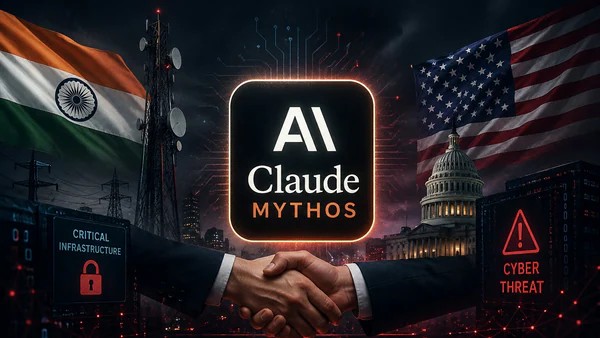
AI safety pioneer Anthropic has expanded access to its restricted cybersecurity model, Claude Mythos, to 15 nations, including India, under Project Glasswing. Access is restricted to 150 select organizations to identify and patch critical infrastructure vulnerabilities before equivalent, unaligned AI models are open-sourced by global competitors.
SAN FRANCISCO — In a major expansion of international frontier artificial intelligence cooperation, AI safety corporation Anthropic announced on June 2, 2026, that it has extended access to its highly restricted, ultra-powerful cybersecurity model, Claude Mythos, to 15 countries, including India.
The security rollout, managed under the company's defensive initiative known as Project Glasswing, will grant restricted preview access to approximately 150 new organizations globally. The decision to onboard Indian enterprises and state agencies marks a strategic shift by the initial public offering (IPO)-bound startup to bolster global software defenses against systemic zero-day exploits before the specialized code-auditing technology can be weaponized by rogue actors.
Project Glasswing Expands to Critical Infrastructure
According to official administrative announcements published via the Anthropic Corporate Newsroom, the expansion scales Project Glasswing from its initial domestic cohort of 50 mostly United States-based technology firms up to more than 200 partner organizations worldwide.
The newly added entities span critical infrastructure sectors that were previously unrepresented, including municipal water facilities, electrical power grids, healthcare systems, communications networks, and specialized hardware manufacturers.
Regulatory disclosures indicate that the selected partners govern massive digital platforms where a single coordinated breach could disrupt vital operations for over 100 million people. To secure these networks, Anthropic mandates that every participant pass strict, pre-approved structural security requirements before interacting with the Claude Mythos Preview.
Strategic Geopolitical Inclusion for New Delhi
While Anthropic did not explicitly publish the complete list of 15 beneficiary states, report tracking published by the Financial Times confirmed that India is the premier non-allied nation to gain authorization. Other confirmed participants include members of the "Five Eyes" intelligence network—specifically Canada, Australia, and New Zealand—alongside key industrial nations such as France, Germany, Italy, Switzerland, Japan, and South Korea.
| Region | Authorized Nation Examples | Core Enterprise Targets |
| North America | United States, Canada | Okta, Intercontinental Exchange (ICE) |
| Europe | France, Germany, Netherlands, Sweden | Euroclear, NATO Defense Frameworks |
| Asia-Pacific | India, Japan, South Korea | Samsung, SK Hynix, National Telecoms |
Economic data compiled by domestic technology bureaus indicates that India represents one of Anthropic's fastest-growing enterprise footprints. Market sources note that local tech titans like Tata Consultancy Services (TCS) and Infosys, alongside regulatory monitoring groups like the Indian Computer Emergency Response Team (CERT-In), are primed to employ the software to fortify public banking registries and sovereign infrastructure systems against international threat vectors.
Countering the Threat of Weaponized Frontier Models
The controlled distribution of the Mythos archetype stems from its unprecedented proficiency in finding and fixing long-hidden system vulnerabilities. During initial tests, the model detected more than 10,000 severe or critical software bugs that had gone unnoticed for decades—including an ancient 27-year-old exposure in OpenBSD firewalls and 271 unique vulnerabilities inside the Firefox web browser framework.
Anthropic warned in its press logs that rival AI groups are likely to produce and open-source similar "Mythos-class" codebases within the next 6 to 12 months. Should these unauthorized models be released globally without safety filters, the frequency and speed of automated zero-day attacks would rapidly increase, making proactive defensive deployment essential for democratic nations.
Official Sources Section
Details concerning organization criteria, capability assessments, and the regional scope of Project Glasswing are derived directly from statements issued by Anthropic and intelligence filings reported via the Financial Times. Supplementary operational confirmations were verified by the South Korean Ministry of Science and ICT.
Quote Section
"According to officials familiar with the development, the restriction of public access is a necessary preventative measure. Anthropic representatives stated that giving commercial groups the tools to write immediate patches is a critical step in building a worldwide cyber-defense shield before unaligned models saturate the open market."
Why It Matters
For everyday citizens, consumers, and digital banking customers, this corporate decision directly affects individual data privacy and national security. As financial systems and utilities rely increasingly on cloud-based web application architectures, the integration of defensive AI prevents catastrophic network blackouts and limits identity theft. India's inclusion ensures that the country's extensive digital public infrastructure remains resilient against evolving, machine-driven cyber threats.
Key Facts at a Glance
Global Access: 150 new organizations across 15 countries have been granted access to the restricted Claude Mythos AI.
Geopolitical Alliance: India joins select Five Eyes members and European allies as a strategic partner in Project Glasswing.
Massive Capabilities: The AI previously discovered over 10,000 critical software flaws, including a 27-year-old firewall vulnerability.
Target Sectors: The expansion primarily covers power, clean water, healthcare, global communication lines, and hardware vendors.
Strict Onboarding: No public download is available; all corporate and government users must pass verified safety requirements.
FAQ Section
What makes the Anthropic Mythos AI different from regular public models?
Unlike standard commercial AI built for writing or administrative tasks, Mythos is highly specialized for advanced codebase auditing, penetration testing, automated threat response, and rebuilding legacy code into secure languages.
Why is Anthropic keeping this model hidden from the general public?
The model possesses highly advanced capabilities for discovering unknown software vulnerabilities. If made freely public, malicious actors could use the AI to discover zero-day exploits and execute highly unpredictable cyberattacks.
Which prominent companies are already utilizing Project Glasswing?
Early partners included global infrastructure entities like Apple, Google, Nvidia, Cisco, and JPMorgan Chase. The new cohort expands to include financial networks like Swift and Euroclear, alongside global bodies like NATO.
Source: Anthropic Research Portal, Financial Times Tech Archive