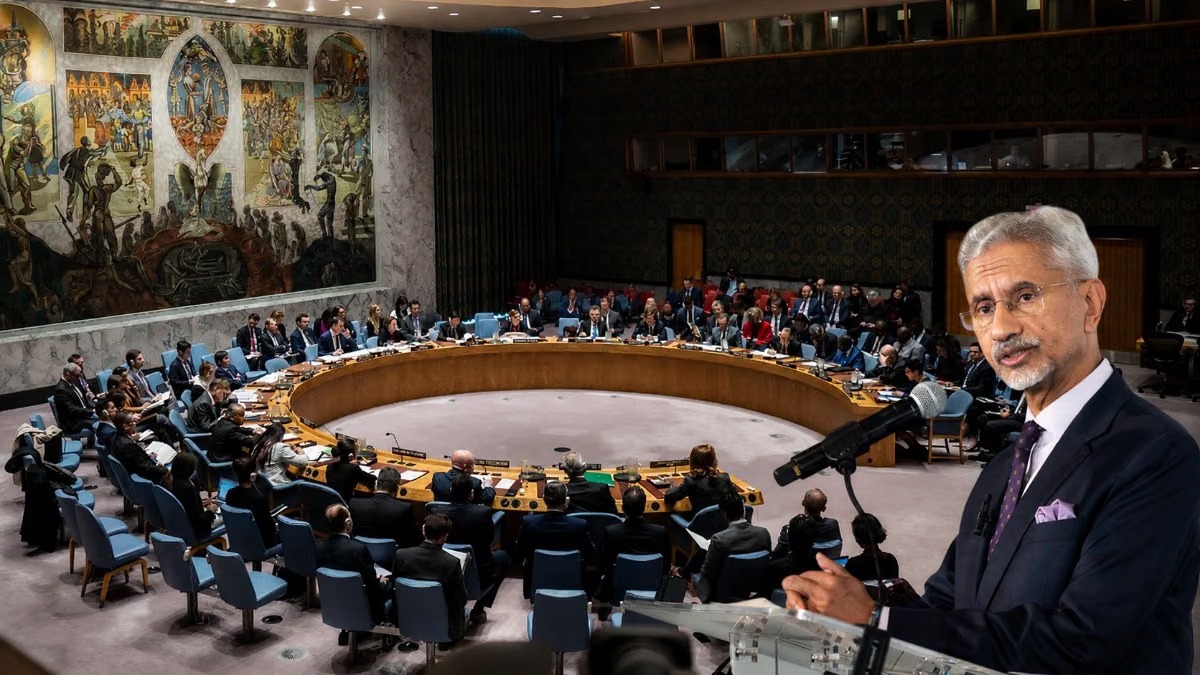
External Affairs Minister Dr. S. Jaishankar has officially launched India's campaign for a non-permanent seat at the United Nations Security Council (UNSC) for the 2028-29 term. Unveiled at the UN headquarters in New York, India’s bid is guided by the core "SHANTI" structural vision.
UNITED NATIONS, NEW YORK — India has formally initiated its international campaign to secure a non-permanent seat on the United Nations Security Council (UNSC) for the upcoming 2028–29 biennial term. The development marks a strategic push by New Delhi to entrench its role as a leading global voice amid widening structural fractures in the international order.
External Affairs Minister Dr. S. Jaishankar officially launched the national candidature during a high-level diplomatic reception at the UN headquarters on Monday, July 13, 2026. Addressing an assembly of global permanent representatives, ambassadors, and senior secretariat officials, Jaishankar presented India’s structural framework for the election, which is scheduled to occur in June 2027. The strategic roadmap positions India as a bridge-builder between divergent geopolitical blocs, leveraging its history of diplomatic mediation and vast contributions to global humanitarian assistance.
The Strategic Framework: Unveiling the SHANTI Vision
At the core of India’s operational platform for the 2028–29 term is a newly introduced multilateral paradigm summarized under the acronym "SHANTI". Derived from the traditional Sanskrit word for peace, the platform translates into a structured policy framework: Securing Holistic Advancement through Norms, Trust, and Integrity.
According to formal statements released by the Ministry of External Affairs (MEA), the SHANTI doctrine responds to a global paradox where advanced material capabilities coexist with rising transnational instability, violence, and institutional paralysis within the UN system.
The campaign focuses on six core areas:
Amplifying the Global South: Integrating developing nations into primary decision-making processes to build an equitable global order.
Reformed Multilateralism: Advancing structural adjustments to make the 15-member council representative of contemporary demographic and economic realities.
Future-Ready Peacekeeping: Infusing advanced communication technology, strict accountability protocols, and clearer mandates to protect field forces.
Securing Maritime Commons: Upholding international maritime law, specifically the UNCLOS framework, to insulate global commercial shipping from piracy and drone threats.
Countering Terror Financing: Strengthening institutional monitoring mechanisms to cut financial networks feeding transnational terror entities.
Governing Frontier Technologies: Implementing global norms to regulate artificial intelligence (AI) and counter cyber-warfare operations.
Leverage Metrics: Peacekeeping Vitals and Development Footprint
To anchor its diplomatic pitch, New Delhi highlighted its long-standing record as a primary provider of international stability. Statistical updates compiled by the Indian Permanent Mission to the UN show that India has contributed approximately 300,000 personnel across 50 independent UN peacekeeping missions since the organization's founding.
Currently, India maintains more than 4,300 active personnel deployed across 10 of the 11 operational field missions worldwide, with a heavy presence across highly volatile sectors in Africa. Furthermore, Jaishankar emphasized that India acts as a committed capacity builder, with the Centre for UN Peacekeeping in New Delhi having provided specialized tactical training to military officers from 98 distinct nations.
Beyond security deployments, the campaign highlights India's expanding footprint as a non-conditional development partner. Indian-funded development projects, lines of credit, and technical assistance initiatives are actively active in 79 developing countries, reinforcing New Delhi's position as a reliable voice for the Global South.
Geopolitical Contests and Council Reform Pressures
The upcoming election cycle presents a focused regional contest. In the official voting rounds scheduled for June 2027, India will compete directly against Tajikistan for the single available seat assigned to the Asia-Pacific Group category for the 2028–29 block. India has previously filled a non-permanent seat at the horseshoe table on eight separate occasions, with its most recent tenure spanning the 2021–22 cycle.
While launching the campaign for the temporary seat, the MEA continues to lobby aggressively for a permanent seat on an expanded UN Security Council. In coordination with G4 partners (Japan, Germany, and Brazil), India maintains that the current composition of the UNSC which leaves entire continents unrepresented among its veto-wielding permanent five members is structurally outdated and incapable of addressing modern security threats.
Official Sources Section
The campaign priorities, technological focus targets, and deployment data detailed in this dispatch are verified directly via official press transcripts released by the Ministry of External Affairs (MEA) and candidate background reports published by the United Nations Security Council Affairs Division.
Quote Section
Outlining the ethos of India's approach to international law during his address, External Affairs Minister Dr. S. Jaishankar stated:
"India's focus will be on working for a secure, peaceful, and equitable world a world where the voice of the Global South is heard in equal measure... We are convinced that peace is strengthened by participation, not achieved by domination. The world must, therefore, focus on holistic advancement, both as individual nations and as the international community. But that journey can only be undertaken effectively when global order is valued and rules are respected."
Why It Matters
For international citizens and developing countries, India's bid ensures that the economic, climate, and food security concerns of the Global South are pushed to the top of the UN agenda during a time of high global inflation and active conflict. For multilateral institutions and trading firms, India's focus on securing maritime routes and stabilizing global supply chains helps protect international commerce from piracy and localized regional blockades. Additionally, for defense sectors and humanitarian bodies, the proposed updates to UN peacekeeping mandates promise better-equipped, safer, and more realistic missions in active conflict zones.
Key Facts at a Glance
Campaign Launch: The official bid for the 2028–29 UNSC non-permanent seat was unveiled at the UN headquarters on July 13, 2026.
Core Doctrine: The campaign operates under the "SHANTI" model: Securing Holistic Advancement through Norms, Trust, and Integrity.
Election Timeline: The final voting by the UN General Assembly will take place in June 2027, with India contesting Tajikistan for the Asia-Pacific seat.
Peacekeeping Track Record: India has deployed nearly 300,000 personnel across roughly 50 historical UN peacekeeping operations.
Development Reach: Highlighted active Indian-financed development projects currently spanning 79 partner nations.
FAQ Section
How many times has India served on the UN Security Council in the past?
India has served as an elected, non-permanent member of the UNSC for eight terms, with its historical stints spanning 1950–51, 1967–68, 1972–73, 1977–78, 1984–85, 1991–92, 2011–12, and most recently during the 2021–22 cycle.
What is the difference between a permanent and a non-permanent UNSC seat?
The UNSC has five permanent members (P5) with absolute veto power over resolutions. The ten non-permanent members are elected by the General Assembly for two-year terms; they participate in all votes and hold rotating presidencies but do not possess individual veto capabilities.
Who is India's direct competitor for the Asia-Pacific seat in the June 2027 election?
India will face a direct vote against Tajikistan for the single allocated seat available within the Asia-Pacific Group category for the 2028–29 term.
Source: Ministry of External Affairs (MEA); United Nations Security Council Affairs Division; Permanent Mission of India to the UN, New York; Press Trust of India (PTI) Diplomatic Archive.