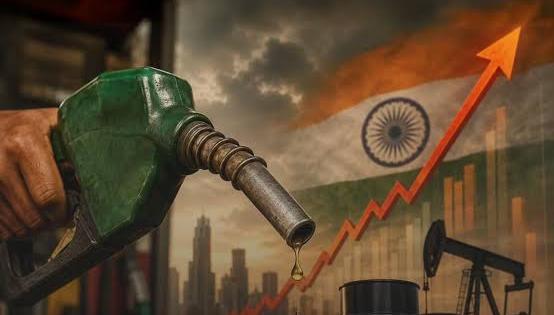
Indian state fuel retailers are facing sharp revenue under-recoveries due to elevated global energy costs. Recent industry data shows a marketing revenue loss of 9 rupees per litre on gasoline and 36.5 rupees per litre on diesel. Additionally, losses on domestic liquefied petroleum gas sales have hit roughly 700 rupees per cylinder.
NEW DELHI — Indian state fuel retailers are incurring significant revenue losses on the domestic sale of gasoline, diesel, and liquefied petroleum gas (LPG) as global crude oil prices remain elevated. According to an Indian oil industry source on June 5, 2026, state-controlled oil marketing companies (OMCs) are witnessing a revenue loss of 9 rupees per litre on gasoline (petrol) and 36.5 rupees per litre on diesel. Concurrently, the marketing under-recovery on domestic liquefied petroleum gas sales has expanded to approximately 700 rupees per 14.2 kg cylinder, threatening to strain corporate balance sheets and federal subsidy allocations.
Escalating Fuel Under-Recoveries Strain Retail Networks
The widening gap between international purchasing benchmarks and frozen domestic retail prices has intensified pressure on India’s three dominant state fuel retailers: Indian Oil Corporation Limited (IOCL), Bharat Petroleum Corporation Limited (BPCL), and Hindustan Petroleum Corporation Limited (HPCL). These entities, which collectively control over 90 percent of the domestic retail fuel network, have absorbed the brunt of the pricing mismatch to shield consumers from inflationary shocks.
The industry source confirmed that the revenue loss on gasoline sales has reached 9 rupees per litre, while the deficit on diesel—the backbone of India's transport and agricultural sectors—is more than four times higher at 36.5 rupees per litre. Analysts note that because diesel accounts for approximately two-fifths of refined fuel consumption in India, a prolonged under-recovery of this magnitude severely impacts the daily operating cash flows of retail corporations.
Severe Deficits in Domestic Cooking Gas Distribution
The situation is equally challenging in the clean cooking energy segment. State fuel retailers are absorbing a revenue loss on liquefied petroleum gas sales of around 700 rupees for every standard 14.2 kg cylinder distributed. Millions of households depend on these subsidized cylinders for daily sustenance, meaning any alteration to the current pricing mechanism carries significant economic and political weight.
Impact on Consumers, Logistics, and Corporate Stability
The current pricing structure creates contrasting outcomes for different segments of the Indian economy. For citizens and retail consumers, the absorbed losses mean pump prices remain insulated from volatile global energy indicators. This stabilization helps manage household expenditures and limits direct escalations in food and essential commodity distribution costs.
For institutional investors and the corporate sector, however, the financial trend remains a point of concern. Persistent under-recoveries typically weaken the gross refining and marketing margins of public sector oil firms. If state fuel retailers continue to witness an operating revenue loss on gasoline sales alongside massive drops in diesel margins, capital expenditure for green energy transitions and refinery upgrades could experience structural delays.
Official Sources Section
While the baseline metrics were provided by a verified industry source familiar with operational accounting, formal financial evaluations remain subject to periodic review by the Ministry of Petroleum and Natural Gas and structural audits compiled for the BSE Limited. Financial analysts rely on data tracking boards maintained by the Petroleum Planning & Analysis Cell (PPAC) to map how international import costs translate into domestic marketing overheads.
Quote Section
Evaluating the operational environment, industry authorities are closely monitoring the fiscal trajectory.
"According to officials familiar with institutional energy pricing, the disparity between international refined product benchmarks and local retail prices has widened progressively over consecutive quarters," the source stated. "Public sector oil marketing entities are currently leveraging internal cash reserves to sustain supply chain continuity while waiting for potential fiscal interventions or tax rationalization from central authorities."
Why It Matters
The practical implications of these fuel deficits extend directly to national budget calculations and market competition. If international crude oil values remain high, the government may need to issue direct capital support or reduce central excise duties to prevent state fuel retailers from facing credit downgrades. Furthermore, independent, private fuel retailers may find it difficult to compete at the pumps, as selling products at a state-mandated discount would force them to match the unsustainable 36.5 rupees per litre loss on diesel.
Key Facts at a Glance
Gasoline Deficit: State fuel retailers are absorbing a direct revenue loss of 9 rupees per litre on retail petrol purchases.
Diesel Cracks: Under-recoveries on diesel have expanded sharply to 36.5 rupees per litre, affecting commercial transport margins.
Cooking Gas Pressures: The revenue loss on liquefied petroleum gas sales stands at approximately 700 rupees per 14.2 kg cylinder.
Market Control: The financial impact is concentrated across major state-owned marketing firms holding the vast majority of consumer market share.
FAQ Section
Why are state fuel retailers experiencing a revenue loss on gasoline sales?
The loss occurs because international crude oil and refined product costs have risen, while domestic retail prices at the pump have been kept steady to protect consumers from inflation.
How does the revenue loss on liquefied petroleum gas sales affect normal households?
Currently, it does not affect households directly, as state retailers absorb the 700 rupees deficit per cylinder to keep cooking gas affordable. However, it increases the likelihood of a fiscal correction later.
Will retail fuel prices increase for consumers soon?
Any adjustment depends on policy decisions by the oil marketing companies and federal ministries. Under-recoveries can be resolved either through retail price hikes, global oil price corrections, or government subsidies.
Source: Indian Oil Industry Regulatory Estimates, Ministry of Petroleum and Natural Gas, BSE India.