Indian universities registered broad progress in the QS World University Rankings 2027, with 52 institutions featured. Led by IIT Delhi climbing to 118th globally, the nation expanded its research and employability metrics. However, global higher education analysts highlight that persistent internationalization deficits and a structural academic reputation gap continue to limit top-tier performance.
India's higher education ecosystem achieved significant structural expansion on Thursday, June 18, 2026, as global analytics firm Quacquarelli Symonds released its highly anticipated QS World University Rankings 2027. A record-setting 52 Indian universities featured in the global evaluation, establishing India as the fifth most represented higher education system worldwide and the fastest-growing among G20 nations.
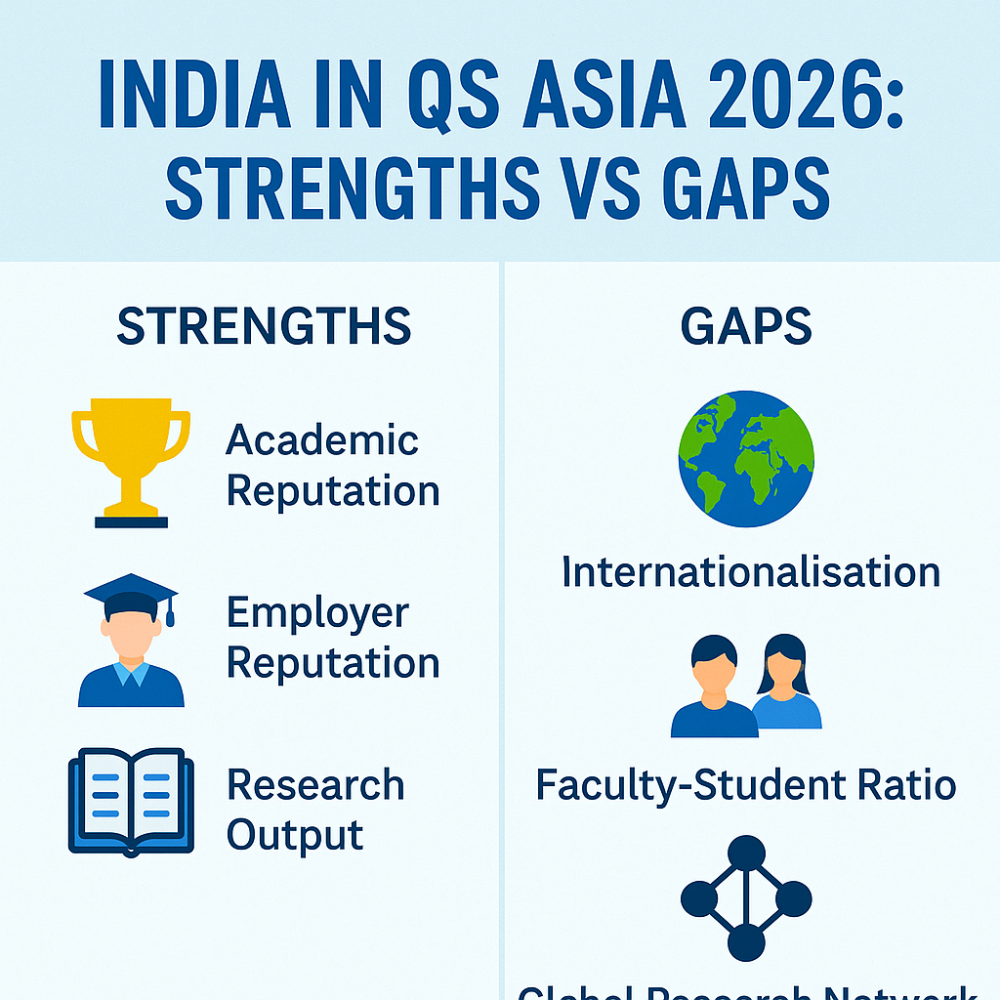
While more than half of previously ranked Indian institutions improved their individual positions spearheaded by the Indian Institute of Technology (IIT) Delhi rising to 118th place the report highlights a persistent challenge. Despite booming scientific research output and high corporate employer scores, Indian universities face an ongoing deficit in international student recruitment and global academic reputation metrics, preventing them from breaking into the elite global top 100.
Broad-Based Progress Across Public and Private Sectors
The latest ranking iteration underscores a crucial evolution: India's academic ascension is no longer exclusively confined to the elite IIT ecosystem. Out of the 18 domestic institutions that achieved their highest-ever global ranks, 13 are non-IIT public and private entities.
| Domestic Rank | Institution | 2027 Global Rank | Change From Prior Year |
| 1 | Indian Institute of Technology Delhi (IITD) | 118 | Up 5 positions |
| 2 | Indian Institute of Technology Bombay (IITB) | 134 | Down 5 positions |
| 3 | Indian Institute of Technology Madras (IITM) | 170 | Up 10 positions |
| 4 | Indian Institute of Technology Kharagpur (IIT-KGP) | 205 | Up 10 positions |
| 5 | Indian Institute of Technology Kanpur (IITK) | 221 | Down 2 positions |
| 5 | Indian Institute of Science (IISc) Bangalore | 221 | Down 2 positions |
Among the fastest-rising universities outside the technical core, Jamia Millia Islamia jumped to 686th place, while Vellore Institute of Technology (VIT) leaped 94 spots to secure 597th globally. Similarly, Birla Institute of Technology and Science (BITS) Pilani moved up 93 spots to rank 575th, illustrating a broad-based distribution of institutional progress across multiple Indian states.
The Dual Realities of Research Prowess and Global Isolation
According to the analytical criteria utilized by QS, India has solidified its position as the world's third-largest ecosystem for scholarly research volume. Eleven domestic institutions ranked within the top 100 globally for Citations per Faculty a critical index measuring institutional research influence. The Indian Institute of Science (IISc) Bangalore maintained an near-perfect metric score of 99.9 in this specialized division.
However, the comprehensive analytics reveal that these research achievements do not automatically translate into a corresponding global standing. The primary friction points limiting Indian universities continue to be internationalization metrics, which measure the ratio of international faculty and international students on campus.
Furthermore, even prominent institutions experienced slight recalibrations in subjective academic reputation scores, which rely on global surveys of peer professors. Analysts observe that because Indian campuses are heavily oriented toward serving domestic student demand, they remain insulated from international faculty networks, keeping their global reputational footprints lower than their physical research output would warrant.
Official Sources Section
The entire comparative ranking dataset, regional parameter metrics, and institutional scoring breakdowns are derived from the official data published by QS Quacquarelli Symonds.
National progress commentary and public policy associations were validated via the official press releases issued by the Ministry of Education, Government of India.
Expert Perspectives
"India's strong performance in the latest global university rankings reflects the transformative impact of the National Education Policy (NEP) 2020. As institutions achieve record-high rankings, India is emerging as a leading global knowledge hub, driven by research, innovation, and the talent of its youth."
— Dharmendra Pradhan, Union Minister of Education, India
"As India advances towards its Viksit Bharat 2047 vision, its universities will be among the institutions that shape the country's future most profoundly. Their contribution extends beyond classrooms. However, internationalisation and subjective global academic reputation remain key areas requiring further improvement."
— Jessica Turner, Chief Executive Officer, QS Quacquarelli Symonds
Why It Matters: Practical Implications
For Indian students and parents, the broad improvements across private and non-IIT universities indicate that world-class education is becoming more accessible locally without requiring expensive overseas migration. For international corporations and institutional investors, the dramatic rise in India's 'Employer Reputation' scores—with six institutions now placing inside the global top 100—confirms that Indian graduates are increasingly recognized as highly prepared for the global white-collar workforce.
For university administrators, the findings emphasize the need to actively recruit international researchers to build long-term institutional prestige.
Key Facts at a Glance
Global Record Placement: IIT Delhi achieved a historic high of 118th place globally, matching the best-ever ranking secured by an Indian institution.
System Scale Expansion: India's presence expanded to 52 universities, up from just 14 institutions in 2017 a 271% growth trajectory.
Research Strength: India possesses the third-largest research output globally, with 11 domestic institutions placing in the top 100 for citations per faculty member.
The Non-IIT Shift: Thirteen of the 18 Indian institutions achieving historic-high rankings this year are non-IIT entities, showing a healthy diversification of academic excellence.
Primary Headwinds: Low ratios of international students and international faculty continue to hold down overall institutional score aggregates.
Frequently Asked Questions
Which Indian university is ranked highest globally in the 2027 index?
The Indian Institute of Technology (IIT) Delhi holds the top spot nationally, climbing to 118th place globally and outperforming IIT Bombay, which dropped slightly to 134th.
Why do Indian universities score poorly on internationalization metrics?
Most premier public institutions in India prioritize massive domestic student demand through highly competitive entry exams. Consequently, they offer very few seats or active marketing programs to attract foreign undergraduates or international faculty.
What is the significance of the 'Citations per Faculty' metric for India?
This metric evaluates how frequently papers published by an institution's professors are referenced by other scientists globally. India's top-tier scores here demonstrate that its scientific research is highly influential, even if overall institutional reputation lags.
Source: QS World University Rankings Official Hub, Ministry of Education, Government of India, IIT Delhi Institutional Ranking Cell.