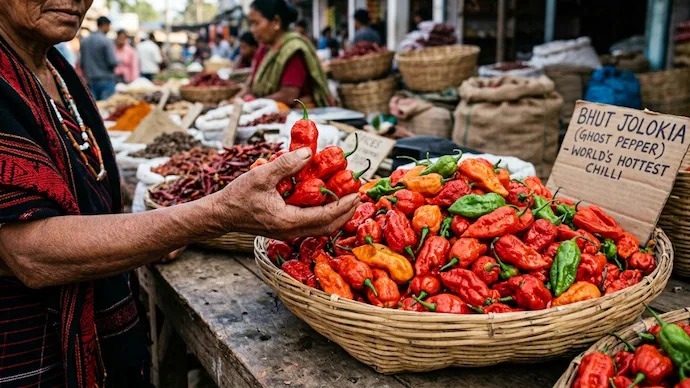
The Bhut Jolokia, or "Ghost Chilli," is a world-renowned super-hot pepper native to India's North Eastern states, particularly Assam and Nagaland. Once the Guinness World Record holder for the hottest chilli, it remains a cultural staple and a prized ingredient for spice enthusiasts and researchers globally due to its unique smoky heat.
Assam and the wider North East region of India have long been recognized globally as the home of the Bhut Jolokia, a legendary pepper once crowned the world’s spiciest chilli.
GUWAHATI — The North Eastern region of India is home to the Bhut Jolokia, widely known internationally as the "Ghost Chilli" or "Ghost Pepper." This fiery variety of Capsicum chinense has cemented its place in agricultural history, gaining global fame for its intense heat, which measures over one million Scoville Heat Units (SHU).
A Global Culinary Icon
The Bhut Jolokia rose to international prominence in 2007 when the Guinness World Records officially recognized it as the hottest chilli pepper on the planet. While newer laboratory-bred varieties like the Carolina Reaper and Pepper X have since surpassed its heat levels, the Bhut Jolokia remains a hallmark of super-hot chillies.
Its cultivation is deeply rooted in the warm, humid climate of India’s North Eastern states, primarily Assam, Nagaland, Manipur, and Arunachal Pradesh. Depending on the specific locality, it is referred to by various names, including Bih Jolokia (poison chilli) in Assam, Naga Jolokia (Naga chilli) in Nagaland, and Umorok in Manipur.
Cultural Significance and Versatility
Beyond its reputation as a "culinary dare," the Bhut Jolokia serves as a staple ingredient in the traditional food culture of the Northeast. It is frequently incorporated into local chutneys, pickles, and meat-based curries. Many households traditionally preserve these chillies in mustard oil, allowing them to retain their characteristic smoky and fruity flavour profile for year-round use.
The chilli’s utility extends well beyond the kitchen. Local communities have long utilized the pepper as a natural deterrent, smearing crushed chillies on boundary fences to keep wild elephants away from villages. Researchers have also explored its high capsaicin content for various scientific and industrial applications, including non-lethal defence equipment like pepper sprays.
Why It Matters
The global fascination with the Bhut Jolokia has transformed it from a regional speciality into a sought-after commodity for hot sauce manufacturers, gourmet retailers, and nutraceutical researchers. For the North East, the cultivation of this pepper provides a unique narrative of agricultural provenance, helping to drive demand for organic, traditionally farmed produce in both domestic and international wholesale markets.
Key Facts at a Glance
Renowned Heat: Measures over one million Scoville Heat Units (SHU).
Key Regions: Primarily grown in Assam, Nagaland, Manipur, and Arunachal Pradesh.
Historical Milestone: Held the Guinness World Record as the world's hottest chilli from 2007 to 2011.
Local Names: Also known as Bih Jolokia, Naga Jolokia, Raja Mircha (King Chilli), and Umorok.
Diverse Applications: Used in culinary arts, traditional medicine, and even as a natural animal repellent.
Frequently Asked Questions
Is the Bhut Jolokia still the world's spiciest chilli?
No, while it held the title in 2007, it has since been surpassed by newer, human-bred varieties such as the Carolina Reaper and Pepper X. However, it remains one of the hottest naturally occurring peppers globally.
Where can one find the best Bhut Jolokia in India?
The chilli is native to the North East, with Assam and Nagaland being the primary cultivation hubs. It is widely available in local markets throughout these states during the harvest season.
What should one do if they consume too much?
Consuming water is generally ineffective against the heat of capsaicin. It is recommended to use dairy products like milk or curd, which contain casein, a protein that helps break down the heat-inducing oils.
Official Sources