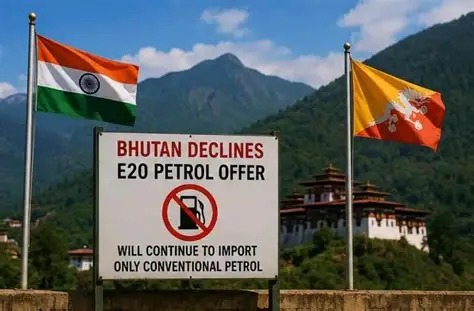
Bhutan has declined India's offer to supply E20 petrol, citing concerns that its aging fuel storage infrastructure cannot safely handle ethanol-blended fuel. Officials noted that the hygroscopic nature of ethanol poses a contamination risk in the country's mountainous terrain, prompting a preference for conventional petrol until infrastructure can be upgraded.
Citing critical challenges related to fuel storage and mountainous terrain, Bhutan has officially declined an offer from Indian Oil Marketing Companies to supply E20 petrol.
THIMPHU — The Himalayan nation of Bhutan has formally requested that India continue the supply of conventional petrol, opting out of the transition to E20 fuel—a blend containing 20% ethanol and 80% gasoline. The decision, confirmed by officials this week, highlights the practical hurdles surrounding the storage and distribution of ethanol-blended fuels in regions with challenging topography.
Storage Challenges and 'Hygroscopic' Risks
While India has been aggressively pushing its ethanol-blending program to reduce crude oil imports and lower carbon emissions, Bhutan’s Department of Trade indicated that its current infrastructure is not equipped to manage the specific chemical properties of E20 fuel.
According to technical reports, the primary concern is that ethanol is highly "hygroscopic," meaning it readily absorbs moisture from the atmosphere. In the humid, mountainous terrain of Bhutan, officials fear that water could easily seep into the nation's aging underground storage tanks. Once moisture enters an ethanol-blended fuel supply, it can cause "phase separation," where the ethanol and water bond and settle at the bottom of the tank, effectively diluting the fuel and leaving a water-rich mixture that can severely damage vehicle engines.
"Considering the existing condition and quality of several of our underground storage tanks, the import and handling of ethanol-blended fuel may pose significant challenges in ensuring fuel quality," a Bhutanese official stated.
Mountainous Terrain and Engine Performance
Beyond storage infrastructure, Bhutan’s unique geography also played a role in the decision. Vehicles navigating the country’s steep, winding mountain passes require consistent, high-power performance. There is ongoing concern among local authorities that E20 fuel—which some reports suggest can slightly alter engine combustion efficiency compared to pure petrol—might not deliver the stability required for such demanding driving conditions.
For now, the Bhutanese government has requested that India maintain the supply of conventional petrol as long as it remains available in the Indian market. They have also requested that Indian Oil Marketing Companies (OMCs) provide advance notice and consultation if there are plans to shift toward higher ethanol blends in the future, alongside a potential request for upgraded, leak-proof storage technology.
Why It Matters
Bhutan’s decision serves as a significant case study in the global transition to clean energy. It demonstrates that a "one-size-fits-all" approach to biofuel adoption may not be feasible for all nations. For neighboring countries and energy partners, the development underscores that infrastructure readiness—specifically the ability to maintain a moisture-free supply chain—is just as important as the production of green fuels themselves.
Key Facts at a Glance
The Request: Bhutan has opted for continued supply of conventional petrol instead of the E20 blend currently being rolled out in India.
Scientific Hurdle: Ethanol is hygroscopic, making it prone to absorbing moisture that leads to phase separation and fuel degradation in older storage systems.
Infrastructure: Bhutan’s underground storage tanks and depots require potential upgrades to stainless steel or specialized materials before they can safely handle ethanol-blended fuel.
Geographic Factors: The combination of mountainous terrain and high humidity increases the risk of seepage and condensation, complicating fuel maintenance.
Frequently Asked Questions
Why did Bhutan reject E20 petrol?
The rejection is not an opposition to clean fuel, but a practical response to infrastructure limitations. Bhutan’s current fuel storage tanks are aging and susceptible to moisture, which causes ethanol-blended fuel to degrade and potentially damage vehicle engines.
What is 'phase separation' in ethanol-blended fuel?
It is a process where water absorbed by ethanol causes the ethanol-water mixture to separate from the petrol, settling at the bottom of the tank. This leads to poor combustion, engine corrosion, and potential mechanical failure.
Does this affect India’s ethanol-blending program?
No. India’s program is primarily driven by domestic demand, and while Bhutan is a close partner, the decision has no significant impact on the overall rollout of E20 petrol within India.
Official Sources