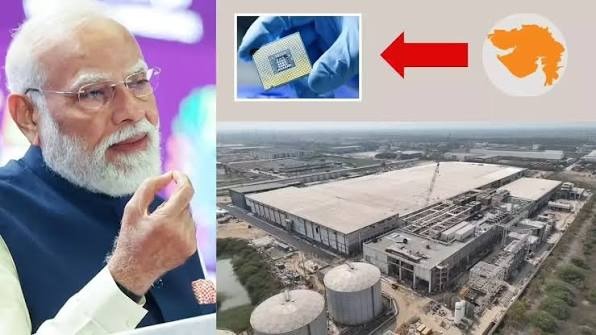
Prime Minister Narendra Modi inaugurated India’s third semiconductor plant, an OSAT facility in Sanand, Gujarat, built with an investment of ₹7,600 crore. Minister Ashwini Vaishnaw highlighted this as the realization of a 60-year vision, marking a key step in India’s goal to become a global hub for semiconductor assembly and testing.
Prime Minister Narendra Modi today inaugurated the country’s third semiconductor facility in Sanand, a key development in India’s long-term strategy to reduce import dependence and anchor the nation in the global chip supply chain.
The inauguration of the CG Semi Outsourced Semiconductor Assembly and Test (OSAT) facility marks a decisive milestone for India’s technology ambitions. Following the commencement of production at Micron’s ATMP facility in February and Kaynes Semicon’s unit in March, this third plant highlights the rapid acceleration of the India Semiconductor Mission (ISM). Speaking from the event, Union Minister of Railways Ashwini Vaishnaw emphasized that this project is the realization of a vision that has been a national priority for six decades, now finally achieved through the strategic execution of the current administration.
A New Hub for Global Chip Production
The CG Semi facility, a joint venture involving CG Power and Industrial Solutions Ltd., Japan’s Renesas Electronics, and Thailand’s Stars Microelectronics, represents an investment of over ₹7,600 crore. The plant is designed to provide end-to-end assembly and testing services for semiconductors, a vital stage in the chip manufacturing process where silicon wafers are converted into finished chips ready for consumer and industrial use.
According to officials, the Sanand facility will reach a peak production capacity of up to five billion chips annually. These components are intended to serve critical sectors, including automotive, telecommunications, 5G infrastructure, artificial intelligence, and industrial power applications. By scaling up the OSAT ecosystem, Sanand is rapidly evolving into a semiconductor cluster comparable to global hubs like Hsinchu in Taiwan or Gyeonggi in South Korea.
Strengthening the Semiconductor Ecosystem
The push for domestic manufacturing is part of a broader "Atmanirbhar Bharat" (Self-Reliant India) initiative. Beyond the facility inauguration, Minister Vaishnaw highlighted that the government’s approach is not limited to factory construction but involves building a holistic ecosystem. This includes fostering design talent, improving logistics, and ensuring a steady pipeline of skilled workers.
The impact of this expansion is expected to be significant for local economic development. The CG Semi project alone is projected to generate approximately 5,000 direct and indirect employment opportunities over the next five years, contributing to the state of Gujarat’s position as a leader in India's technology hardware roadmap.
Official Statements and Infrastructure Plans
During the event, Minister Vaishnaw noted the rapid pace of execution, with three major plants coming online within a span of four months. Alongside the semiconductor milestone, he announced five major infrastructure decisions for Ahmedabad, focusing on urban mobility and rail connectivity. These include:
Completion of an underpass in Omnagar before the upcoming Navratri festival.
A new master plan for the redevelopment of Asarwa station into a major terminal.
The creation of a second entry point at Ahmedabad station to improve commuter access.
Extensions to station roads in Sabarmati to ease traffic congestion.
Integration of local rail offices into a modernized terminal facility.
Why It Matters
The operationalization of this third plant is critical for India's technological sovereignty. As chips become the "new oil" of the digital economy, shifting from an import-dependent model to domestic production mitigates supply chain risks. For businesses and consumers, this strengthens the availability of electronic components, potentially reducing costs and delays for manufacturers in the automotive and consumer electronics sectors.
Key Facts at a Glance
Investment: Over ₹7,600 crore invested in the CG Semi OSAT facility.
Production Capacity: Up to 5 billion chips annually upon reaching full capacity.
Strategic Goal: Strengthening the domestic ecosystem to reduce reliance on global semiconductor imports.
Employment: Expected to generate 5,000 direct and indirect jobs over five years.
Joint Venture: A partnership between CG Power, Renesas Electronics (Japan), and Stars Microelectronics (Thailand).
Frequently Asked Questions
What is an OSAT facility?
OSAT stands for Outsourced Semiconductor Assembly and Test. These facilities receive processed silicon wafers and perform the essential steps of packaging, testing, and assembly to make the chips usable for devices.
Why is Sanand significant?
Sanand has emerged as India’s first major semiconductor cluster. Its concentration of OSAT and ATMP units, supported by specialized infrastructure, makes it a central hub for the nation’s chip manufacturing ambitions.
What is the India Semiconductor Mission (ISM)?
The ISM is a government-led initiative under the Ministry of Electronics and Information Technology (MeitY) that provides fiscal support of up to 50% of capital expenditure for companies setting up fabs and assembly units in India.
How does this impact the common citizen?
By building a domestic manufacturing base, India aims to make essential electronics—from smartphones to electric vehicles—more accessible and affordable, while also creating high-value jobs for engineers and technical staff.
Source: Ministry of Electronics and Information Technology, India Semiconductor Mission (ISM), Press Information Bureau