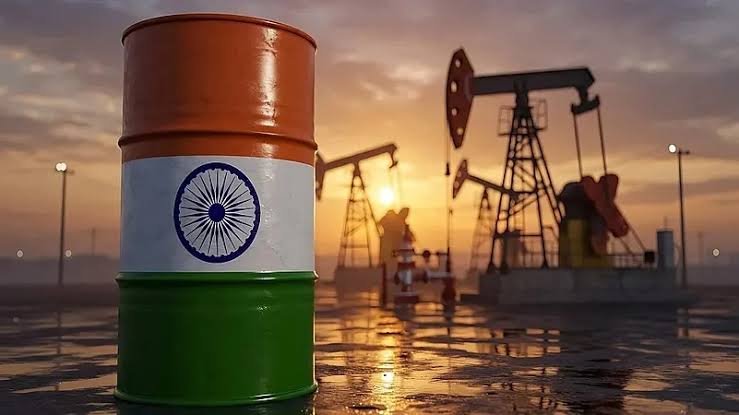
An official EY India report reveals that the nation’s robust domestic petroleum refining infrastructure successfully mitigated the impact of the recent West Asia energy crisis. Processing raw crude locally prevented expensive dependencies on foreign refined fuel imports, saving massive processing costs and anchoring India’s projected fiscal year 2027 GDP growth at 6.6%–6.8%.
NEW DELHI — India’s extensive crude oil refining infrastructure successfully mitigated the severe economic impact of the recent West Asia-led energy crisis, preventing an expensive dependence on imported refined petroleum products, according to a report released by professional services firm EY on June 26, 2026. The findings reveal that while India's baseline reliance on raw foreign crude has grown substantially over the last two decades, its strategic choice to process that crude domestically has built a vital economic buffer against international supply disruptions.
According to the latest EY Economy Watch report, this robust domestic refining footprint directly saved the country massive supplementary processing costs that would have accrued if the nation had been forced to directly source overseas refined fuels. The development is critical for Indian consumers, corporate operations, and fiscal policymakers, as it protected internal retail fuel prices and industrial input bills from the worst of the volatile spikes seen in international energy markets through the first half of 2026.
The Shift in India's Petroleum Economy
The EY research charts a clear historical shift in India's macroeconomic energy structure. Over the past twenty-seven years, the country's baseline dependence on imported raw crude oil surged past 90% in fiscal year 2026, marking a stark climb from just 54.9% recorded in fiscal year 1999. This growing reliance on global suppliers has been compounded by a structural contraction in internal extraction; domestic crude production fell to 26 million metric tons in fiscal year 2026, down from a historic high of 35.9 million metric tons achieved in fiscal year 2012.
Concurrently, domestic demand for petroleum, oil, and lubricants (PoL) products witnessed exponential expansion, climbing from 90.6 million metric tons in fiscal year 1999 to 243.2 million metric tons in fiscal year 2026. However, instead of importing finished products like gasoline, diesel, and aviation turbine fuel, India systematically expanded its downstream processing plants to match this consumption curve.
"India may continue to augment its refining capacity, which has helped save refining costs had India been forced to directly import refined petroleum products," the EY report detailed, highlighting that local conversion capacity effectively decoupled processing margins from volatile international product markets.
Macroeconomic Resilience and Growth Projections
The report underlines that India's domestic energy efficiency metrics have registered consistent structural improvements. The energy intensity of India’s overall economic output, alongside the direct ratio of petroleum consumption to gross domestic product (GDP), has steadily decreased. This transition supports a sustainable model for high-velocity, energy-efficient growth over an extended time horizon.
Backed by these stable domestic drivers and a gradual normalization of broader global energy systems following a recent United States-Iran memorandum of understanding, EY revised its economic outlook for the country. The firm projects India's real GDP growth at 6.6% to 6.8% for fiscal year 2027. Additionally, the Consumer Price Index (CPI) inflation is anticipated to remain manageable at approximately 4.5%, while the fiscal deficit is targeted at 4.4% and the current account deficit is projected at 1.5% of GDP.
Policy Roadmap: Strategic Reserves and Structural Reforms
To lock in long-term economic security against future supply-chain blockades or global commodity price spikes, EY advises Indian administrators to rapidly overhaul their physical stockpile frameworks. The consultancy explicitly notes that the country’s existing strategic crude reserves remain thin, providing a safety net of roughly four to five days of aggregate domestic consumption, falling well behind international standards maintained by nations like Japan and China.
The report recommends the deployment of a comprehensive national strategy covering:
Expanded Inventory Volumetrics: Building relatively larger strategic physical reserves of crude oil, liquefied petroleum gas (Gas), and agricultural fertilizers.
Structured Release Frameworks: Formulating clear triggers for physical resource drawdowns and purchase schedules while balancing institutional carrying costs.
Supply Line Diversification: Maximizing domestic exploration, utilizing alternative trade routes like the India-Middle East-Europe Economic Corridor (IMEC), and accelerating nuclear and renewable green energy transformations.
Official Sources Section
The analysis, historical indicators, demand metrics, and forward-looking economic growth numbers cited in this coverage originate directly from the June 2026 edition of the EY Economy Watch report, compiled and published by Ernst & Young LLP India.
Quote Section
Commenting on the structural fiscal advantages outlined in the data, D.K. Srivastava, Chief Policy Advisor at EY India, stated inside the release:
"Higher nominal GDP growth of about 12.5% is likely to strengthen revenue growth, supporting fiscal consolidation while creating space for continued developmental and infrastructure spending."
Why It Matters
For citizens and retail consumers, India's self-reliant refining landscape acts as a shield against rapid inflation at the fuel pump and grocery aisle. When global energy spikes occur, having domestic refineries means avoiding the premium markup of foreign finished fuels, keeping transport and manufacturing logistics costs predictable. For corporate investors, this stability preserves operational margins across energy-dependent sectors like manufacturing, automotive logistics, and infrastructure development.
Key Facts at a Glance
Import Disparity: India's imported raw crude dependence crossed 90% in fiscal year 2026, up from 54.9% in fiscal year 1999.
Consumption Growth: Domestic petroleum, oil, and lubricant demand rose to 243.2 million metric tons in fiscal year 2026 from 90.6 million metric tons in fiscal year 1999.
Stockpile Deficit: Present strategic crude oil reserves in India cover approximately four to five days of domestic consumption.
Growth Forecast: EY projects India's fiscal year 2027 real GDP growth to settle between 6.6% and 6.8%, with manageable CPI inflation capped near 4.5%.
FAQ Section
Q1: Why did India's refining capacity help during the West Asia energy crisis?
A1: By processing imported raw crude oil within domestic refineries, India avoided buying expensive, finished petroleum products from international markets, shielding the economy from foreign processing markups and supply premiums.
Q2: How much oil does India currently import?
A2: According to official data for fiscal year 2026, India imports more than 90% of its raw crude oil requirements, driven by an expansion in domestic consumption alongside a decline in domestic extraction.
Q3: What are the current limitations of India's strategic oil reserves?
A3: The country's strategic oil stockpiles are relatively small, holding enough inventory to satisfy about four to five days of baseline domestic consumption. EY recommends expanding these buffers to protect against prolonged global supply shocks.
Q4: What is the economic growth outlook for India in fiscal year 2027?
A4: Supported by normalizing energy markets and strong domestic fundamentals, the EY Economy Watch report projects India’s real GDP growth at 6.6% to 6.8% with a stable inflation target of 4.5%.
Source: Official statistical releases and policy recommendations from the June 2026 Economy Watch publication by Ernst & Young LLP India.