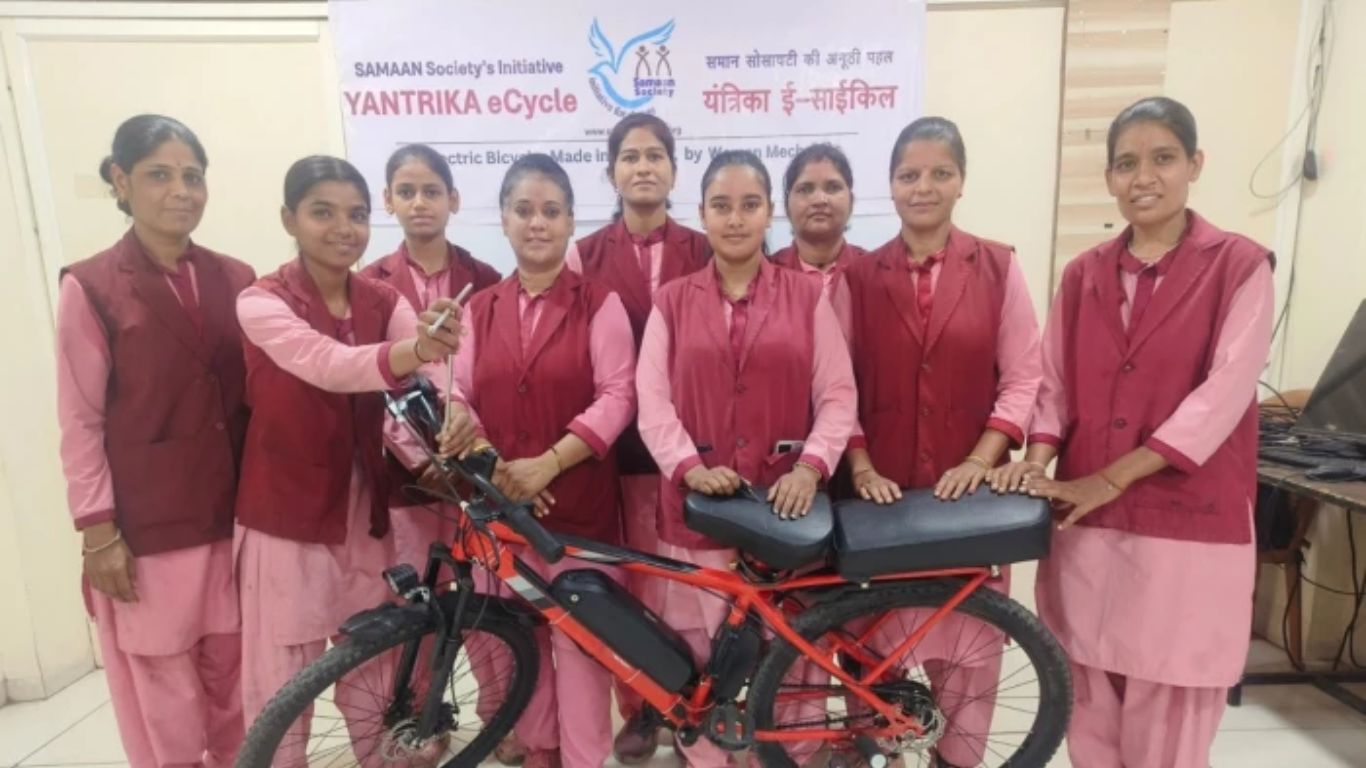
Five women mechanics from Indore’s Samaan Society have developed "Yantrika," an affordable electric bicycle, with technical support from IIT Bombay. Aimed at curbing rising fuel costs and promoting green mobility, the project marks a significant achievement in technical innovation and women's empowerment in the automotive sector.
INDORE — A group of five women mechanics from the Indore-based Samaan Society has successfully developed a cost-effective electric bicycle named "Yantrika." The initiative, which seeks to provide an affordable and environmentally friendly commuting option, was unveiled on the eve of World Environment Day, June 5, 2026. The project received technical guidance from the Centre for Technology Alternatives for Rural Areas (C-TARA) at IIT Bombay.
The "Yantrika" e-cycle is designed to address the challenges of rising fuel costs and urban pollution, specifically targeting women and laborers who require reliable, low-cost transportation for their daily commutes.
Innovation Driven by Social Empowerment
The development of the e-cycle is the culmination of six months of research, design, and testing in collaboration with IIT Bombay. Professor Satish Agnihotri and his students from C-TARA provided the necessary technical expertise, testing various prototypes to ensure the final model was both durable and efficient for Indian road conditions.
According to Rajendra Bandhu, director of the Samaan Society, the manufacturing cost for a single unit currently stands at approximately Rs 32,000. However, with large-scale production, the team anticipates the price could be reduced to around Rs 25,000, making it highly competitive for middle- and lower-income consumers. The e-cycle boasts a range of approximately 25 to 30 kilometers on a single charge and achieves a maximum speed of 20 to 25 kilometers per hour.
Breaking Barriers in the Auto Industry
This innovation is an extension of the Samaan Society’s ongoing mission to empower women through non-traditional livelihoods. The mechanics involved are part of India's first all-women garage, "Yantrika Service Center," which was established to break gender stereotypes in the male-dominated automotive repair sector.
"The goal is to facilitate daily commuting, especially for women and laborers, by providing a sustainable and affordable transport option," said Sapna Jadhav, one of the mechanics who worked on the project. By transitioning from traditional bike repairs to electric vehicle innovation, these women are demonstrating that technical skill-building can foster entrepreneurial growth and social change.
Quote Section
According to officials from the Samaan Society, the project is a testament to the potential of grassroots innovation. They stated that the collaboration with IIT Bombay was essential in refining the cycle’s technology and ensuring it meets the practical needs of commuters in rural and semi-urban environments.
Why It Matters
The Yantrika e-cycle serves as a practical solution to the rising costs of fossil fuel-powered transportation. For consumers in the middle- and lower-income brackets, it offers a cost-efficient way to travel to work without the burden of petrol expenses. Furthermore, for the Indian EV sector, this project highlights how local, small-scale innovation—when paired with institutional technical support—can create viable products that align with the national agenda for sustainable and self-reliant (Atmanirbhar) energy.
Key Facts at a Glance
Vehicle Name: Yantrika.
Range: Approximately 25–30 kilometers per single charge.
Technical Support: IIT Bombay's Centre for Technology Alternatives for Rural Areas (C-TARA).
Primary Objective: To provide affordable, eco-friendly transport for women and laborers.
Early Adoption: IIT Bombay has already ordered 10 units for use on its own campus.
FAQ
How much does the Yantrika e-cycle cost?
The current manufacturing cost is Rs 32,000 per unit, with the potential to reduce to Rs 25,000 upon large-scale production.
Who developed the e-cycle?
A team of five women mechanics trained by the Indore-based NGO Samaan Society, with technical guidance from IIT Bombay.
What is the maximum speed of the Yantrika?
The e-cycle is designed for a maximum speed of 20 to 25 kilometers per hour.
Where can the e-cycle be used?
It is designed for daily short-distance commuting, making it ideal for urban and semi-urban environments for laborers and women traveling to work.
Official Sources