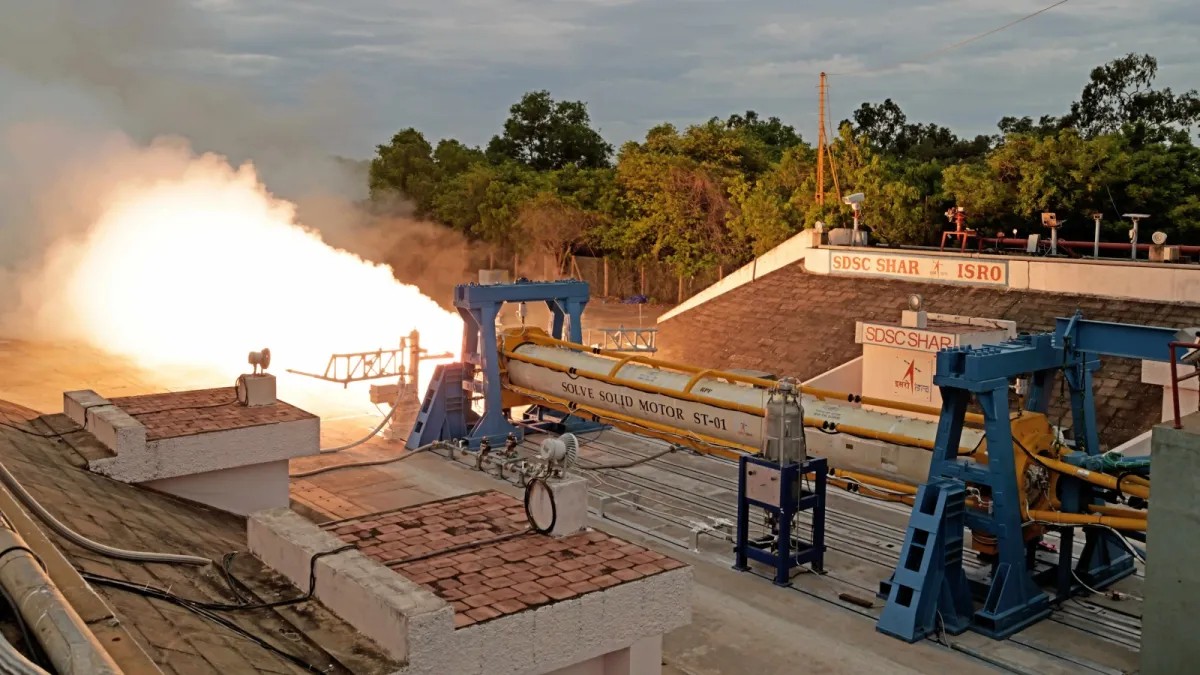
ISRO successfully completed its critical integrated parachute tests for the Gaganyaan mission at Sriharikota, validating a 10-parachute deceleration array designed for safe crew module splashdowns. Alongside this milestone, the space agency announced the development of the solid-motor SOLVE rocket platform to conduct advanced high-altitude capsule separation experiments.
SRIHARIKOTA — The Indian Space Research Organisation (ISRO) has successfully conducted a critical series of Integrated Parachute tests at its Satish Dhawan Space Centre in Sriharikota, Andhra Pradesh. Completed on July 3, 2026, the successful operation validates the complex deceleration systems that will govern the terminal phase of India's flagship Gaganyaan human spaceflight program.
This development is vital to current aerospace timelines as it proves the airworthiness of the systems responsible for bringing Indian astronauts back to Earth safely. The test marks a major step forward in certifying the Crew Module's emergency splashdown systems under realistic, multi-tiered deployment scenarios before uncrewed and crewed orbital missions proceed.
Technical Precision of the Deceleration Array
The terminal landing phase of a spacecraft returning from orbit involves managed friction and deceleration to protect structural integrity and human life. According to technical reports released by space agency officials, the recent integrated parachute tests evaluated a highly complex array comprising 10 distinct parachutes deployed in a rapid, automated sequence.
The operational breakdown of the descent sequence functions through four distinct types of parachutes:
Apex Cover Separation (ACS) Parachutes: Two initial systems are fired via mortars to strip away the protective apex cover protecting the main parachute bay, ensuring no structural parts re-contact the module.
Drogue Parachutes: Two highly aerodynamic drogues deploy immediately afterward to stabilize the falling spacecraft and execute the first massive stage of speed reduction.
Pilot Parachutes: Three small pilot assemblies are deployed via dedicated pyro-releasers to physically pull out the main canopies.
Main Parachutes: Three massive, 25-meter-diameter parachutes handle final deceleration, slowing the heavy Crew Module down to a secure terminal splashdown velocity of approximately 8 meters per second.
The testing protocols conducted at Sriharikota deliberately simulated a high-stress launchpad abort scenario to verify that the onboard computer networks, sensors, and mechanical release links could trigger and execute this multi-stage separation smoothly under irregular aerodynamic loads.
Introducing the SOLVE Test Rocket System
Building upon the successful validation of the parachute lines, ISRO announced on July 4, 2026, that it is finalizing a custom testing platform named the Sub-Orbital Launch Vehicle for Experiments (SOLVE). This platform is a dedicated, solid motor-powered test rocket designed specifically to carry experimental space payloads into exact sub-orbital trajectories.
The SOLVE system will allow engineers to replicate extreme atmospheric re-entry conditions without needing to mount expensive full-scale orbital launches. Future test operations will utilize the SOLVE platform to launch the simulated crew capsule into altitudes ranging between 10 kilometers and 17 kilometers.
Once the vehicle achieves the target height, the onboard telemetry commands an intentional separation, casting the capsule into a free-fall environment to test backup deployment matrices, structural asymmetrical balance, and software redundancy lines.
Strategic Implications for the Indian Space Ecosystem
The successful verification of the integrated parachute tests impacts multiple sectors within India’s expanding commercial space landscape. For space fans and citizens, it represents a visible validation of domestic crew safety systems, building high institutional trust for India's upcoming crewed space flight.
For commercial space investors and private public-sector businesses involved in the Make in India space push, the achievement highlights the growing capabilities of the domestic aerospace defense supply chain.
The parachute assemblies and pyro-mortars are developed in close coordination with the Aerial Delivery Research and Development Establishment (ADRDE), a specialized branch of the Defence Research and Development Organisation (DRDO). This successful cross-agency execution underscores the commercial maturity of India’s state-backed defense suppliers, opening fresh opportunities for future international aerospace export contracts.
Official Sources Section
According to official press notices, status updates, and programmatic bulletins distributed by the Indian Space Research Organisation (ISRO), the successful execution of these deceleration trials fulfills a major criterion set forth by the mission's internal Test Authorization Board (TAB).
The administrative updates confirm that the test data from the onboard Solid State Data Recorders (SSDR) matched simulated computer projections with high accuracy, clearing the path for upcoming uncrewed demonstration flights.
Quote Section
"According to officials at the space agency, the successful completion of the integrated parachute tests at Sriharikota stabilizes the terminal safety roadmap for the Gaganyaan orbital module. The synchronization of ten distinct parachutes deploying sequentially proves the structural reliability of our primary and redundant recovery systems."
Why It Matters
Ensuring the absolute safety of the crew during re-entry and touchdown is the most critical hurdle of any human space program. A failure in any single link of a parachute deployment chain can lead to catastrophic mission failure.
By systematically validating these systems through integrated drops, ISRO minimizes risk for its future astronauts, secures public funding investments, and ensures India remains positioned to enter the elite tier of independent nations capable of domestic human spaceflight.
Key Facts at a Glance
Test Date: Successfully completed on July 3, 2026, at the Satish Dhawan Space Centre in Sriharikota.
System Metrics: Involved the synchronized deployment of 10 separate parachutes across 4 technical categories.
Terminal Velocity: Successfully reduced the simulated capsule speed down to a safe ocean splashdown speed of 8 meters per second.
New Platform: ISRO confirmed development of the solid-propellant SOLVE rocket system to test capsule dynamics at altitudes of up to 17 kilometers.
Inter-Agency Alliance: Developed via an ongoing joint engineering framework between ISRO, DRDO-ADRDE, and the Indian Armed Forces.
Frequently Asked Questions (FAQ)
What is the main purpose of the integrated parachute tests?
The main purpose is to test and validate the parachute-based deceleration system that slows down the Gaganyaan Crew Module as it returns through Earth's atmosphere, ensuring a safe, soft splashdown in the sea.
How many parachutes are used to slow down the Gaganyaan capsule?
The deceleration system uses a total of 10 parachutes deployed in a precise sequence. This includes 2 apex cover separation parachutes, 2 drogue stabilization parachutes, 3 pilot parachutes, and 3 large main landing parachutes.
What is the newly announced SOLVE rocket system?
SOLVE stands for Sub-Orbital Launch Vehicle for Experiments. It is a solid motor-powered test rocket designed by ISRO to launch simulated crew capsules to altitudes between 10 km and 17 km to test structural and parachute frameworks under variable conditions.
Which agencies are collaborating on these space safety tests?
The development involves close collaboration between ISRO's Vikram Sarabhai Space Centre (VSSC), the Defence Research and Development Organisation’s (DRDO) Aerial Delivery Research and Development Establishment (ADRDE), the Indian Air Force, and the Indian Navy.
Source: Official Mission Briefings, Deceleration System Logs, and Institutional Press Releases published by the Indian Space Research Organisation (ISRO).