Japan and India have launched an institutional framework to promote biogas-run cars, converting agricultural and livestock waste into clean vehicle fuel. Powered by Suzuki’s advanced refining technology and the National Dairy Development Board’s cooperative network, the initiative utilizes India’s existing CNG ecosystem to accelerate rural decarbonization and boost farming incomes.
NEW DELHI — In a major push toward deep decarbonization, Japan and India have officially established a cooperative institutional framework to promote biogas-run cars across the South Asian nation. The clean energy partnership, consolidated following bilateral delegations between India’s Ministry of Cooperation and Japan’s Ministry of Economy, Trade and Industry (METI) at the Atal Akshay Urja Bhawan, seeks to rapidly scale compressed biomethane gas (CBG) infrastructure. By deploying advanced Japanese refining technologies across India’s expansive grassroots dairy cooperative networks, the initiative provides a structured roadmap to turn agricultural and livestock waste into a viable alternative to conventional fossil fuels for passenger vehicles.
Technical Integration of Waste-to-Wealth Systems
Under the newly formalized framework to promote biogas-run cars, the primary focus centers on bridging industrial engineering with rural raw supply chains. Suzuki Motor Corporation, in tandem with its local subsidiary Suzuki R&D Center India Private Limited and the National Dairy Development Board (NDDB), is driving the core technology transfer. The project introduces sophisticated Japanese fermentation and production management know-how to refine raw methane harvested from animal waste into vehicular-grade compressed biogas.
According to technical specifications released by engineering teams, the processed biomethane matches the chemical profile of standard Compressed Natural Gas (CNG). This direct chemical parity allows existing CNG vehicles—which currently command roughly 20% of the entire Indian passenger car market—to operate on 100% renewable biogas without requiring extensive, cost-prohibitive powertrain modifications.
Scaling Up Infrastructure and Economic Value Chains
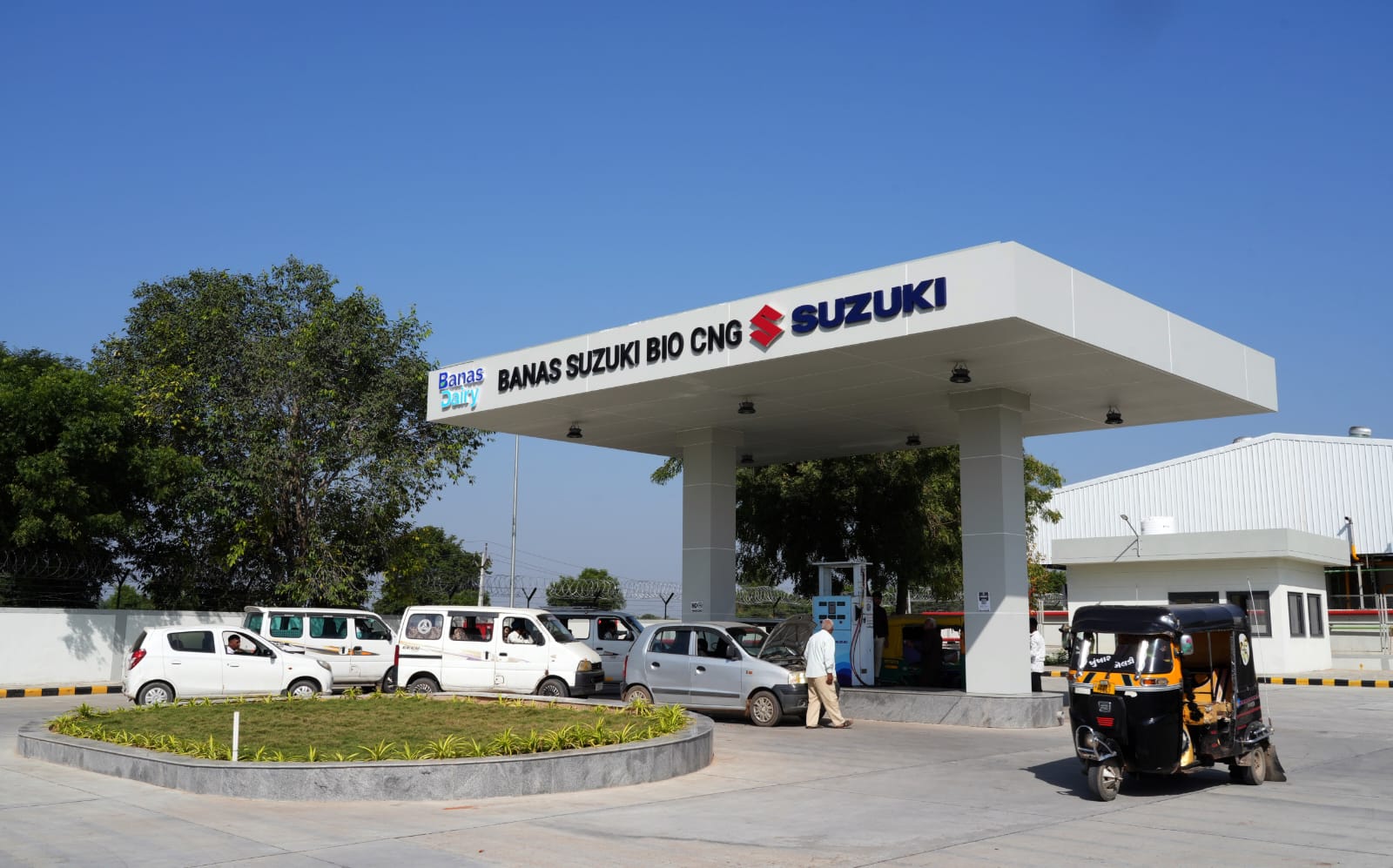
The initial deployment phase under the joint framework has rolled out operational facilities in the state of Gujarat, processing up to 100 tonnes of cow dung per day to generate 1.5 tonnes of automotive-grade fuel. Suzuki has already deployed two active commercial plants and finalized plans to establish an additional seven facilities across agricultural belts.
To ensure long-term financial viability, the bilateral roadmap integrates an immediate circular economic loop for regional communities:
Feedstock Procurement: Commercial operators purchase raw manure directly from dairy farmers through localized cooperative networks, establishing consistent secondary revenues for rural families.
Refueling Stations: Dedicated fuel dispensing pumps are being constructed directly adjacent to the processing hubs to streamline logistics for regional logistics networks and public transport vehicles.
Agricultural By-products: Solid and liquid organic residue generated during the anaerobic digestion cycle is repurposed as chemical-free organic fertilizer and distributed back to domestic farmers.
Official Sources Section
The corporate policies, technological blueprints, and government milestones outlined in this news brief are sourced directly from public statements released by India's Ministry of Cooperation, official project filings from the National Dairy Development Board, and international industrial cooperation briefs released by Suzuki Motor Corporation.
Quote Section
Highlighting the structural goals of the initiative, Dr. Ashish Bhutani, Secretary for the Ministry of Cooperation, stated during the bilateral plenary session:
"The cooperative structure offers an effective framework for implementing such green energy projects at scale because of its strong grassroots presence and direct engagement with millions of milk producers. Linking biogas plants with dairy cooperatives can significantly drive rural sustainability under our national vision."
A spokesperson for the Japanese delegation led by Takehiko Matsuo added:
"Bringing Japanese advanced technology and international best practices to India's agricultural sectors allows us to simultaneously address global warming challenges, curb methane emissions from livestock waste, and promote a viable circular economy transition."
Why It Matters
The formalization of the framework to promote biogas-run cars addresses severe environmental and economic pain points. For automakers and consumers, it offers an immediate pathway to lower fleet emissions without waiting for full-scale electric vehicle (EV) grid readiness or charging infrastructure buildouts. For international energy investors, measuring greenhouse gas emission reductions across this joint supply chain opens up a robust pipeline for generating valuable international carbon credits, ensuring high economic viability for the scaling business model.
Key Facts at a Glance
Bilateral Initiative: Japan and India have finalized a state-level framework to promote biogas-run cars via combined automotive engineering and dairy cooperative infrastructure.
Drop-in Fuel Capability: The processed fuel is chemically identical to conventional CNG, utilizing India's existing 20% market share of gas-compatible vehicles.
Rural Revitalization: Farmers receive direct payouts for raw organic feedstock, boosting the average household's financial stability while producing chemical-free bio-fertilizer.
Global Support: The cross-border technological deployment model has been integrated into the United Nations Industrial Development Organization (UNIDO) program for global technology transfers.
Frequently Asked Questions (FAQ)
What is the core objective of the new Japan-India biogas agreement?
The agreement establishes a framework to promote biogas-run cars by integrating Japanese waste-to-energy technologies with India's dairy cooperative networks to produce clean, vehicular-grade compressed biomethane.
Can standard cars run on this newly developed biogas?
Yes. The compressed biogas generated from cow dung has the same chemical composition as compressed natural gas (CNG). Vehicles already equipped with factory CNG kits can use this fuel seamlessly without mechanical modifications.
How does this framework economically impact local farmers?
Local dairy farmers gain an active secondary income stream by selling raw cattle dung to the processing facilities at established rates, while receiving high-quality organic fertilizers produced as a natural by-product of the gas refining process.
Which organizations are leading the commercial rollout?
The project is structurally supported by India's Ministry of Cooperation and Japan's Ministry of Economy, Trade and Industry, with direct commercial implementation led by Suzuki Motor Corporation, the National Dairy Development Board (NDDB), and localized dairy cooperatives.
Sources: Ministry of Cooperation, Government of India, Ministry of Economy, Trade and Industry (METI), Japan, Suzuki Motor Corporation Global Sustainability Division