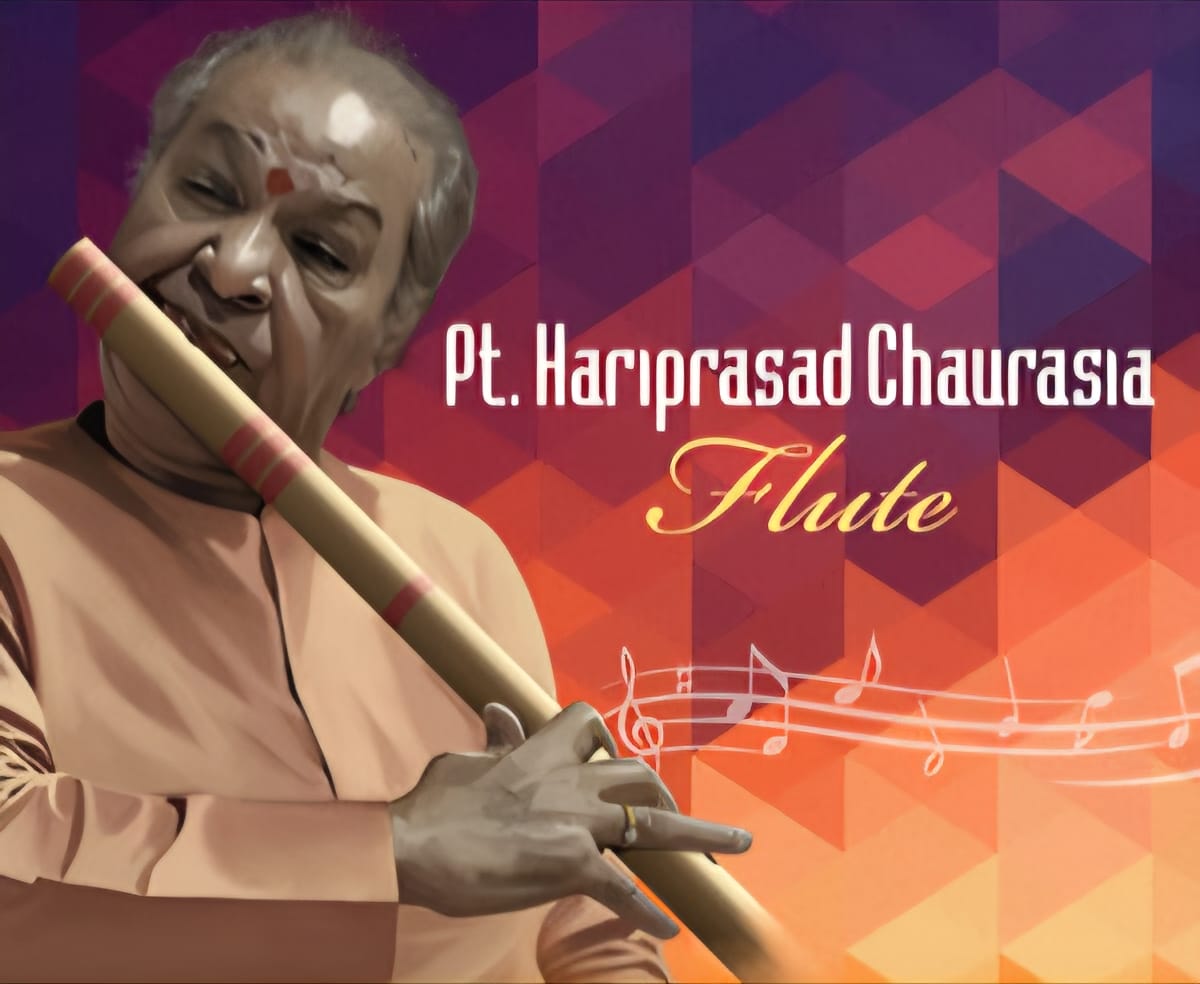
Pandit Hariprasad Chaurasia marked his 88th birthday on July 1, 2026, celebrated by the New Delhi premiere of the biographical musical “Bansuri Jab Gaane Lage.” The event honored his massive legacy in transforming the bamboo flute into a global classical instrument and his legendary cinematic compositions under the "Shiv-Hari" banner.
NEW DELHI — HCL Concerts has staged a major commemorative musical production at the Kamani Auditorium in New Delhi to honor the 88th birthday of Pandit Hariprasad Chaurasia, the premier virtuoso who transformed the simple wooden bansuri into a global classical instrument. The landmark celebration on July 1, 2026, coincided with the premier of “Bansuri Jab Gaane Lage,” a dramatic stage production curated by his family to chart his life journey.
Addressing an audience of cultural delegates, musicians, and public officials, Chaurasia declared that the bansuri remains his central anchor, asserting that the bamboo flute will continue to command deep global listenership for generations to come.
From Secret Disciple to Global Classical Innovator
Biographical records maintained by national cultural institutions show that Pandit Hariprasad Chaurasia's ascent to musical prominence defied conventional hereditary lineages. Born into a non-musical family in Allahabad in 1938, Chaurasia initially undertook rigorous vocal training under Pandit Rajaram at the age of 15 before secretly shifting his focus to the wind instrument under the guidance of Pandit Bholanath Prasanna.
His technical mastery was finalized after years of persistence when he was accepted as a disciple by the reclusive classical purist Annapurna Devi of the Senia-Maihar gharana. Under her instruction, Chaurasia adopted a left-handed playing style to structurally reorient his approach to classical ragas.
By integrating the deep, structural vocal nuances of dhrupad and khayal into the physical framework of the woodwind instrument, he successfully elevated the bansuri from a folk accompaniment to a primary, high-capacity concert instrument on international stages.
Cross-Genre Collaborations and Bollywood's "Shiv-Hari" Era
Beyond his foundational work in classical pure ragas, Chaurasia achieved widespread commercial success through his historical contributions to Indian cinema. Working in tandem with santoor maestro Pandit Shivkumar Sharma under the moniker "Shiv-Hari," the duo composed chart-topping soundtracks for definitive Bollywood films produced by Yash Chopra, including Silsila (1981), Chandni (1989), Lamhe (1991), and Darr (1993).
The recent Delhi production featured live vocal and instrumental medleys of these cinematic highlights, alongside his historic solo flute interlude from Subhash Ghai's 1983 film Hero, which remains an enduring touchstone of Indian pop culture.
On the international front, Chaurasia's cross-cultural explorations altered the global footprint of Indian music. His work on the seminal 1967 album Call of the Valley introduced Indian classical modalities to Western mainstream audiences. He later executed high-profile fusion projects alongside international luminaries, including:
George Harrison of The Beatles
John McLaughlin, English jazz-fusion guitarist
Jan Garbarek, Norwegian saxophonist
Yehudi Menuhin, classical violin virtuoso
Institutional Legacy and Future Lineage Preservation
To protect the oral traditions of Hindustani classical music against modern digital attrition, Chaurasia has focused heavily on institutional education. He established the Vrindaban Gurukul hubs in Mumbai (2003) and Bhubaneswar (2010), where students learn under the traditional guru-shishya (teacher-disciple) paradigm.
His structural teaching methods have produced a new generation of standard-bearers, led by his nephew, the double Grammy Award-winning flautist Rakesh Chaurasia, who continues to perform globally. Additionally, Chaurasia's educational influence extended into Europe, where he served for years as the Artistic Director of the World Music Department at the Rotterdam Conservatory in the Netherlands.
Official Sources Section
Biographical data, career milestones, and national awards cited in this retrospective are mapped directly from archival records at the Sangeet Natak Akademi, official state investiture logs for the Padma Bhushan (1992) and Padma Vibhushan (2000) managed by the Ministry of Home Affairs, and production briefs from HCL Concerts.
Quote Section
"The flute is my family, and it will always remain my family," Pandit Hariprasad Chaurasia stated during a media briefing on his 88th birthday. "As long as I am here, as long as my flute is with me, this family will continue. And people, whether they like it or not, will listen to the flute more than any other instrument. I play the flute every day anyway."
Why It Matters
The formal celebration of Hariprasad Chaurasia's 88th birthday underscores the structural importance of preserving India's classical arts within modern urban spaces. By transitioning his life story into a multi-media theatrical production, cultural organizations ensure that the classical performance methodology remains accessible to contemporary audiences, sustaining the economic and educational pipelines that support traditional acoustic musicians in a highly digitized entertainment industry.
Key Facts at a Glance
Milestone Celebration: Flute maestro Pandit Hariprasad Chaurasia celebrated his 88th birthday on July 1, 2026, marked by a dedicated theatrical production in New Delhi.
Biographical Stage Play: The event featured the premiere of “Bansuri Jab Gaane Lage,” a biographical musical directed by Bhushan Koregaonkar and Kunal Vijayakar.
Cinematic Impact: Chaurasia's legendary work in commercial Indian cinema includes composing hit soundtracks for Silsila and Chandni under the iconic "Shiv-Hari" partnership.
National Honors: The maestro's global legacy is backed by India's highest civilian accolades, including the Sangeet Natak Akademi Award, Padma Bhushan, and Padma Vibhushan.
Frequently Asked Questions
What is the unique playing style of Pandit Hariprasad Chaurasia?
At the direction of his guru Annapurna Devi, Chaurasia adopted a specialized left-handed playing technique. He modified the traditional bansuri format to replicate the structural, continuous breathing expressions of Indian vocal music.
What was Chaurasia's contribution to Bollywood cinema?
Partnering with santoor player Pt. Shivkumar Sharma as "Shiv-Hari," he composed background scores and complete musical tracks for classic Indian films, creating highly recognizable melodies like the iconic flute piece in the movie Hero.
Where does Pandit Hariprasad Chaurasia train new flute students?
He provides classical education through the traditional guru-shishya system at his dedicated residential institutions, the Vrindaban Gurukul, located in Mumbai and Bhubaneswar.
Source: Sangeet Natak Akademi Official Fellowships, HCL Concerts Press Bureau, and Press Trust of India (PTI) Cultural Briefings (July 2026).