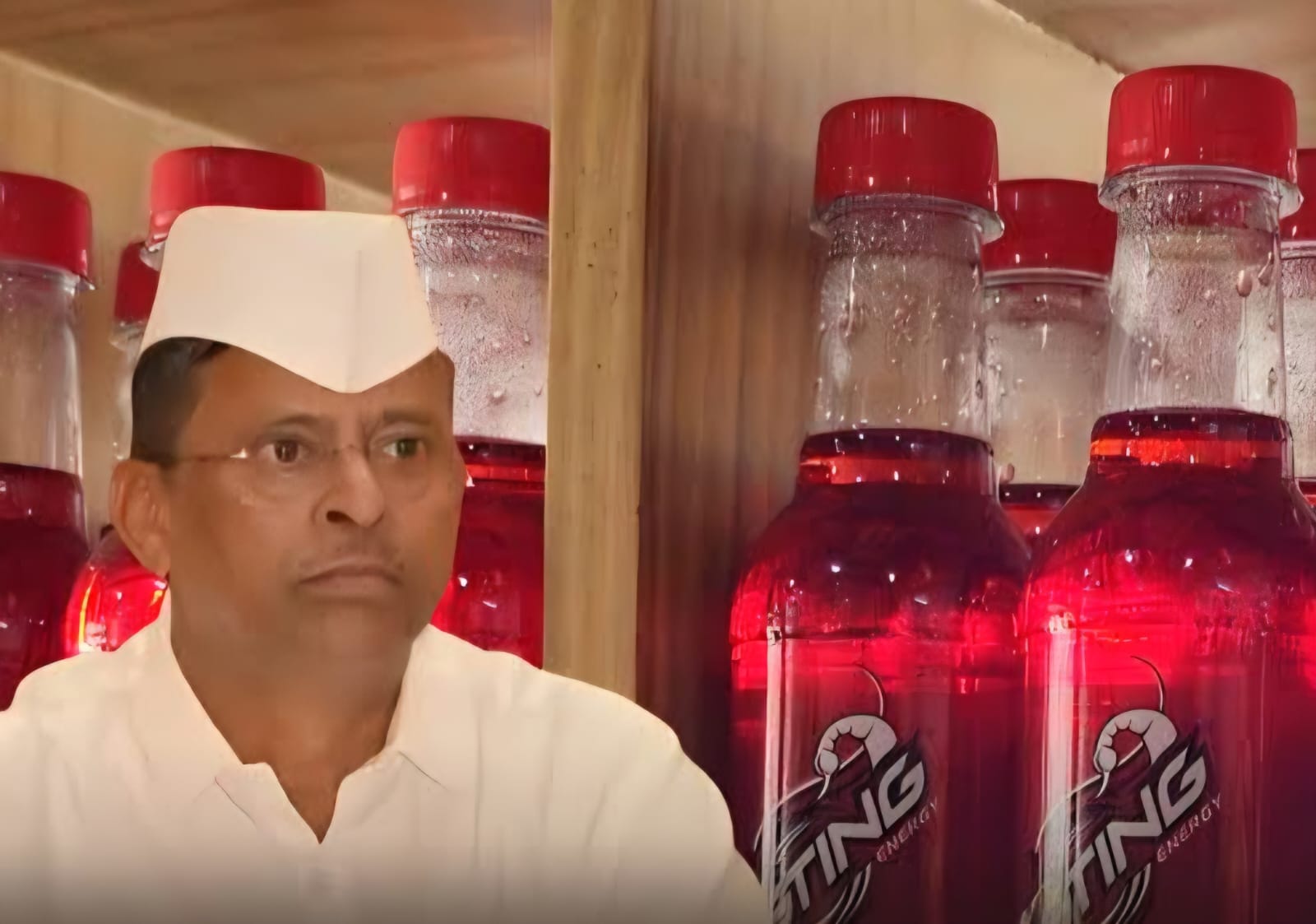
The Maharashtra government has banned the sale of Sting and other energy drinks within a 500-meter radius of schools. Announced by FDA Minister Narhari Zirwal following a central FSSAI crackdown on misleading health claims, the step addresses pediatric health concerns regarding excessive caffeine and sugar levels in young students
MUMBAI — The Maharashtra government announced a comprehensive ban on Friday prohibiting the sale of "Sting" and other energy drinks within a 500-meter radius of schools across the state. The statutory order aims to curb the easy access and escalating consumption of highly caffeinated and sugar-laden beverages among minors and schoolchildren.
The development, confirmed in the state legislative assembly, comes closely on the heels of a wider federal regulatory crackdown by the Food Safety and Standards Authority of India (FSSAI), which questioned the overall branding and health assertions made by top-tier beverage manufacturers in the country.
State Assembly Targets Sting as FDA Ordered to Enforce Buffer Zone
The policy announcement was made by Maharashtra’s Food and Drug Administration (FDA) Minister Narhari Zirwal during a legislative session. Replying to a calling-attention motion raised by Bharatiya Janata Party (BJP) MLA Vikram Pachpute regarding the heavy marketing and availability of energy drinks near school perimeters, Zirwal validated the underlying physiological and behavioral risks for developing adolescents.
The state government has issued clear directives to the Maharashtra Food and Drug Administration (FDA) to immediately deploy field inspectors to police shopkeepers, kiosks, and retail vendors operating within the 500-meter restriction zone. Under the new protocol, authorities will seize non-compliant stock and file immediate punitive actions against local business owners who violate the perimeter rules.
Rising Sugar and Caffeine Content Raise Pediatric Health Alerts
Public health professionals and food safety advocates have increasingly voiced concerns over the chemical compositions of popular mass-market beverages under the scanner. Medical data indicates that a typical 250 ml serving of Sting energy drink contains approximately:
70 to 75 mg of Caffeine: Roughly equivalent to an adult-strength brewed cup of coffee.
28 to 30 grams of Sugar: Translating to roughly seven teaspoons of processed sugar.
100 to 120 Calories: Sourced entirely from simple carbohydrates.
Pediatric specialists warn that these concentration levels can disrupt the metabolic balance in children, contributing directly to elevated heart rates, acute sleep disruption, baseline anxiety, early-onset insulin resistance, and a habitual dependency on high-dose stimulants at an early age.
Broader FSSAI Crackdown Challenges Energy Drink Classifications
The administrative action in Maharashtra mirrors a wider national pushback against the beverage segment. Earlier this week, the FSSAI issued formal show-cause notices to six primary marketplace brands over alleged misbranding and misleading promotional claims under the Food Safety and Standards Act, 2006.
The central food safety regulator highlighted that there is currently no officially notified standard category for an "energy drink" under Indian food regulations. Along with PepsiCo India’s Sting Energy Drink, the multi-brand sweep includes Red Bull, Monster Energy, Hell Energy, Adrenaline Rush, and Reliance Consumer Products' Campa Energy Gold Boost. The federal body has specifically objected to marketing slogans such as "vitalizes body and mind" or "enhances focus," ruling that therapeutic assertions cannot be applied arbitrarily to conventional proprietary food or beverage items without explicit clinical clearances.
Official Sources Section
According to official assembly logs provided by the Maharashtra Legislature and directives mapped out by the Maharashtra Food and Drug Administration (FDA), the perimeter restriction applies universally across all state board, CBSE, and international schools operating within provincial lines. Parallelly, the State Education Department has been ordered to work alongside school administrations to launch health-awareness modules educating parents and guardians about synthetic stimulant risks.
Quote Section
"The concerns raised regarding the sale of 'Sting' energy drink in and around school premises are valid. If the sale of such energy drinks or any other intoxicating substances is found within 500 metres of a school campus, immediate action will be taken against those responsible."
— Narhari Zirwal, Maharashtra Food and Drug Administration Minister
Why It Matters
The policy shift creates an immediate compliance buffer that directly impacts local retail businesses, convenience store chains, and small-scale street vendors situated near educational hubs. For parents and school counselors, the restriction provides legislative backing to combat heavy commercial targeting toward children. Financially, the decision places pressure on multi-national beverage corporations, which must rapidly modify their regional supply chain distributions and geographic marketing footprints in one of India's largest consumer state economies.
Key Facts at a Glance
Buffer Zone Mandated: A mandatory 500-meter sales ban on energy drinks is now active around all Maharashtra schools.
Primary Target: PepsiCo India's popular "Sting" beverage is the focal point of the local retail ban, alongside secondary brands.
Enforcement Body: The Maharashtra Food and Drug Administration (FDA) has been directed to carry out spot checks and penalize violators.
Parallel Action: The national food regulator, FSSAI, has issued non-compliance notices to six major beverage brands challenging the "energy drink" terminology.
FAQ Section
What drinks are banned under the new Maharashtra school rule?
The ban targets non-alcoholic caffeinated beverages commercially labeled or marketed as "energy drinks," with PepsiCo's Sting explicitly mentioned under the state's legislative directive.
What is the exact physical boundary of the ban?
Retailers, grocery shops, and street vendors are completely prohibited from selling these items within a 500-meter radial distance from any school gate or school property line.
Why is the government targeting energy drinks for minors?
Medical professionals point out that the exceptionally high caffeine and sugar contents (often up to 75 mg of caffeine and 30 grams of sugar per small bottle) trigger metabolic spikes, sleep deprivation, and heart rate irregularities in growing children.
What penalties do shopkeepers face for violating the perimeter ban?
According to minister statements, the state FDA has been given full authority to take immediate administrative and punitive action, which includes stock confiscation and formal regulatory penalties under local food safety codes.
Source: Maharashtra Food and Drug Administration (FDA), Food Safety and Standards Authority of India (FSSAI), Legislative Assembly Question Archives (PTI)