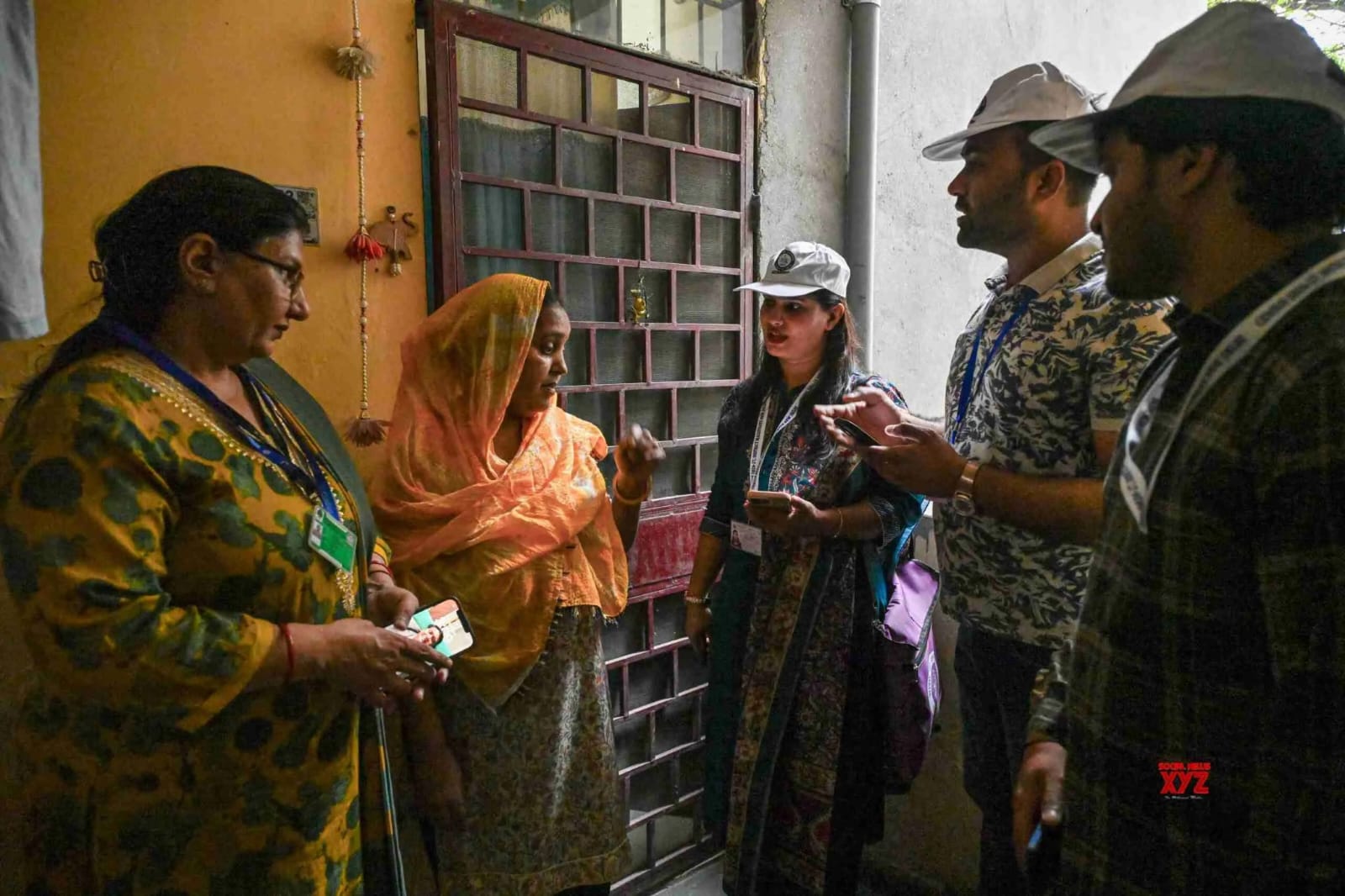
Misplaced data concerns among landlords and migrants are slowing down India's first digital census house-listing drive in New Delhi. Fearing tax audits or loss of state identification, some residents are evading enumerators, prompting authorities to reiterate that individual data remains strictly confidential under the Census Act of 1948.
NEW DELHI — The ongoing first phase of India's long-delayed population census is facing unexpected friction in the national capital. Field officials report that despite completing roughly 82% of the house-listing work across New Delhi's municipal zones, a significant section of residents is deliberately keeping off the census. This reluctance stems from misplaced fears that personal economic data could be shared with law enforcement, tax entities, or municipal bodies to penalize them.
The development presents a critical challenge for urban planning. The House Listing and Housing Operations (HLO) drive, which forms the baseline for the country's first fully digital population census, relies on precise, absolute coverage to map infrastructure needs. Field workers have run into resistance from property owners, migrant communities, and tenants in unauthorized colonies, slowing down enumeration progress as the June 14 deadline approaches.
Tax Scrutiny and Document Loss Fears Drive Resistance
According to administrative feedback received by regional coordination offices, the resistance varies distinctly by neighborhood demographics. In rental and commercial hubs like East Delhi, Northwest Delhi, and coaching centers like Mukherjee Nagar, landlords are actively blocking access to tenants or insisting that entire multi-unit residential structures be logged as single-family households.
Officials involved in the exercise state that landlords fear detailed household data will be forwarded to the Income Tax Department to cross-verify rental yields or identify structural violations in unauthorized colonies. Meanwhile, migrant workers are expressing severe hesitation following a recent special intensive revision of regional databases. Many migrants who retain their voter cards or Aadhaar registries in their home states fear that registering their presence in Delhi will automatically invalidate their documentation back home or mark them as illegal squatters.
Digital Fraud Concerns Compound Enumeration Friction
The transition to a fully digital enumeration format, where around 32 lakh field workers enter data directly into a mobile application on their personal phones, has introduced unexpected trust barriers. Senior officials have warned residents against sharing personal data via physical paperwork, revealing that dynamic scams using fake printed census forms have been reported across northeast and east Delhi localities.
To counter both fraud and privacy apprehensions, the Office of the Registrar General and Census Commissioner has re-emphasized that census field supervisors carry verified identification smart cards equipped with secure QR codes. Residents are being strongly advised to verify these digital credentials on the spot before providing household responses.
Legal Protections Shielding Individual Records
Faced with mounting localized non-cooperation, census coordinators have deployed unique measures, including street plays (nukkad nataks) and civil defence volunteers to accompany field teams. Officials are continuously emphasizing the strict statutory firewalls protecting citizen responses.
Under the provisions of the Census Act, 1948, all individual data collected during a census is classified as strictly confidential. The legislation guarantees that raw personal records are legally shielded from all judicial discovery, civic regulatory bodies, or criminal investigators. Only anonymized, highly aggregated data sets are eventually made public for macro-level statistical modeling and state policy formulation.
Official Sources Section
The local metrics, statutory rules, and administrative challenges outlined in this report are based on field updates provided by the Municipal Corporation of Delhi (MCD) census coordination desk, official operational circulars from the Office of the Registrar General & Census Commissioner, India, and field directives published by the Ministry of Home Affairs.
Quote Section
"Whenever such episodes occur, senior officials have to intervene and explain that data collected are confidential and cannot be used by any authority for purposes other than the Census. Fear of being penalised by tax or civic authorities sits in the minds of owners of private houses... which we are trying to correct through awareness activities and direct dialogue."
— Anu Gupta, Census Coordinator for South and Old Delhi, in an official administrative summary.
Why It Matters
When entire communities avoid official demographic counts, the consequences hit local public infrastructure directly. Central and state governments utilize census data to allocate municipal funding, design subsidized health clinics, calibrate public transportation routes, and distribute electrical grid workloads. Artificially low population counts caused by data anxiety directly translate to underfunded civic services and severe resource shortages for those neighborhoods over the next decade.
Key Facts at a Glance
Widespread Reluctance: Significant pockets of tenants, property owners, and migrants across Delhi are avoiding census enumerators due to misplaced anxieties regarding data tracking.
Confidentiality Shield: Individual data is strictly insulated by the Census Act of 1948, making it completely inadmissible as evidence before any tax or law enforcement authority.
Scam Warning: Authorities have issued public alerts regarding fraudulent paper forms circulating in East Delhi, clarifying that the current house-listing phase is entirely digital.
Security Deployments: Civil defence volunteers are being actively deployed alongside schoolteachers and Anganwadi workers in sensitive blocks to ensure field safety.
FAQ Section
Q1: Can the data I give to a census enumerator be used against me by the Income Tax Department?
No. Under the Census Act of 1948, individual census records are strictly confidential and cannot be accessed by the Income Tax Department, civic municipal bodies, or any court of law.
Q2: Will migrant workers lose their home-state welfare benefits if they register in Delhi?
No. The census is purely a demographic counting exercise designed to map where people live and work. It has no bearing on state-level land ownership registries, ration cards, or local electoral rolls.
Q3: How do I know if an individual at my door is a real government census worker?
Official digital enumerators carry identity cards featuring a verifiable QR code. Residents can scan the code to instantly verify the worker’s credentials via the government portal.
Q4: When does the current house-listing phase end in Delhi?
The active door-to-door house-listing and mapping operations across the Municipal Corporation of Delhi (MCD) zones are scheduled to conclude on June 14.
Source: Office of the Registrar General & Census Commissioner, India, Ministry of Home Affairs, Press Information Bureau (PIB) India.