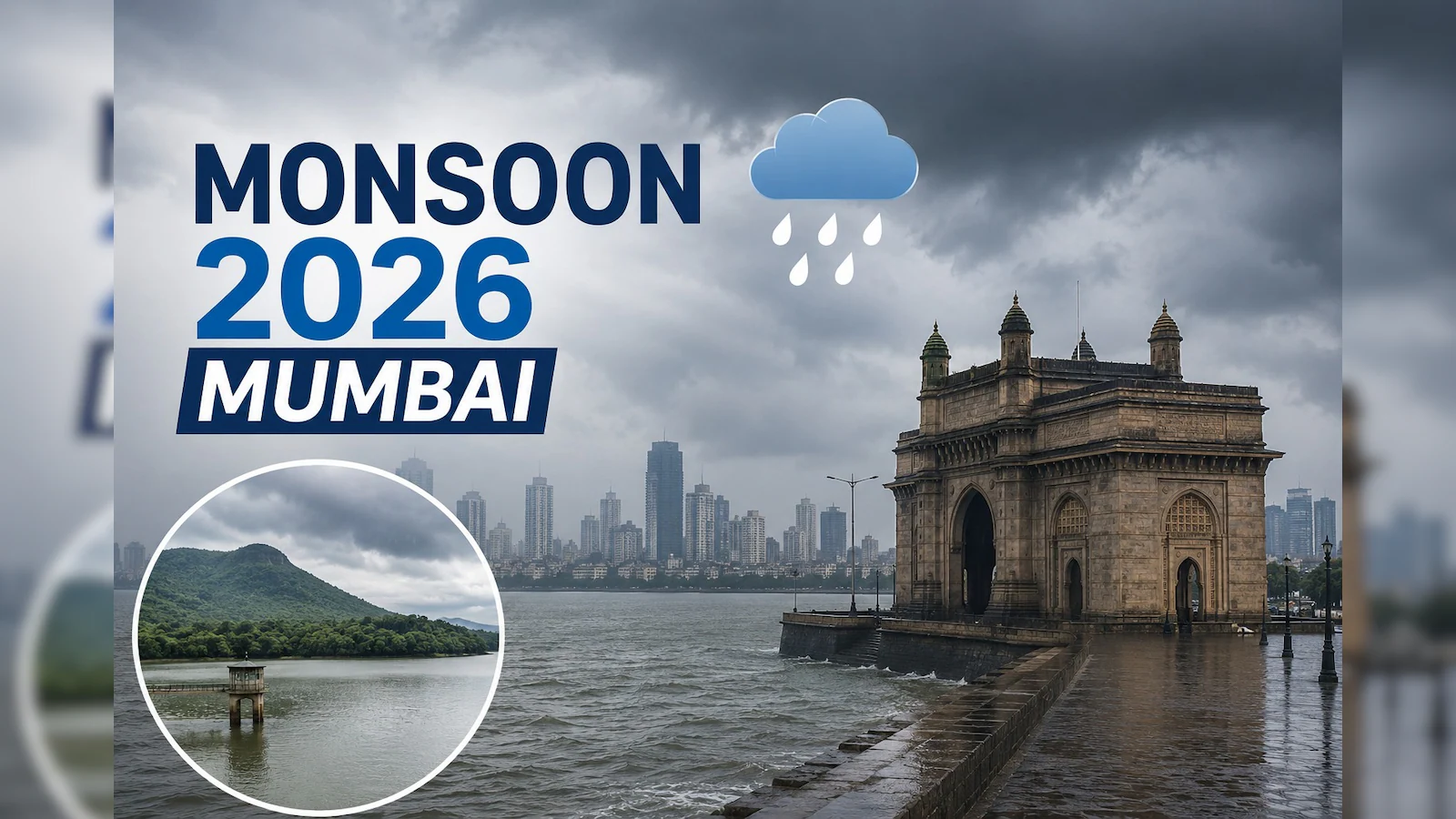
The formal arrival of the Mumbai monsoon is delayed past its June 11 schedule, with weather officials projecting an adjusted onset around June 15. The delay hits as municipal lake levels drop to a low 12.5% capacity, keeping a strict citywide 10% water rationing policy in effect.
MUMBAI — The formal arrival of the critical southwest monsoon over Mumbai has faced a structural atmospheric delay, remaining stalled past its official annual onset timeline. Meteorological evaluations conducted in mid-June 2026 confirm that while the weather system successfully advanced into regional Maharashtra on schedule, its localized momentum toward the metropolitan area has decelerated. The delay coincides with a critical drop in municipal water reserves, prompting heightened observation from civic management teams and infrastructure regulators monitoring the city's primary utility supply.
Delayed Onset Trajectory Confirmed by Weather Officials
According to statutory tracking briefings from the India Meteorological Department (IMD), the official baseline schedule for the monsoon arrival over the financial capital is June 11. However, structural convective tracking shows that the critical advancing front has encountered slower-moving air currents along the Konkan coast.
While seasonal rainfall entered southern sections of the state early, its northern translation has stabilized into a temporary holding pattern. Weather researchers at private tracking agency Skymet note that an evolving lower-level cyclonic circulation is expected to organize near the Goa and South Konkan coastline. This atmospheric system is projected to shift closer to the mainland, opening a window for a potential formal Mumbai monsoon arrival around June 15, with a standard structural margin of plus or minus one day.
Municipal Water Storage Plummets to Critical Thresholds
Data released by the hydraulic engineering division of the Brihanmumbai Municipal Corporation (BMC) highlights an intensifying supply deficit across the seven primary catchments feeding the city. The combined net water stock across the metropolitan reservoirs has receded to just 12.49% of total operational capacity, containing roughly 1,80,756 million liters out of a maximum 14,47,363 million liters.
Lake Storage Distribution Matrix
The internal storage distribution highlights severe variance across individual operational reservoirs:
| Reservoir Facility | Current Storage Percentage | Operational Status |
| Upper Vaitarna | 0.00% | Completely Depleted |
| Tansa Lake | 7.50% | Critical Minimum |
| Bhatsa Lake | 12.00% | Low Flow Level |
| Middle Vaitarna | 15.29% | Constrained Supply |
| Tulsi Lake | 25.00% | Sub-Normal Reserve |
| Modak Sagar | 33.00% | Active Catchment |
| Vihar Lake | 42.00% | Maximum Remaining |
The present reserve level forces continued reliance on a citywide 10% water cut implemented by the municipal administration to preserve remaining baseline allocations until heavy catchment area rainfall initiates recharge cycles.
Extended Forecast Patterns Indicate Light Regional Showers
The institutional weather forecast for the immediate short-term horizon mandates partly cloudy conditions paired with isolated, light convective thundershowers throughout Mumbai, Thane, and Palghar. These isolated pre-monsoon bursts will offer localized thermal relief but will not deliver the sustained volume needed to elevate water levels inside the distant mountain catchments.
Long-range macro models issued by the IMD for the entire 2026 southwest monsoon cycle indicate that cumulative country-wide precipitation is most likely to settle below normal parameters, tracking near 92% of the historic Long Period Average (LPA). This broader variation is largely driven by evolving neutral El Niño–Southern Oscillation (ENSO) parameters moving closer to definitive El Niño trends over the equatorial Pacific Ocean.
Official Sources Section
All direct meteorological metrics, long-range predictive models, and reservoir reserve tracking cited in this dispatch are corroborated via formal statements from the India Meteorological Department (IMD) and published daily resource updates maintained by the Brihanmumbai Municipal Corporation (BMC).
Quote Section
"The overall conditions remain favorable for a gradual systemic advance into more parts of the central Arabian Sea and regional Maharashtra over the coming days. A localized cyclonic architecture developing along the coast is expected to trigger increased rainfall intensity, establishing formal onset parameters for the metropolitan region after a brief initial pause."
— According to official statements from the IMD regional forecasting desk.
Why It Matters
A delayed monsoon directly impacts public healthcare planning, urban mobility, and consumer commodity inflation across India's most populous metropolitan area. Commercial entities must adjust transit timelines around the eventual heavy downpour, while municipal planners are forced to manage strict utility quotas to prevent residential storage depletion. Additionally, standard commercial tanker supply systems face operational strains, requiring businesses and residential complexes to practice strategic storage conservation until natural lake replenishment begins.
Key Facts at a Glance
Revised Arrival Target: Current convective modeling establishes a projected onset timeframe centered around June 15.
Depleted Catchment Reserves: Total municipal lake water storage has decreased to a low baseline of 12.49% capacity.
Empty Infrastructure Nodes: The Upper Vaitarna reservoir node has run entirely dry, reporting a 0% active water balance.
Active Supply Constraints: A mandatory 10% water cut remains actively enforced across municipal boundaries by the BMC.
Long-Term Deficit Signal: Seasonal models predict macro-monsoon volumes dropping to 92% of the traditional long period average due to shifting oceanic temperatures.
FAQ Section
Why is the Mumbai monsoon delayed when it arrived in Maharashtra on time?
While the monsoon system entered southern Maharashtra on schedule around June 6, its forward momentum slowed due to weak localized wind patterns and atmospheric pressures along the west coast. The system needs a strong low-pressure trigger, such as a cyclonic circulation, to drive it further north into Mumbai.
When will regular water supplies resume without municipal cuts?
The BMC will review the active 10% water cut only after sustained, heavy rainfall covers the primary lake catchment areas located in Thane and Palghar districts. Light pre-monsoon showers inside the city center do not contribute to the deep reservoir lake levels.
What is causing the prediction for a below-normal monsoon this year?
Global climate models indicate that earlier neutral ocean states are steadily evolving toward El Niño conditions in the equatorial Pacific. Historically, an El Niño setup tends to suppress or weaken the performance of the southwest monsoon over the Indian subcontinent.
Are city transportation networks preparing for the revised arrival date?
Yes. Central and Western Railway divisions, along with municipal transit authorities, maintain standard monsoon protocols. Fleet adjustments and drainage clearing systems remain actively positioned for mobilization as soon as heavy downpours are formally logged.
Source: India Meteorological Department Official Bulletins, Brihanmumbai Municipal Corporation Hydro-Metrics.