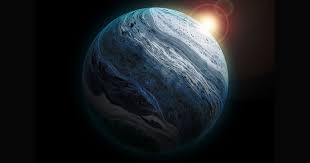
Astrophysicists analyzing the deep blue exoplanet HD 189733b have confirmed that its deceptive, Earth-like cobalt appearance masks a lethal environment. Located 63 light-years away, the gas giant experiences devastating supersonic winds exceeding 5,400 mph and horizontal rain composed entirely of scorching, molten glass particles, redefining planetary weather boundaries.
WASHINGTON — Space science organizations collaborating with NASA have detailed unprecedented meteorological findings regarding the deep blue exoplanet HD 189733b, a hostile world situated 63 light-years from Earth. While its striking cobalt-blue appearance closely resembles a peaceful, water-rich paradise from orbit, official data updates published on June 6, 2026, confirm that the gas giant is a violent environment where atmospheric silicates condense into molten glass rain, falling horizontally at seven times the speed of sound.
The rapid development provides astrophysicists with a critical benchmark for studying extreme atmospheric dynamics and alien weather systems. By decoding how elements behave under intense stellar radiation, researchers can better map structural envelopes for planetary systems across the galaxy.
Extreme Atmospheric Dynamics Discovered on Alien Worlds
The celestial body known as the deep blue exoplanet HD 189733b is classified by astrophysicists as a "hot Jupiter"—a class of massive gas worlds that share dimensional similarities with Jupiter but orbit aggressively close to their parent stars. According to data consolidated by the NASA Exoplanet Archive, this world sits nearly 30 times closer to its host star than Earth does to the Sun, completing a full orbit in just 2.2 Earth days.
This extreme proximity drives atmospheric temperatures upward of 1,000 degrees Celsius on its star-facing hemisphere. The dramatic temperature delta between the permanently illuminated dayside and the cooler nightside creates an immense atmospheric pressure differential.
Researchers at the University of Warwick used high-resolution spectroscopy to measure Doppler shifts in the planet's wind patterns. They mapped a global wind system traveling at speeds exceeding 5,400 miles per hour (approximately 8,700 kilometers per hour). These extreme currents carry microscopic particles across the planet's atmospheric boundary layer at supersonic velocities.
The Chemistry of Molten Glass Rain and Optical Illusions
The beautiful coloration of the deep blue exoplanet HD 189733b, initially verified through color-measurement data from the Hubble Space Telescope, does not originate from liquid water oceans. Instead, spectroscopic analyses indicate that the high-altitude haze layer is entirely composed of floating silicates—the primary component of terrestrial rock, sand, and glass manufacture.
Under the blistering temperatures, these silicates condense into tiny liquid droplets of molten glass rain. Rather than falling downward due to gravity, these particles are caught up by the 5,400 mph winds into a continuous, horizontal storm that shreds anything in its path.
Astronomical agencies explain that these suspended glass shards scatter light through a process called Rayleigh scattering. Because the silicate particles are smaller than the wavelengths of visible light, they scatter shorter blue wavelengths far more efficiently than longer red wavelengths. This optical illusion creates a deep sapphire blue hue that completely masks one of the most hostile environments discovered in modern astronomy.
While the deep blue exoplanet HD 189733b is entirely uninhabitable for humans, its detailed characterization yields significant long-term benefits for tech investors, private aerospace institutions, and science education platforms.
| Sector Impacted | Application Area | Practical Outgrowth |
| Aerospace Technology R&D | Planetary Sensor Arrays | Refines data calibration for spectrometers used on the James Webb Space Telescope. |
| Supercomputing / AI | Global Circulation Models | Enhances fluid dynamics algorithms used to simulate extreme weather patterns. |
| Public Science Platforms | Interactive Astronomy | Drives ticket sales and engagement for observatories and planetariums globally. |
Official Sources Section
The documented metrics regarding the weather systems, temperature ranges, and chemical composition of the deep blue exoplanet HD 189733b originate directly from peer-reviewed findings and data archives hosted by the NASA Exoplanet Archive and the University of Warwick Astrophysics Group.
Quote Section
In an official public educational summary highlighting extreme space phenomena, NASA representatives stated:
"The nightmare world of HD 189733b is the killer you never see coming. Getting caught in the rain on this planet is more than an inconvenience; it's death by a thousand cuts. This scorching alien world rains glass—sideways—in its howling winds."
Why It Matters
Characterizing worlds like the deep blue exoplanet HD 189733b helps scientists validate core principles of physics under conditions that cannot be replicated in a laboratory on Earth. By tracking how heat distributes across a gas giant experiencing severe stellar radiation, researchers can refine their instruments to analyze the atmospheric makeup of smaller, rocky exoplanets that may fall within habitable zones elsewhere in our universe.
Key Facts at a Glance
Interstellar Proximity: Located approximately 63 light-years from Earth in the northern constellation of Vulpecula.
Supersonic Wind Speeds: Atmospheric wind currents clock in at 5,400 mph, roughly seven times the speed of sound.
Lethal Precipitation: High-altitude clouds condense silicates into molten glass rain that storms horizontally across the planet.
Rapid Orbit: The hot Jupiter races around its host star at incredible speeds, completing a full "year" every 53 hours.
FAQ Section
What makes the deep blue exoplanet HD 189733b look blue if it has no water?
The planet's blue appearance is driven by a thick, hazy atmosphere full of silicate particles. These tiny glass pieces scatter blue light far more effectively than other colors, mimicking the look of Earth's oceans.
How hot does it get on this exoplanet?
The planet experiences extreme temperatures that average 919 degrees Celsius (1,686 degrees Fahrenheit) and can spike past 1,200 degrees Celsius depending on atmospheric currents moving from the day side to the night side.
Can any form of life survive on exoplanet HD 189733b?
No. Because it is a gas giant with blistering temperatures, supersonic winds, heavy gravity, and a constant torrent of horizontal molten glass rain, it cannot sustain any known biological life.
Source: NASA Exoplanet Archive Database, University of Warwick Astrophysics Research Bulletins, Space Telescope Science Institute Archive