Russian President Vladimir Putin strongly endorsed India's foreign policy of strategic autonomy at the St. Petersburg International Economic Forum. Blasting Western pressure on New Delhi as "detrimental," Putin praised Prime Minister Narendra Modi's leadership and projected a bilateral trade target of $100 billion, driven by robust energy and technological cooperation.
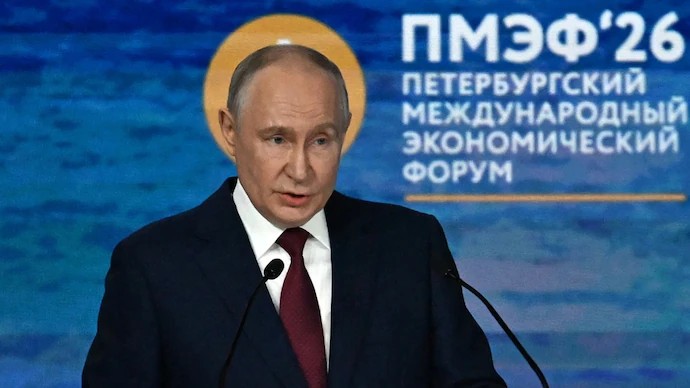
ST. PETERSBURG — Russian President Vladimir Putin strongly endorsed India's independent foreign policy stance, stating that Western attempts to exert pressure on New Delhi regarding its strategic partnership with Moscow are futile and will inevitably damage international relations. Speaking during a wide-ranging interaction with the heads of leading global news agencies at the St. Petersburg International Economic Forum (SPIEF), Putin characterized India as a "reliable partner" and commended Prime Minister Narendra Modi's leadership for steering the country’s significant economic growth.
The developments underscore how India’s policy of strategic autonomy continues to reshape global diplomacy, balancing deep ties with Russia alongside its expanding economic and security alignment with Western nations, including the United States.
Western Sanctions Pressure Termed 'Detrimental'
Addressing concerns from international journalists regarding India-Russia trade and Western discomfort over New Delhi's stance, President Putin explicitly called out efforts by external powers to alter India’s diplomatic path. According to official transcripts of the meeting, the Russian leader stated that putting diplomatic or economic pressure on a country with the largest population in the world is a counterproductive strategy that will create a "boomerang" effect against those implementing it.
Putin emphasized that India's growing engagement with Western capitals, specifically Washington, does not undermine or conflict with the time-tested bilateral relations between Moscow and New Delhi. The Kremlin views India’s diplomatic maneuvering not as a shift in alliances, but as a demonstration of a sovereign nation acting strictly in its own national and economic interest.
Expanding Economic Frontiers and the $100 Billion Target
The economic relationship between the two nations has transformed dramatically, driven heavily by Indian imports of discounted Russian crude oil. This trade surge has positioned Russia as one of India's top trading partners, though it has simultaneously widened the trade deficit in Moscow's favor.
To balance this rapidly expanding economic partnership, both nations are exploring alternative settlement mechanisms. Discussions are actively underway between financial authorities to bypass the Western-dominated SWIFT network by utilizing local currencies—the Indian Rupee (INR) and the Russian Ruble (RUB)—alongside specialized electronic payment corridors.
Mutual Commitments in Technology and Defense
Beyond hydrocarbons, Putin highlighted a shared determination to scale up cooperation in advanced technology, joint infrastructure ventures, and industrial innovation. India and Russia have a deep-seated history of co-developing military hardware, such as the BrahMos supersonic cruise missile project, and Moscow remains a key supplier of critical defense components to the Indian Armed Forces.
The Russian President reiterated that Moscow is fully committed to fulfilling its supply chain obligations to New Delhi, particularly across the defense, aerospace, and civil nuclear energy sectors. He added that Russia sees no negative consequences or strategic friction arising from India's participation in groups like the Quadrilateral Security Dialogue (Quad), recognizing that India's multi-aligned approach serves its internal growth objectives.
Official Sources Section
The statements and data detailed in this report are based on official transcripts provided by the Kremlin Press Office and the state-run Akashvani News during the St. Petersburg International Economic Forum. Additional bilateral trade projections align with recent regulatory updates from the Ministry of External Affairs, India.
Quote Section
"Everyone has understood that putting pressure on Prime Minister Narendra Modi and India, which has the largest population in the world, is detrimental to international relations and to bilateral relations. It doesn't matter where this pressure comes from. We consider India a reliable partner and we see no negative consequences from New Delhi's bilateral relations with any other country."
— Russian President Vladimir Putin, during the SPIEF global media interaction.
Why It Matters
For global markets and everyday consumers, India’s firm stance on strategic autonomy ensures it maintains access to stable, affordable energy resources, which helps curb domestic inflation and keeps manufacturing inputs competitive. For international investors, it signals that India remains a pragmatic marketplace that refuses to let external geopolitical blockades dictate its domestic economic priorities or resource procurement.
Key Facts at a Glance
Sovereignty Defended: Vladimir Putin stated that Western pressure on India to scale back relations with Moscow is counterproductive and will "boomerang."
Trade Target: The Kremlin announced an ambitious bilateral trade target of $100 billion, building on the current record-high trade volumes driven by energy imports.
No Western Conflict: Russia explicitly stated that India's deepening strategic and economic ties with the United States do not harm its long-term partnership with Moscow.
Payment Systems: Both nations continue to develop non-SWIFT financial mechanisms using local currencies to safeguard trade from unilateral sanctions.
FAQ Section
Q1: What does "strategic autonomy" mean for India's foreign policy?
Strategic autonomy is India's long-standing policy of maintaining independent decision-making in international affairs, allowing New Delhi to pursue partnerships with multiple competing powers (like Russia and the US) based strictly on its own national security and economic interests.
Q2: How has the trade dynamic between India and Russia changed recently?
Bilateral trade has jumped significantly, driven primarily by India's acquisition of Russian crude oil. The countries are now looking to diversify this trade into technology, pharmaceuticals, and manufacturing to bridge the current trade imbalance.
Q3: Does India's relationship with the US conflict with its ties to Russia?
According to both Indian officials and Russian leadership, India's engagement with Western nations does not come at the expense of its historical, time-tested partnership with Moscow. New Delhi maintains that it is not a zero-sum game.
Q4: How are India and Russia handling trade payments under Western sanctions?
The two nations are actively utilizing local currency settlement systems and exploring dedicated bank-to-bank messaging platforms to facilitate transactions outside of the Western-backed SWIFT network.
Source: Kremlin Press Office, Ministry of External Affairs, India, Akashvani News Service.