Union Commerce Minister Piyush Goyal announced an ambitious plan to boost India’s seafood exports to $30 billion within five years. Aiming to triple current $8.5 billion revenues, the strategy targets a critical transition toward high-quality, value-added products, backed by modern cold-chain infrastructure and newly signed global free trade agreements.
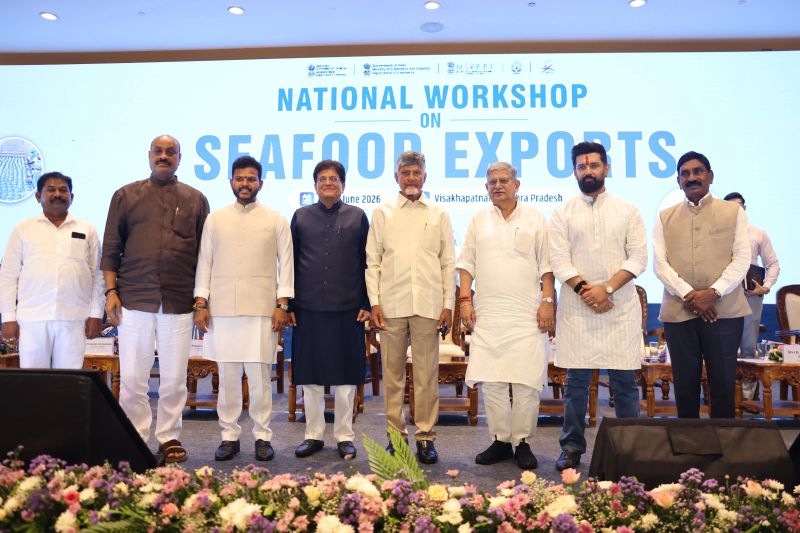
VISAKHAPATNAM — India has set an ambitious economic target to more than triple its seafood exports, aiming to reach $30 billion within the next five years. Speaking on June 5, 2026, at a national workshop on seafood exports in Visakhapatnam, Union Minister for Commerce and Industry Piyush Goyal announced that the central government is implementing a structured strategy to shift the country’s marine industry away from low-margin raw commodity shipments toward premium, value-added products and international brand building.
The policy directive comes at a pivotal moment for India's blue economy. Despite enduring steep international tariff pressures, including a protective 55.8% duty cycle implemented by the United States on certain processed segments, India’s aggregate marine shipments recently hit an all-time financial high. The new export target aims to maximize direct economic gains for small-scale local fisherfolk and regional commercial aquaculture hubs alike.
Pivoting From Commodity Volumes to Value Addition
To scale up from the current export baseline of approximately $8.5 billion, the government's roadmap requires an industrial transition. Minister Goyal noted that historical growth patterns heavily relied on the volume of unrefined raw materials, which leaves local processing houses vulnerable to global market price fluctuations.
According to official briefings from the Ministry of Commerce and Industry, the upcoming framework will actively discourage the reliance on raw commodity imports, such as raw shrimp for re-export, and prioritize local advanced processing instead. By expanding domestic manufacturing capabilities, the country plans to retain a higher margin of processing profits before products hit high-demand western and Asian supermarket shelves.
Trade Agreements to Anchor Global Market Access
A core driver for achieving the $30 billion goal is India's aggressive pursuit of bilateral trade pacts. Over the past three and a half years, New Delhi has finalized nine separate free trade agreements (FTAs) with developed economies. Industry analysts point out that these treaties significantly lower import duties on Indian goods, giving marine producers a distinct competitive price advantage in newly accessible regions.
Furthermore, market diversification has helped cushion domestic aquaculture operators from geo-economic disputes. When high US tariffs threatened the primary shrimp segment, Indian exporters successfully diverted surplus volumes to the European Union, Japan, China, and Southeast Asian countries to offset potential losses.
Infrastructure Overhaul and Regional Expansion
The joint export promotion initiative involves synchronized execution between the Department of Commerce and the Ministry of Fisheries, Animal Husbandry and Dairying. Minister Rajiv Ranjan Singh announced at the Visakhapatnam event that structural reforms are being rolled out via the Pradhan Mantri Matsya Sampada Yojana (PMMSY) program.
A major component includes the approval of a modern, technology-enabled Smart and Integrated Fishing Harbour at Kakinada, Andhra Pradesh, budgeted at ₹72.42 crore. To support logistics, Union Civil Aviation Minister Rammohan Naidu additionally confirmed plans to expand the country's cargo terminal network, pitching a "One Airport, One Product" logistics chain intended to slash customs processing windows for perishable marine goods.
Official Sources Section
The specific data points, policy plans, and ministerial directives outlined in this news report are drawn directly from official press briefings hosted by the Press Information Bureau (PIB) India, regulatory filings from the Marine Products Export Development Authority (MPEDA), and state economic addresses co-signed by the Government of Andhra Pradesh.
Quote Section
"Let's target USD 30 billion in the next five years. Take India's fish across the world. Reduce the import of raw shrimp, export value-added goods, and build strong international brands. The target can be achieved by focusing on increasing production quality and leveraging our newly signed free trade agreements."
— Piyush Goyal, Union Minister for Commerce and Industry.
Why It Matters
For commercial businesses and cold-chain logistics providers, this policy shift indicates an upcoming wave of government capital subsidies for advanced factory machinery and high-speed cargo terminal handling. For coastal and inland fisherfolk, the focus on value addition aims to insulate local market floor prices from raw global market drops, ensuring steadier, higher baseline household incomes.
Key Facts at a Glance
Ambitious Target: India's Ministry of Commerce has challenged the seafood export industry to scale up from $8.5 billion to $30 billion within five years.
Infrastructure Backing: A dedicated ₹72.42 crore Smart and Integrated Fishing Harbour has been approved at Kakinada under the PMMSY flagship framework.
Tariff Resilience: Despite facing a restrictive 55.8% tariff environment in specific Western corridors, overall shipment volumes hit a record 19.72 lakh metric tonnes last fiscal year.
Andhra Pradesh Leadership: The state remains India's dominant seafood hub, producing 55.39 lakh tonnes of aquaculture products and holding a 66% share of all shrimp exports.
FAQ Section
Q1: What is driving the sudden push for a $30 billion seafood export target?
The target is driven by India’s expanding aquaculture capacity and the strategic need to transition from a low-margin exporter of raw fish commodities into a high-revenue global supplier of processed, branded, and packaged seafood.
Q2: How will the government support small-scale fishers in reaching this goal?
Through the PMMSY scheme, the government is funding local post-harvest processing plants in coastal districts, reducing storage waste, and setting up dedicated domestic regional desks to help local cooperatives meet international sanitary standards.
Q3: Which nations are currently the biggest buyers of Indian marine products?
The United States and China remain the largest primary destinations for Indian seafood, though the European Union, Japan, and Southeast Asia are seeing fast-growing market shares due to recent tariff realignments.
Q4: What specific types of seafood dominate India's export catalog?
Frozen shrimp remains India's primary flagship export product, accounting for over two-thirds of total marine export earnings, followed closely by fresh-frozen finfish, squid, and cuttlefish.
Source: Press Information Bureau (PIB) India, Ministry of Commerce and Industry, Ministry of Fisheries, Animal Husbandry and Dairying.