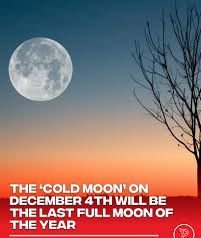





The Cold Moon, the final full moon of 2025, peaked on December 4–5, illuminating skies worldwide. Known for its crisp brilliance in winter nights, this celestial event marks the year’s last lunar spectacle. Astronomers and skywatchers celebrated its cultural significance, seasonal symbolism, and scientific importance as a natural calendar marker.
As 2025 draws to a close, the night sky offered a breathtaking farewell in the form of the Cold Moon, the year’s last full moon. Peaking on December 4–5, the Cold Moon lit up the heavens with its icy glow, captivating stargazers across continents.
The Cold Moon derives its name from the frigid December nights in the Northern Hemisphere, when winter begins to tighten its grip. Historically, this full moon served as a natural marker for agricultural communities, signaling the onset of harsher weather and shorter days.
Astronomers note that the Cold Moon’s timing is particularly significant, as it coincides with the approach of the winter solstice later in December. Its brilliance is enhanced by the Earth’s position, often appearing larger and brighter against the crisp winter sky.
Cultural traditions also celebrate this lunar event. In Native American and European folklore, the Cold Moon symbolizes reflection, closure, and preparation for renewal—a fitting metaphor as the year transitions into 2026.
Major Takeaways
Final Full Moon of 2025: The Cold Moon peaked on December 4–5.
Seasonal Symbolism: Associated with winter’s arrival and the year’s closure.
Astronomical Significance: Appears brighter due to Earth’s orbital position near solstice.
Cultural Meaning: Represents reflection, endings, and preparation for new beginnings.
Global Visibility: Observed across the Northern and Southern Hemispheres, though with varying seasonal contexts.
Notable Updates
Skywatchers reported exceptional clarity in regions with minimal cloud cover.
The Cold Moon coincided with Gemini constellation visibility, offering a dual celestial treat.
Social media buzzed with images and reflections, highlighting the moon’s role as both a scientific and cultural phenomenon.
Astronomers reminded enthusiasts that the next full moon, the Wolf Moon, will rise in January 2026.
Conclusion
The Cold Moon of December 2025 was more than a celestial event—it was a reminder of nature’s rhythm and humanity’s enduring fascination with the skies. As the last full moon of the year, it symbolized closure, reflection, and anticipation, setting the stage for a new year under the stars.
Sources: NASA Skywatching Updates, Space.com, EarthSky.