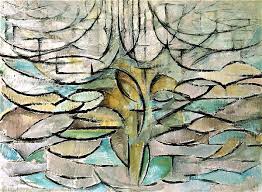







A groundbreaking study has revealed that trees depicted in paintings by renowned artists Leonardo da Vinci and Piet Mondrian follow mathematical laws of natural branching. The research, recently published in the journal PNAS Nexus, sheds light on the hidden mathematical structures embedded within these iconic artworks.
The study's key finding indicates that the parameter α in these artworks varies from 1.5 to 2.8, closely mirroring the patterns observed in real trees in nature. This suggests that the artists, either consciously or subconsciously, captured the essence of natural branching in their creations.
Researchers found that trees in these paintings follow a 'self-similar' branching pattern known as a fractal, where structures repeat at smaller scales. Leonardo da Vinci had previously observed that tree limbs maintain their thickness as they branch, employing a parameter α to determine the relationships between branch diameters. The research team expanded this concept by analyzing trees in art from various parts of the world, encompassing 16th-century Indian architecture and 20th-century abstract art.
Notably, Piet Mondrian's "Gray Tree" painting was found to adhere to branch diameter scaling with an exponent of 2.8. In contrast, his later work, "Blossoming Apple Tree," did not exhibit this characteristic, making it challenging to identify as a tree from a mathematical perspective. This discovery offers a fresh lens through which to appreciate and recreate the beauty of trees in art, bridging the gap between artistic intuition and scientific understanding.
Source: Independent