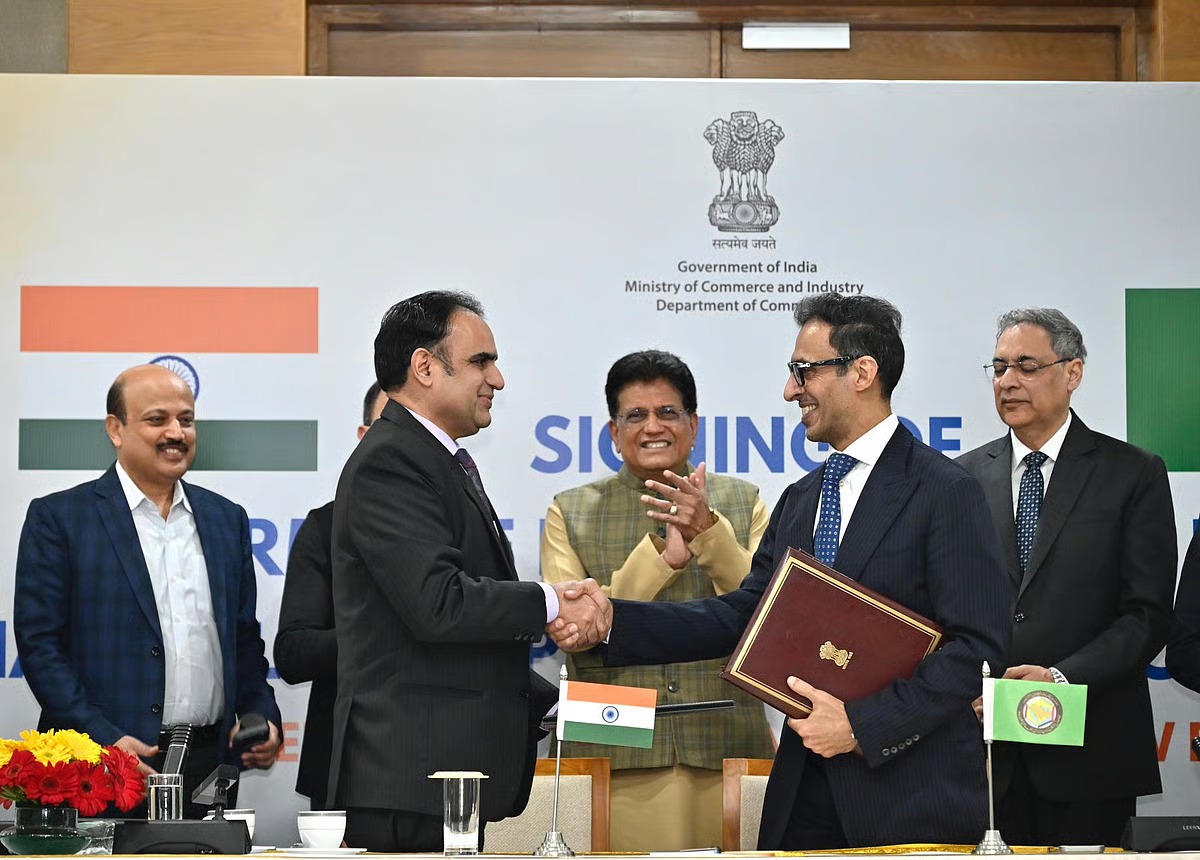

India has restarted negotiations for a Free Trade Agreement (FTA) with the Gulf Cooperation Council (GCC), comprising six Arab nations—Saudi Arabia, UAE, Qatar, Kuwait, Oman, and Bahrain. The deal is expected to expand India’s $179 billion trade with the bloc, strengthen energy security, and open new opportunities in infrastructure, ICT, and petrochemicals.
India’s renewed push for a Free Trade Agreement (FTA) with the GCC bloc marks a pivotal moment in its global economic strategy. The signing of the Terms of Reference (ToR) in New Delhi formally revives negotiations that had stalled since 2011, signaling a fresh chapter in India’s engagement with West Asia.
The GCC is one of India’s most important trading partners, with bilateral trade valued at $179 billion in FY25. The UAE alone accounts for over $100 billion annually, making it India’s third-largest partner. The proposed FTA is expected to reduce tariffs, enhance market access for Indian exports, and deepen cooperation in energy, petrochemicals, food processing, infrastructure, and ICT sectors.
Commerce Minister Piyush Goyal emphasized that the agreement would create a “robust framework” for trade and investment, while GCC officials highlighted the importance of building resilient supply chains amid global uncertainty. Analysts believe the deal could significantly strengthen India’s energy security, diversify export markets, and boost India’s strategic influence in West Asia.
Key Highlights
-
FTA revival: India and GCC sign ToR to resume talks.
-
Trade value: Current India-GCC trade stands at $179 billion.
-
Major partner: UAE contributes $100 billion in bilateral trade.
-
Sectoral gains: Energy, petrochemicals, food processing, ICT, infrastructure.
-
Strategic impact: Enhances India’s exports, energy security, and regional influence.
Sources: Firstpost, Times Now, Business Today, The Hindu