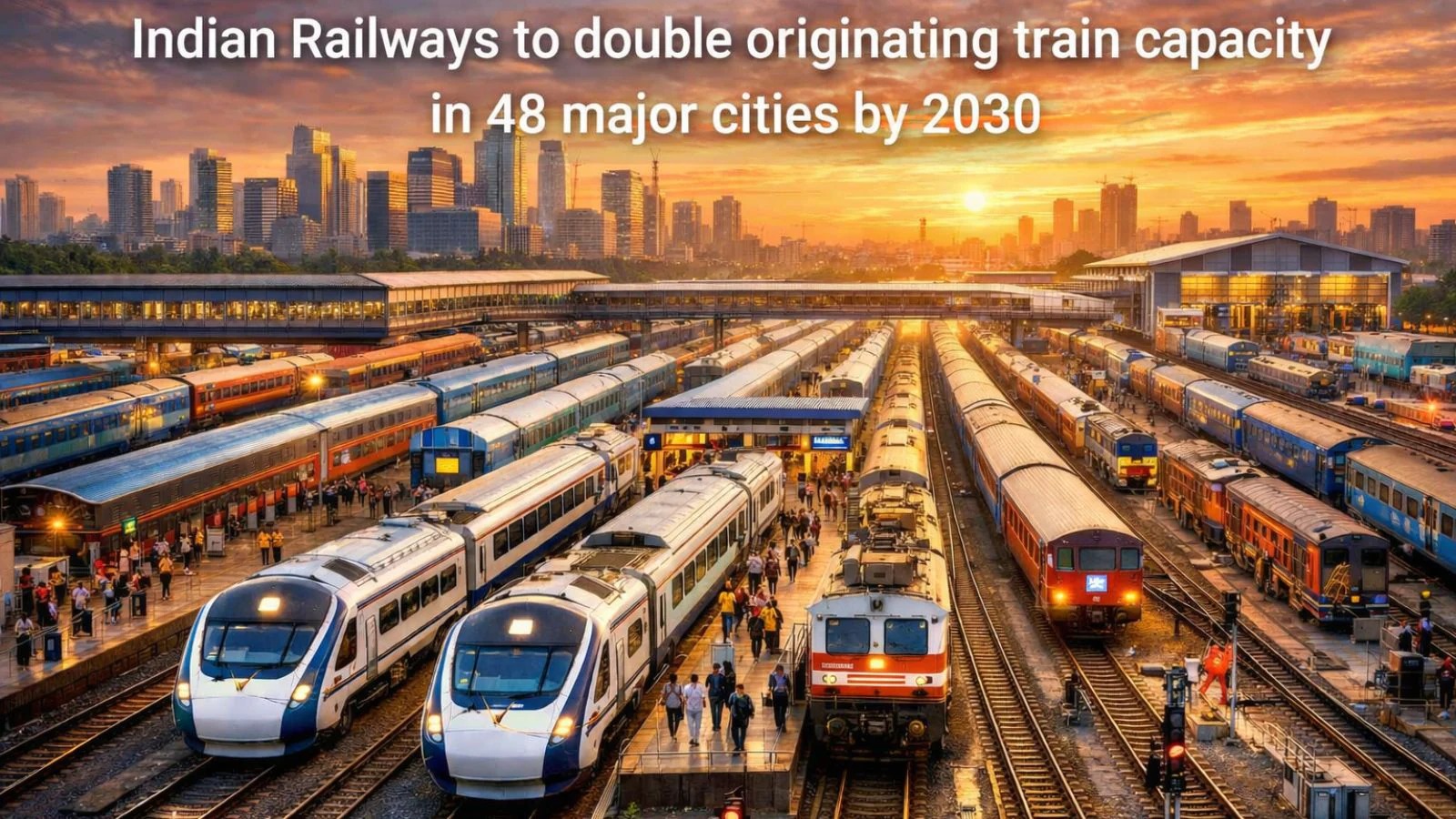






Indian Railways will double the originating train capacity in 48 major cities by 2030, with phased increases over the next five years. The plan includes augmenting existing terminals, creating new ones, developing mega coaching complexes, and upgrading signalling and multitracking to handle higher volumes, aligning with sustained travel demand growth.
Capacity Expansion Plan
The Ministry of Railways said capacity addition will be progressive, with benefits accruing immediately as works proceed. Terminals will be augmented with more platforms, stabling lines, pit lines, and shunting facilities, while new terminals will be identified and created around urban areas to distribute traffic load evenly.
Implementation And Works In Scope
The plan spans four work streams: terminal augmentation, new terminal creation, development of maintenance facilities including mega coaching complexes, and sectional capacity increases through traffic works, signalling upgrades, and multitracking. Zonal railways have been directed to raise train handling capacity across divisions to meet demand and future requirements.
Cities In Focus
The 48-city list includes metros and large hubs such as Delhi, Mumbai, Kolkata, Chennai, Bengaluru, Hyderabad, Patna, Bhopal, and Puri, with nearby stations considered to balance capacity around each terminal. For example, capacity planning around Pune factors Hadapsar, Khadki, and Alandi to spread originations and reduce bottlenecks.
Key Highlights
-
Capacity to double by 2030 with phased increases over the next five years
-
Terminals to get additional platforms, pit lines, stabling lines, and shunting facilities
-
New terminals to be created in and around urban areas for balanced traffic
-
Maintenance to be strengthened via mega coaching complexes
-
Sectional capacity to rise through signalling upgrades, traffic facility works, and multitracking
-
Nearby stations to be integrated into planning to decongest primary hubs
-
Zonal railways instructed to raise train handling capacity across divisions
Impact On Passengers And Operations
Doubling originations in major cities should reduce waitlists, improve punctuality, and expand connectivity, especially during peak travel seasons. By distributing originations across multiple terminals and strengthening maintenance and signalling, Railways aims to ease congestion and enhance reliability, setting the network up for sustained growth through 2030.
Sources: The Indian Express, CNBC-TV18, The Hindu, The Economic Times, DD News On Air, Orissa Post