


Image Source: WOWNEWS24X7
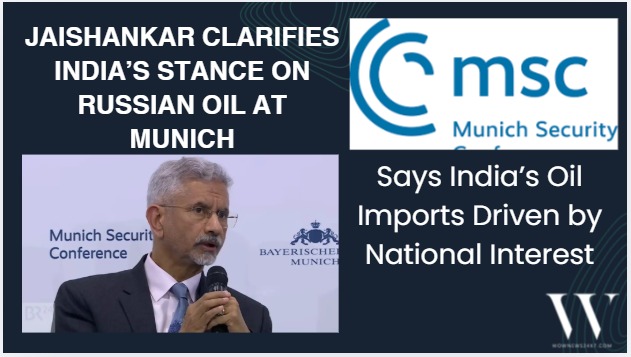
At the 62nd Munich Security Conference, External Affairs Minister S. Jaishankar dismissed claims that India would halt Russian oil imports under U.S. pressure. He emphasized India’s commitment to strategic autonomy, stating that energy procurement decisions are guided by costs, risks, and availability, not external dictates, reinforcing India’s independent foreign policy stance.
Show more
Key Highlights
-
The Context: Amid speculation that India might reduce Russian oil imports following trade agreements with the U.S., Jaishankar clarified that India remains firmly committed to strategic autonomy.
-
Jaishankar’s Statement: Speaking at a panel with German Foreign Minister Johann Wadephul, Jaishankar said, “We are very much wedded to strategic autonomy.” He stressed that India’s energy decisions are shaped by market realities rather than political pressure.
-
Energy Market Complexity: He explained that oil procurement is influenced by availability, costs, and risks, underscoring that India will continue to diversify energy sources to safeguard national interests.
-
Pushback Against U.S. Claims: Washington recently suggested that India had agreed to scale back Russian crude purchases. Jaishankar rejected this narrative, asserting that India’s choices are independent and pragmatic.
-
Strategic Autonomy Tradition: Jaishankar highlighted that India’s foreign policy has long been anchored in autonomy, adapting to global shifts while maintaining flexibility in partnerships.
-
Global Diplomacy: India’s stance signals to both allies and rivals that it will not compromise sovereignty in energy or foreign policy decisions, even amid geopolitical tensions.
Why This Matters
-
Energy Security: India, the world’s third-largest oil consumer, must balance affordability and reliability in energy imports.
-
Geopolitical Balance: By resisting external pressure, India reinforces its role as an independent actor in global geopolitics.
-
Policy Continuity: The reaffirmation of strategic autonomy assures domestic and international stakeholders of India’s consistent foreign policy approach.
-
Global Signal: India’s position at Munich strengthens its image as a multipolar power capable of navigating complex global challenges without compromising sovereignty.
Closing Note
Jaishankar’s remarks at the Munich Security Conference reaffirm India’s steadfast commitment to strategic autonomy, especially in energy procurement. By rejecting external pressure and emphasizing independent decision-making, India signals its determination to balance global partnerships with national interests ensuring sovereignty remains at the heart of its foreign policy.
Sources: Times Now, India Today, The Indian Express
Stay Ahead – Explore Now!
China-Mexico Trade Talks Signal Deeper Economic Cooperation

Advertisement
STORIES YOU MAY LIKE
Updated: February 14, 2026 18:46
Updated: February 13, 2026 17:00

Image Source: WOWNEWS24X7
Updated: February 12, 2026 17:33
Advertisement