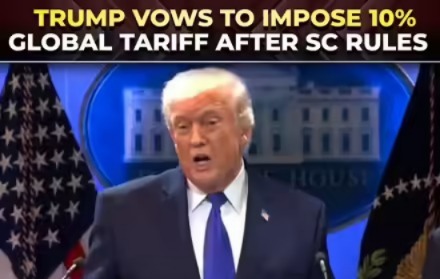





President Donald Trump signed an executive order imposing a 10 percent global tariff on imports, hours after the U.S. Supreme Court struck down his earlier sweeping tariff measures. The new order, issued under Section 122 of the Trade Act of 1974, is set to last for 150 days and has sparked global debate.
On February 20, 2026, President Donald Trump announced a fresh round of global tariffs, defying a Supreme Court ruling that invalidated his earlier reciprocal duties. The Court, in a 6–3 decision, held that Trump had exceeded his authority with broad tariff measures. In response, Trump invoked a different legal provision to impose a 10 percent global tariff across all imports.
The announcement was made at the White House, where Trump criticized the Court’s decision and accused it of being influenced by “foreign interests.” The new tariffs, framed as temporary, are expected to last 150 days but could be extended. Commerce Secretary Howard Lutnick and U.S. Trade Representative Jamieson Greer joined Trump in emphasizing that the move was necessary to protect American industries and jobs.
Global markets and trade partners are closely watching the development, as the tariffs could disrupt supply chains and increase costs. Economists warn of potential inflationary pressures, while Trump’s supporters argue the measure strengthens U.S. economic sovereignty.
Key Highlights
-
Supreme Court struck down Trump’s earlier tariff measures
-
New 10 percent global tariff imposed under Section 122 of Trade Act 1974
-
Tariffs set to last 150 days, with possible extension
-
Trump criticized Supreme Court, citing “foreign influence”
-
Global trade partners brace for economic impact
Sources: CNBC, Politico, The Hindu