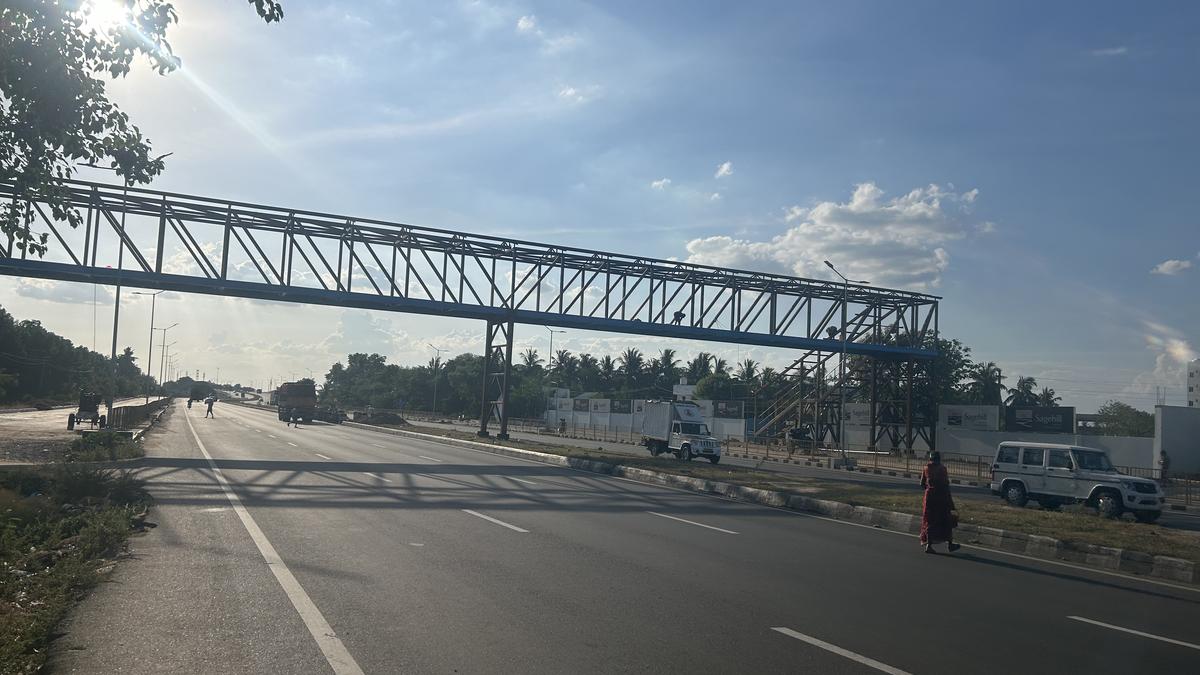
The National Highways Authority of India (NHAI) has started building two modern Foot Over Bridges at accident-prone black spots in Ocheri and Damal along the Chennai - Bengaluru Highway. Featuring safety fencing, CCTV surveillance, and disabled-accessible elevators, the project isolates pedestrian movement to prevent accidents without disrupting high-speed interstate logistics.
RANIPET - In an effort to curb commuter accidents and improve traffic safety, the National Highways Authority of India (NHAI) has officially commenced the construction of two Foot Over Bridges (FOBs) on the high-density Chennai - Bengaluru Highway (NH 48). The critical safety structures are being erected at strategically identified "black spots" segments officially designated as highly accident-prone located at Ocheri and Damal villages along the border connecting the Ranipet and Kancheepuram districts.
The initiative by the infrastructure agency directly responds to a sharp spike in transit accidents involving pedestrians attempting to cross the multi-lane national corridor.
Mitigating Peril at Critical Crossings
According to project engineers, the rapid growth of local habitations, schools, and commercial establishments on both sides of the highway carriage lanes has altered pedestrian patterns. Local residents have frequently resorted to squeezing through narrow gaps in the steel traffic medians to cross the high-speed roadway, placing themselves directly in the path of fast-moving heavy logistics and passenger vehicles.
The new structures are engineered to separate pedestrian movement entirely from the vehicular stream. By offering a protected overhead corridor, the project targets a complete elimination of pedestrian-vehicle conflicts at these two critical crossings without interrupting the heavy traffic volumes passing between the major economic hubs of Tamil Nadu and Karnataka.
Advanced Infrastructure and Inclusive Engineering
To ensure long-term accessibility, the infrastructure design incorporates dedicated safety features intended to support all sections of society, particularly senior citizens, women, and persons with disabilities.
| Infrastructure Feature | Engineering Specification | Targeted Benefit |
| Clearance Vertical Elevation | 6.5 Meters Above Carriageway | Unhindered passage for high-container freight |
| Walkway Corridor Width | 3.0 Meters | Prevents peak-hour commuter congestion |
| Security Countermeasures | CCTV Cameras & Sensor Lighting | Deters anti-social activity during night hours |
| Inclusive Access Systems | Dual Concrete Ramps & Elevators | Full accessibility for wheelchair and stretcher users |
The project blueprints mirror similar safety modernizations executed by the authority near the Christian Medical College (CMC) campus in Puttuthakku, where specialized elevators with a 16-person carrying capacity were integrated to facilitate the movement of medical patients and elderly individuals. The outer perimeters of both upcoming bridges will feature heavy-gauge steel safety fencing to eliminate any possibility of accidental falls onto the highway lanes below.
Official Sources Section
The implementation parameters, location mapping, and project objectives outlined in this report are sourced directly from project notifications published by the National Highways Authority of India. Local site demands and public safety feedback parameters align with public field reviews issued by regional district administration offices and state police data on highway black spot mitigation.
Quote Section
"According to officials from the National Highways Authority of India, standard arterial design guidelines dictate that dedicated pedestrian crossings or underpasses should ideally be positioned every 1.5 kilometers in high-density zones to ensure civilian safety."
"Project engineers stated that initially planned underpass alternatives were dropped because extensive subterranean excavation would cause severe traffic disruptions and prolonged construction delays on this vital interstate trade route."
Why It Matters
The construction of these foot over bridges delivers practical benefits to a wide spectrum of regional stakeholders. For the thousands of rural residents, students, and daily wage laborers in Ocheri and Damal, the structures remove a daily threat to life, providing an entirely isolated, well-lit path across a high-speed transit corridor.
For commercial logistics operators, regional transport businesses, and long-distance motorists using NH 48, the elimination of unpredictable pedestrian crossings reduces sudden braking incidents, helps preserve smooth cargo transit speeds, and lowers liability risks. Furthermore, the installation of round-the-clock surveillance and modern illumination enhances basic security across the expanding suburban periphery of the Ranipet industrial zone.
Key Facts at a Glance
Targeted Locations: New pedestrian facilities are being constructed at high-risk black spots in Ocheri and Damal villages.
Safety Isolation: Steel perimeter fencing will be installed along the highway median to prevent pedestrians from crossing at road level.
Modern Amenities: The installations will include weatherproof protective shelters, automated sensor lighting, and high-definition CCTV security cameras.
Universal Access: The engineering designs feature built-in ramps and mechanized lifts to support disabled individuals and senior citizens.
Frequently Asked Questions
Why did NHAI choose Ocheri and Damal for these foot over bridges?
Both locations were officially flagged as "black spots" by regional law enforcement and road transport authorities due to a high volume of pedestrian accidents caused by rapid local population growth and commercial setups on both sides of the highway.
Will the construction work cause major traffic jams on the Chennai-Bengaluru Highway?
No. NHAI opted for pre-cast overhead footbridges specifically to minimize on-site concrete mixing and long-term lane closures. The choice avoided deep underpass excavations that would have throttled vehicular movement.
How do these structures accommodate individuals with limited mobility?
The design parameters mandate the inclusion of extended accessibility ramps alongside high-capacity mechanical lifts, ensuring that wheelchair users, patients, and senior citizens can navigate the elevation safely.
Sources: