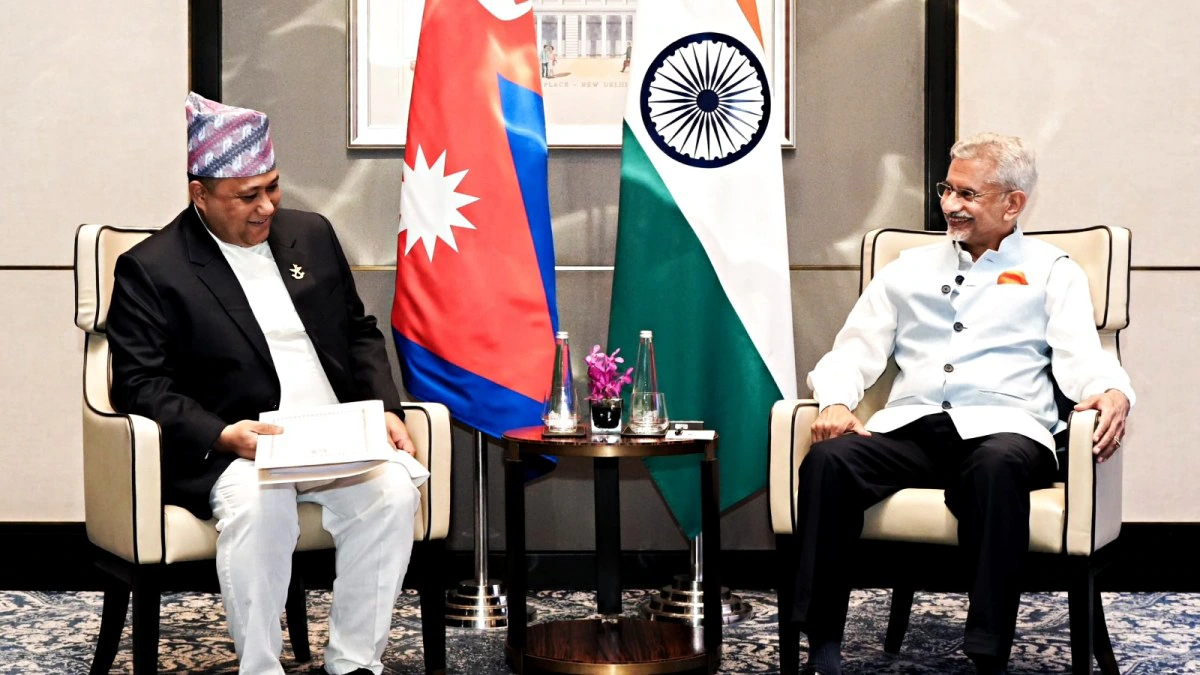
Nepal Foreign Minister Shisir Khanal announced in New Delhi that the relationship with India is Kathmandu’s highest priority, asserting the new government carries "no old baggage." Coordinated talks with S. Jaishankar expanded cross-border hydropower exports to 941 MW and launched a joint AI translation project, stabilizing ties after recent border friction.
NEW DELHI — In a major diplomatic effort to stabilize South Asian cross-border dynamics, Nepal's newly appointed Foreign Minister Shisir Khanal announced that Kathmandu has placed the highest priority on its relationship with India. Speaking during high-level bilateral talks in the Indian capital, Khanal explicitly stated that the newly elected administration carries "no old baggage" and is firmly resolved to build a transformative, result-driven relationship with its southern neighbor. The high-profile visit marks the first formal ministerial engagement between the two countries since Prime Minister Balendra Shah took office in Kathmandu, signaling a mutual effort to move past recent border friction.
Shifting the Trajectory of Bilateral Ties
The official diplomatic meetings, held in New Delhi, focused heavily on expanding economic ties, building cross-border infrastructure, and strengthening energy trade. According to official briefings published by The Hindu, Indian External Affairs Minister S. Jaishankar welcomed the Nepali delegation, stating that both nations now share an unprecedented opportunity to decisively shift the trajectory of India-Nepal relations to realize their full economic potential.
The emphasis on moving forward with "no old baggage" follows a brief period of diplomatic tension. Last month, a border flare-up occurred when New Delhi dismissed territorial claims raised by Kathmandu regarding the resumption of the traditional Kailash Mansarovar Yatra through the Lipulekh Pass crossing in Uttarakhand.
By intentionally keeping contentious territorial boundary debates out of their primary public readouts, both foreign ministers chose instead to focus on functional areas of agreement. However, diplomatic sources confirmed that joint field survey teams are actively working along the shared border, and both sides have agreed to convene an early session of the formal border management mechanism to resolve outstanding issues through quiet, friendly dialogue.
Strategic Energy Pacts and Digital Innovation
A central pillar of the modern India-Nepal relationship is cooperation in the clean energy sector. Under long-term power trading guidelines established by the two countries, India has set a target to import 10,000 megawatts (MW) of hydropower from Nepal over the next decade.
Data from the Ministry of External Affairs confirms that India's Central Electricity Authority recently cleared additional power exports from 12 Nepali hydropower projects. This brings Nepal's total permitted electricity sales to India to 941 MW across 28 distinct projects, providing reliable revenue for Kathmandu while supplying clean energy to Indian state distribution grids in Haryana and Bihar.
Beyond infrastructure and energy, the New Delhi meeting also expanded bilateral cooperation into digital technology. The ministers witnessed the formal signing of a Memorandum of Understanding (MoU) between Digital India Bhashini and Kathmandu University. This partnership will co-create a specialized national digital infrastructure for a "Voice First" language translation platform in Nepal, utilizing artificial intelligence to bridge regional communication gaps.
Official Sources Section
The framework agreements, energy transmission statistics, and joint statements are based directly on official press releases from the Indian Ministry of External Affairs and the Ministry of Foreign Affairs of Nepal. Background details on power trade volumes and regional distribution metrics reflect data verified by the Central Electricity Authority of India, while the institutional translation platform goals match the signed digital infrastructure blueprints.
Quote Section
"According to officials from the Ministry of External Affairs, there are strong structural complementarities between the good governance objectives outlined by the new administration in Kathmandu and the regional initiatives spearheaded by India."
"Organizers stated that the entry into force of the India-Nepal Mutual Legal Assistance Agreement in Criminal Matters will provide an essential institutional legal framework to combat cross-border crimes effectively."
Why It Matters
The reset in the relationship with India carries practical implications for regional trade stability, corporate energy investors, and millions of citizens who cross the open border daily. By prioritizing practical economic cooperation over historic border disputes, Nepal secures a reliable market for its expanding hydropower surplus and ensures uninterrupted supplies of vital commodities like fuel and fertilizers. For India, a stable relationship with Kathmandu counters expanding extra-regional influence in the Himalayas and protects critical open-border security arrangements.
Key Facts at a Glance
Highest Priority Status: Nepal’s new government has formally designated its relationship with India as its top diplomatic priority, moving forward with "no old baggage."
Hydropower Expansion: Total approved Nepali electricity exports to Indian state grids have risen to 941 MW from 28 distinct generation projects.
AI Technology Pact: A new partnership between Digital India Bhashini and Kathmandu University will develop a customized voice translation platform for Nepal.
Legal Security Alliance: Both nations have finalized the internal protocols required to activate the India-Nepal Mutual Legal Assistance Agreement in Criminal Matters.
Frequently Asked Questions
What did the Nepal Foreign Minister mean by "no old baggage"?
Minister Shisir Khanal emphasized that the new administration in Kathmandu is focusing on future-oriented economic, energy, and digital cooperation rather than letting historical border disputes stall bilateral progress.
How much electricity does Nepal export to India?
Nepal is currently authorized to export 941 MW of hydropower to India from 28 approved projects, with a long-term bilateral goal of reaching 10,000 MW within the next ten years.
Did the two countries discuss the recent Lipulekh Pass border dispute?
While official readouts focused primarily on trade and connectivity, diplomatic sources confirmed that joint field survey teams are active and both nations have agreed to address border issues through an upcoming formal management mechanism.
Sources: