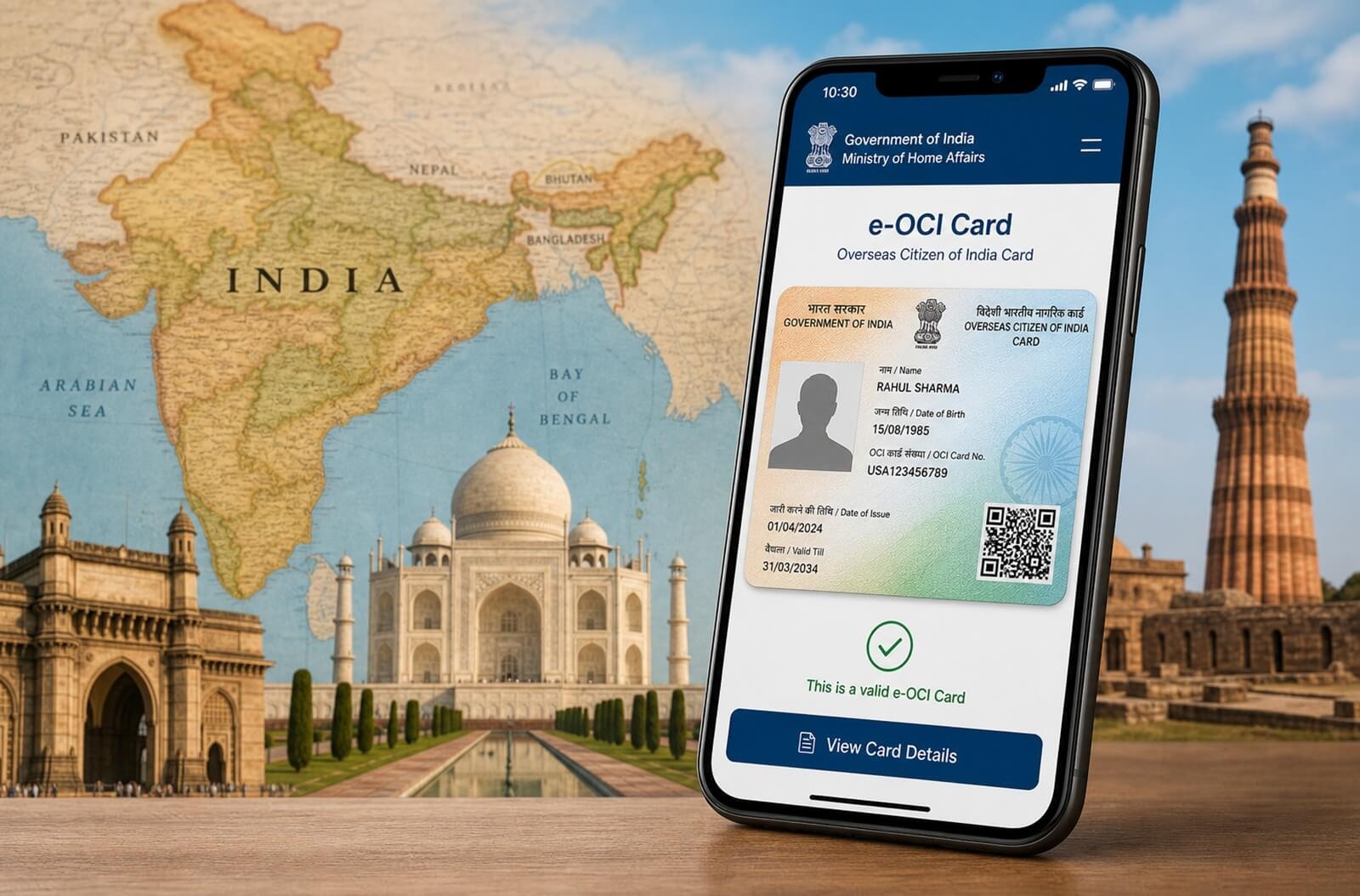
The article examines how the Overseas Citizenship of India (OCI) card is successfully converting the nation's historical "brain drain" into a major "brain gain" wave. Backed by a fully digital e-OCI overhaul in 2026 and long green card backlogs abroad, the card allows elite tech and AI talent to seamlessly return and lead advanced innovation hubs across India.
NEW DELHI, INDIA — The Overseas Citizenship of India (OCI) card has emerged as a central pillar in reversing the nation's historical "brain drain," transforming it into a definitive "brain gain" cycle. Financial and immigration analyses released on Sunday, June 21, 2026, reveal that a record number of highly skilled Indian-origin professionals, scientists, and tech innovators are choosing to return to India.
Driven by expanding backlogs in Western permanent residency systems and supported by recent comprehensive digital upgrades to India's overseas citizenship framework, the OCI card is successfully bringing top global talent back onto home soil. This shift marks a vital economic turning point today, helping the country build long-term leadership in critical next-generation technology fields.
Retaining AI and Engineering Leadership Amid Western Hurdles
For decades, the emigration of elite engineering and scientific graduates from premier institutions was viewed as a unilateral loss of human capital. However, the economic trajectory has shifted over the past two years. Data from global immigration studies indicates that more than one million Indian professionals remain caught in the United States employment-based green card backlog, facing wait times that can stretch for decades. Faced with this uncertainty, skilled professionals are increasingly looking at India as a primary destination for long-term career growth.
The OCI card provides the perfect administrative tool to capture this returning talent pool. Granting holders a multiple-entry, lifelong visa along with the legal right to live and work in the country indefinitely, the card eliminates the bureaucratic friction normally associated with cross-border relocation. This ease of movement has proven especially vital for the artificial intelligence (AI) and semiconductor sectors. Returning researchers are increasingly using their global experience to anchor complex R&D initiatives right here in India.
Global Capability Centres Shift from Cost Savings to Core Innovation
This influx of skilled human capital has completely changed how multinational corporations approach the Indian market. Historically utilized for basic back-office outsourcing and cost savings, India's network of Global Capability Centres (GCCs) has transitioned into hubs for high-end product design and global enterprise transformation.
According to executive tracking data published by TeamLease Digital, the share of mid-to-senior specialized professionals within local GCC setups has climbed significantly, rising from 63 percent in 2023 to an expected 77 percent by the end of this year. Returning professionals are stepping directly into strategic leadership positions, helping bridge prominent domestic talent gaps in specialized fields:
Artificial Intelligence and GenAI: Addressing a 40–55% talent gap in core modeling and neural network architectures.
Data Engineering: Designing large-scale cloud infrastructure stacks for international enterprise operations.
Cybersecurity: Establishing proactive global threat-monitoring protocols and security frameworks.
The 2026 Policy Overhaul: Digital Efficiency and Border Modernization
To better accommodate this influx of global talent, the Ministry of Home Affairs (MHA) and the Bureau of Immigration rolled out a comprehensive modernization of the OCI scheme. The structural updates phase out manual paper processing in favor of a fully centralized digital architecture known as e-OCI. Under the revised rules, eligible foreign nationals can apply for an OCI card without having to complete a mandatory six-month stay in India, drastically reducing administrative delays for families relocating on short notice.
Furthermore, the physical OCI booklet has now become optional, supplemented by a digital card record linked directly to upgraded biometric verification gates at major international airports. This integration enables real-time matching of passport and OCI data, allowing returning scientists, corporate executives, and engineers to clear border control via rapid automated e-gates.
Official Sources Section
The operational rules, digital portal structures, and compliance timelines are governed by the Citizenship (Amendment) Rules 2026 issued by the Ministry of Home Affairs and administered via the official Bureau of Immigration portal. Labor market shifts and hiring percentages within Global Capability Centres align with specialized industry tracking reports compiled by TeamLease Digital.
Quote Section
Commenting on the strategic value of returning tech professionals, Neeti Sharma, Chief Executive Officer at TeamLease Digital, explained the evolving corporate landscape:
"In India, the demand for specialised, premium talent is increasing consistently. For all global companies, India is transitioning from a cost-arbitrage play to a highly skilled talent hub. Returning professionals are not just being hired for execution, but also as strategic anchors to build new capability stacks and lead enterprise-wide transformation."
Why It Matters
For the Indian economy, the transition from brain drain to brain gain accelerates local innovation, builds strong intellectual property pipelines, and reduces reliance on foreign tech architecture. For returning families, the OCI card provides complete legal certainty and parity with resident Indians across financial and educational fields, allowing them to build long-term investment, research, and entrepreneurial roots in India without losing their global mobility.
Key Facts at a Glance
Lifelong Status: The OCI card grants individuals multiple-entry, lifelong visa privileges to live and work indefinitely in India.
The 2026 Shift: Recent legal updates introduce a fully digital e-OCI platform, removing the previous six-month domestic stay requirement for applicants.
GCC Expansion: Mid-to-senior hiring within India-based Global Capability Centres has risen significantly, projected to capture 77% of total sector hiring this year.
Backlog Trigger: Ongoing H-1B visa caps and decade-long green card backlogs in the US act as primary drivers pushing talent to return home.
Immigration Speed: Upgraded biometric protocols link e-OCI files to automated e-gates at Indian airports, enabling faster border clearance.
FAQ Section
Q: Does holding an OCI card grant an individual full Indian citizenship?
A: No. The OCI card acts as a long-term, multi-purpose visa. Cardholders are not entitled to vote in elections, hold constitutional public offices, or acquire agricultural and plantation properties in India.
Q: What are the key compliance rules introduced under the 2026 OCI framework?
A: OCI holders must complete a digital e-arrival card before boarding flights to India. Additionally, whenever a cardholder renews their foreign passport, they must upload the updated details to the online OCI portal within three months to avoid a USD 25 fine.
Q: Can the foreign spouse of an Indian citizen apply for an OCI card immediately?
A: Under the updated 2026 rules, a foreign spouse can apply as soon as they arrive in India on a valid long-term visa, provided their marriage has been legally registered and continuous for a minimum period of two years prior to the application date.
Source: Ministry of Home Affairs (MHA) India, Bureau of Immigration OCI Portal Services, TeamLease Digital Annual Employment Insights.