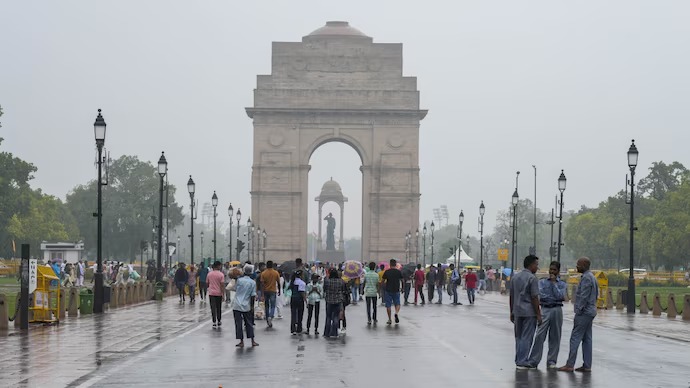
This news report covers the delayed arrival of the southwest monsoon in New Delhi for the 2026 season. While the system reached Kerala on June 4, its progress northward has stalled due to weak pressure systems and a transition toward El Niño conditions. Meteorologists project below-normal seasonal rainfall, creating potential water and agricultural challenges for Northwest India.
NEW DELHI — The India Meteorological Department (IMD) confirmed on June 21, 2026, that the southwest monsoon’s progress into Northwest India, including the National Capital Region (NCR) of Delhi, is experiencing a brief deceleration. While the seasonal weather system set in over Kerala on June 4, its subsequent advancement across central and northern plains has slowed. Concurrently, global climate models reveal a transition toward El Niño conditions in the equatorial Pacific, prompting meteorologists to forecast below-normal rainfall patterns for the region over the coming months.
Delhi Weather Facing Extended Dry Spell
According to the latest extended-range weather bulletin issued by the Regional Meteorological Centre in New Delhi, atmospheric conditions over Haryana, Chandigarh, and Delhi will remain mostly dry heading into late June. The northern limit of the monsoon has stalled temporarily across central India, with the frontline passing through parts of Maharashtra, Telangana, and Bihar.
While isolated thunderstorms and light, transient patch rains are expected due to a weak Western Disturbance passing over the Western Himalayan region, substantial monsoon precipitation in Delhi is delayed. This delay prolongs the hot and humid conditions experienced by residents, with maximum temperatures consistently hovering between 39°C and 41°C.
Expert Explains Reasons Behind the Monsoon Delay
Meteorologists attribute the stalling of the southwest monsoon to a lack of strong low-pressure systems over the Bay of Bengal, which typically act as structural drivers pushing moisture deep into the northern plains.
Furthermore, data from the Monsoon Mission Climate Forecast System (MMCFS) indicates that ENSO-neutral conditions in the Pacific Ocean are rapidly shifting. The emergence of these El Niño anomalies frequently correlates with suppressed convective activity over the Indian subcontinent, disrupting the steady progression of moisture-laden winds toward Northwest India.
Forecast Predicts Below-Normal Seasonal Rainfall
The long-range seasonal forecast updated by the IMD highlights a deficit trend. For the country as a whole, cumulative rainfall measured since the official June 1 start of the season has registered roughly 26% to 35% below the Long Period Average (LPA).
This deficit is expected to hit the agricultural and water management sectors of Northwest India hardest. Farmers in neighbouring agrarian states like Punjab and Haryana, who heavily rely on early monsoon showers for sowing summer crops like paddy, are adjusting schedules to rely more heavily on tube-well irrigation and groundwater reserves.
Official Sources Section
The underlying metrics, dates, and atmospheric readings cited in this report originate directly from official documentation published by the India Meteorological Department (IMD) and the Ministry of Earth Sciences, Government of India. Additional regional data updates were monitored via the Regional Meteorological Centre (RMC) in New Delhi.
Quote Section
"According to officials at the India Meteorological Department, conditions remain favorable for the monsoon to creep into remaining parts of Maharashtra, Chhattisgarh, and parts of South Bihar by June 23. However, its northward push into the plains of Uttar Pradesh, Haryana, and Delhi faces a temporary hiatus due to weak standard trough lines and unfavorable global Pacific indices."
Why It Matters
The timeline of the monsoon directly impacts regional power grids, municipal water availability, and retail market economics. Delaying the cooling rains forces municipal corporations to ration water, drives power consumption to peak thresholds due to air conditioning usage, and introduces inflationary pressures on essential summer crops.
Key Facts at a Glance
Monsoon Arrival Delay: The southwest monsoon set in over Kerala on June 4, 2026, but its advance toward Delhi has hit a temporary plateau.
Deficit Statistics: National cumulative rainfall figures for the opening weeks of June stand at a 26% to 35% deficit against historical averages.
The El Niño Factor: The Monsoon Mission Climate Forecast System confirms an active transition toward El Niño conditions, which typically suppresses precipitation.
Delhi Outlook: The National Capital Region will see isolated light rain from minor Western Disturbances, but structural, heavy monsoon downpours are delayed until late June or early July.
FAQ Section
Q1: When does the monsoon normally reach Delhi?
The standard, historically observed date for the monsoon's arrival in New Delhi is June 27. Current projections suggest the system will miss this standard window by several days.
Q2: What is causing the below-normal rainfall prediction?
The primary driver is the shifting of atmospheric temperatures in the equatorial Pacific Ocean toward an El Niño state. This warms the ocean surface there, altering global wind currents and reducing the intensity of India's monsoon system.
Q3: Will Delhi remain completely dry until the monsoon arrives?
No. The capital will experience sporadic, localized thundershowers driven by localized humidity and passing Western Disturbances. However, these are pre-monsoon activities and do not signal the arrival of the continuous seasonal system.
Source: