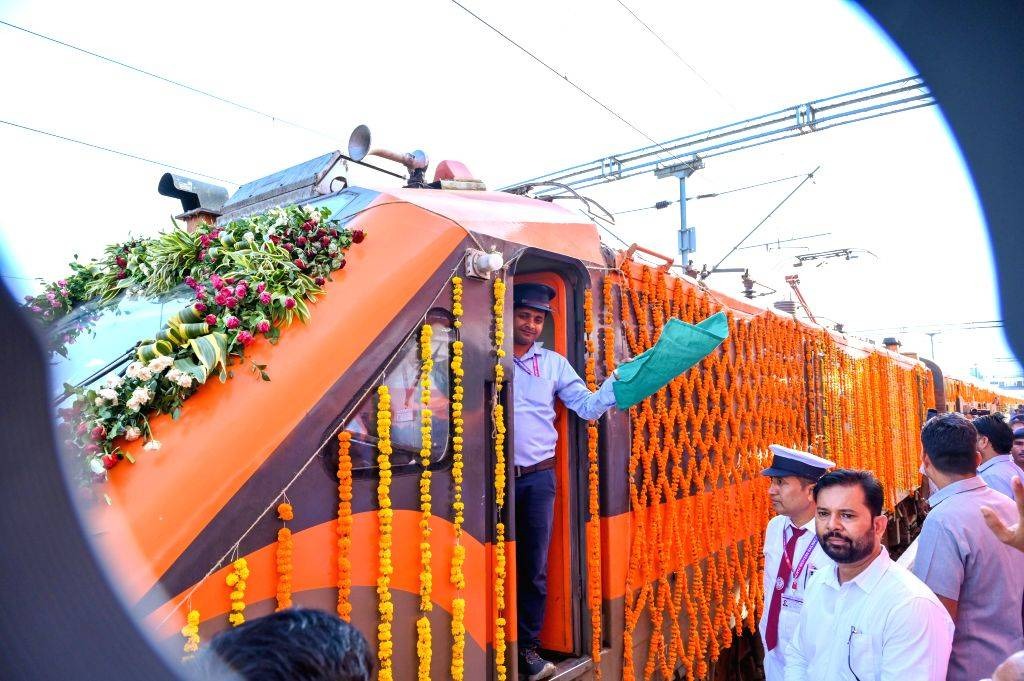
Union Railway Minister Ashwini Vaishnaw and Rajasthan CM Bhajanlal Sharma flagged off the Jaipur-Darbhanga Amrit Bharat Express and opened the ₹205-crore Khatipura Mega Coaching Terminal. The new train improves travel options to Bihar, while the advanced terminal scales up local maintenance capacity to 450 trains monthly.
JAIPUR — Union Railway Minister Ashwini Vaishnaw and Rajasthan Chief Minister Bhajanlal Sharma officially flagged off the new Jaipur (Khatipura)–Darbhanga Amrit Bharat Express on June 21, 2026. The launch coincided with the formal opening of the newly built ₹205-crore Khatipura Mega Coaching Terminal in Jaipur. According to the North Western Railway (NWR) zone, these major infrastructure deployments are strategically engineered to strengthen cross-state mobility between Rajasthan and Bihar while relieving long-standing operational bottlenecks at core urban transit hubs.
Mega Coaching Terminal at Khatipura Open for Operations
The newly operational Mega Coaching Terminal at Khatipura represents a structural upgrade designed to manage long-term passenger volume growth. Built at an estimated cost of ₹205 crore, the terminal layout has been structured to scale with railway capacity demands for the next 20 years. The engineering configuration includes advanced stabling lines, comprehensive washing pits, and multi-tier technical bays capable of handling LHB, Vande Bharat, and DEMU train rakes at a unified site.
The primary administrative objective of shifting operations to Khatipura is to ease heavy traffic saturation at the primary Jaipur Junction. Officials confirmed that the terminal is technically equipped to inspect and maintain roughly 450 trains every month. This maintenance capacity establishes Jaipur as a foundational processing hub for cross-regional corridors extending toward Delhi, Jodhpur, and Bikaner.
Direct High-Capacity Connectivity to Bihar
The newly introduced Khatipura (Jaipur)–Darbhanga Amrit Bharat Express (Train 19725/19726) will run six days a week, bridging the cultural and commercial gap between Rajasthan and Bihar's Mithila region. The train utilizes specialized push-pull technology, operating non-air-conditioned coaches fitted with enhanced internal shock-absorption, ergonomics, and safety standards.
The standard service rake consists of 22 cars, structured with 11 general coaches, 8 sleeper compartments, a pantry car, and 2 guard/luggage modules. The route spans a distance of approximately 1,164 kilometers over a 26-and-a-half-hour timeline, stopping at 23 intermediate stations including Dausa, Bharatpur, Agra, Kanpur Central, Aishbagh (Lucknow), Gorakhpur, and Sitamarhi.
Regional Impact on Industry and Pilgrimage
Economic analysts indicate that the new rail services will significantly lower logistics and transport hurdles for thousands of migrant workers, small traders, and students moving along the Rajasthan-Uttar Pradesh-Bihar axis. Additionally, the infrastructure push includes a newly announced railway station at Sundarpura in Sikar district. This future link is located roughly 11 kilometers from the prominent Khatu Shyamji shrine and is expected to systematically handle hundreds of thousands of annual devotees who previously lacked direct, high-capacity rail connectivity close to the temple site.
Official Sources Section
The operational blueprints, funding statements, and scheduled routes outlined in this coverage originate directly from statements released by the Ministry of Railways and administrative notifications published by the North Western Railway (NWR) zone.
Quote Section
"According to officials present at the flag-off ceremony, India's railway network capacity is undergoing systematic expansion. The Khatipura terminal is the first of 50 planned nationwide mega hubs meant to sustain 450 train inspections a month, enabling the smooth rollout of long-distance economic train corridors."
Why It Matters
Establishing perimeter terminals like Khatipura stops metropolitan city centers from choking under heavy train traffic. For everyday passengers, it translates directly into fewer signal delays outside stations, cleaner and faster rake turnaround times, and highly affordable long-distance links between growing economic zones.
Key Facts at a Glance
Financial Investment: The modern Mega Coaching Terminal at Khatipura was commissioned at an initial cost of ₹205 crore.
Maintenance Bandwidth: The new railway facility is fully equipped to maintain nearly 450 trains monthly.
Train Frequency: The Jaipur-Darbhanga Amrit Bharat Express will run six days a week, utilizing a 22-coach push-pull rake system.
Transit Horizon: The route maps across 1,164 kilometers, establishing essential economic linkages across 23 station halts.
Pilgrimage Expansion: A new station at Sundarpura has been confirmed to provide dedicated transit access to the Khatu Shyamji shrine.
FAQ Section
Q1: What makes the Amrit Bharat Express different from standard express trains?
The Amrit Bharat Express operates on specialized push-pull technology with engines at both the front and rear, enabling rapid acceleration and deceleration. It features completely non-air-conditioned sleeper and general coaches equipped with updated interior layouts, better charging points, and smoother suspension systems at budget-friendly fares.
Q2: How does the new Khatipura terminal affect passengers using Jaipur Junction?
By moving the primary cleaning, stabling, and originating schedules of several long-distance trains to Khatipura, operational pressure on Jaipur Junction drops significantly. This cuts down on train delays caused by platform unavailability at the central station.
Q3: Which major cities are linked on the new Jaipur-Darbhanga route?
The train establishes direct travel links across a vast swath of northern and eastern plains, connecting major stations like Bharatpur, Agra, Kanpur Central, Aishbagh (Lucknow), Gonda, Gorakhpur, and Sitamarhi before reaching Darbhanga.
Source: