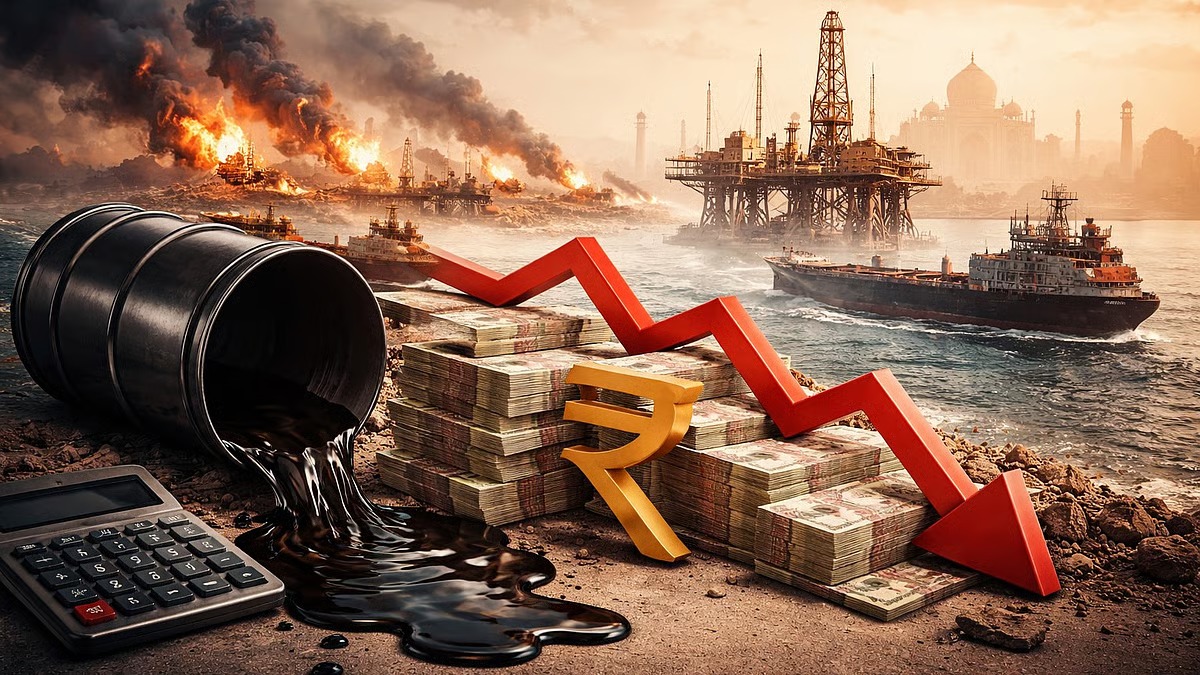
The US-Iran conflict that erupted in early March 2026 is no longer a distant geopolitical event for India it is a live economic emergency. With Brent crude crossing $110 a barrel, the Strait of Hormuz disrupted, and over 220,000 Indian workers repatriated from the Gulf, India's $3.8 trillion economy is absorbing shocks on five simultaneous fronts.
How It Began And Why It Hit Hard
The conflict broke out on March 2, 2026, triggering an immediate surge in crude oil prices from $69 to over $100 a barrel within weeks. India, which imports approximately 90 percent of its crude oil and nearly half of its LPG through the Strait of Hormuz, found itself at the epicentre of the supply shock. Bloomberg noted that about half of India's crude and over three-fourths of its LPG imports transit the Strait now effectively disrupted making the exposure structural, not incidental.
The Oil And Energy Shock
India's Consumer Price Index is forecast to jump to 3.8 percent in April 2026 up from 3.4 percent in March as the 40 percent energy price spike feeds through to consumers. Brent crude touched $109.64 a barrel in late April, while the World Bank currently assumes crude averaging $90 to $100 per barrel for the year with easing only in the second half. Emkay Global has calculated that every $10 per barrel rise in oil prices widens India's current account deficit by 0.5 percent of GDP, adds 35 basis points to retail inflation, and shaves 15 to 20 basis points off GDP growth a compounding pressure that is now running in sequence.
Rupee, Stocks, And Growth Under Pressure
Since the beginning of 2026, India's key equity indices have already fallen approximately 12 percent due to capital flight. The Indian rupee has depreciated nearly 10 percent against the US dollar over the past year, with global equity research firm Bernstein warning it could slide beyond Rs 110 to the dollar in a prolonged conflict scenario. India's GDP growth, which was expected to run at 7 percent for FY27, may now slip below that threshold with several brokerages estimating a potential 1 percent haircut to growth if the conflict drags into the second half of 2026.
The RBI's Five-Risk Warning
The Monetary Policy Committee, led by RBI Governor Sanjay Malhotra, has formally flagged five transmission channels through which the Iran war threatens India's economic stability.
Iran War Economic Impact Highlights
- Elevated crude oil prices are feeding directly into imported inflation and widening India's current account deficit
- Energy market disruptions are affecting fertilisers and industrial inputs, reducing output across agriculture, industry, and services
- India needs 17 million tonnes of urea by August 2026, but a shortfall of 2 million tonnes is pushing the fertiliser subsidy bill toward a record $18 billion
- LPG cylinder prices have already risen by Rs 60, leading to visible changes in household cooking behaviour in lower-income segments
- Essential Commodities Act was invoked on March 9, 2026, to ration gas distribution as supply pressure intensified
- Over 220,000 Indian workers repatriated from Gulf nations, threatening remittance inflows that form a critical balance-of-payments buffer
- India's equity markets have lost approximately 12 percent in 2026 so far, eroding the wealth effect that had been supporting premium consumption
- Heightened global risk aversion is tightening domestic financial conditions and raising the cost of corporate borrowing
- Qatar's force majeure declaration on LNG contracts has added another layer of energy supply insecurity for India
The Remittance Risk Few Are Talking About
India is the world's largest recipient of remittances, with the Gulf region accounting for a disproportionate share of those inflows. Economic downturns across Gulf Cooperation Council nations triggered by conflict-related uncertainty and oil revenue volatility could significantly reduce employment opportunities for Indian workers, hitting the very segment of the population that relies on these transfers as its primary income source. The ISAS, NUS has noted that reduced remittance flows would not only hurt household consumption in states like Kerala, Uttar Pradesh, and Bihar but could also weaken India's broader external account position at exactly the moment it needs foreign exchange resilience.
Can India Hold Its Ground?
India did enter 2026 with inflation near a multi-year low of 2.75 percent in January, giving policymakers some room to absorb the shock before it becomes politically untenable. Finance Minister Nirmala Sitharaman initially described the crude impact as manageable, and the government has so far resisted passing full price increases through to consumers at the pump. The World Bank has noted that credible macro management and strong inflation anchoring give India a cushion but also warned that a gradual pass-through of oil prices to consumers remains the single largest risk to keeping inflation within the RBI's 2 to 6 percent tolerance band for the rest of the year.
Sources: BBC, Reuters, Bloomberg, Indian Express, Times of India, The Diplomat, CNBC, OilPrice.com, ISAS NUS, Economic Times, India Today