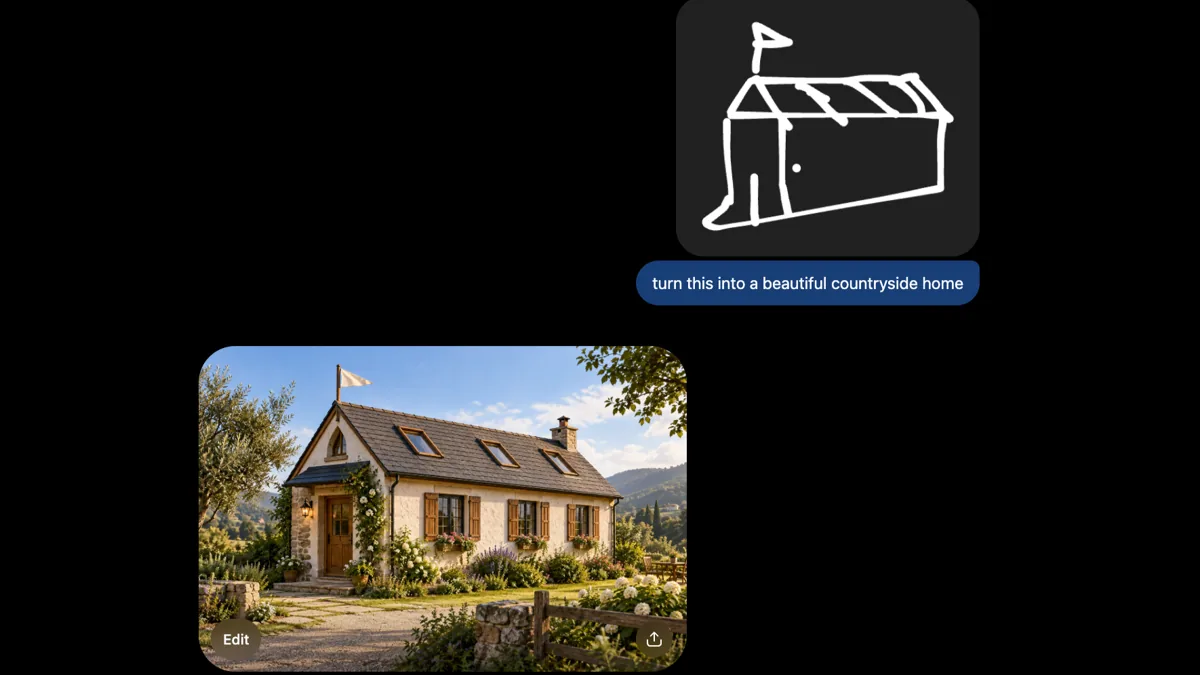
OpenAI has released Images 2.5, introducing a Sketch canvas that enables ChatGPT users to turn doodles into detailed images. The feature pairs rough line drawings with descriptive prompts to maintain spatial accuracy, while cutting generation latency by 50 percent across consumer and developer platforms.
SAN FRANCISCO — Artificial intelligence research company OpenAI rolled out a feature update on Wednesday that enables ChatGPT users to turn doodles into detailed images directly within the chat interface. The capability, titled "Sketch," arrives as part of the company's deployment of its ChatGPT Images 2.5 architecture, which reduces generation latency by up to 50 percent while improving multi-turn editing accuracy. The launch marks an important shift in generative software development, moving consumer tools away from purely text-based prompts toward spatial, multi-modal interaction models that allow creators and enterprise teams to communicate visual compositions more precisely.
Technical Rollout of the Sketch Interface
The new Sketch feature operates via an embedded interactive digital canvas accessible across desktop, web, and mobile versions of ChatGPT. Users can summon the drawing canvas using an inline command or toolbar button, sketch basic wireframes, object outlines, or color zones, and submit the drawing alongside written descriptive prompts.
OpenAI indicated that the underlying Images 2.5 system uses the hand-drawn sketch as a structural coordinate map. Rather than treating the drawing purely as an abstract visual reference, the model analyzes line contours, spatial positioning, and compositional boundaries. By combining these geometric references with supplementary natural-language descriptions, the software can turn doodles into detailed images that preserve the layout intended by the user.
In addition to sketch ingestion, the updated architecture introduces localized commenting, allowing users to highlight specific sections of an output image to request targeted alterations without degrading surrounding elements. The release also adds pre-configured creative templates tailored for commercial merchandise mockups, event flyers, and digital posters.
Latency Reductions and Model Performance
According to company benchmark releases, the Images 2.5 upgrade addresses long-standing issues surrounding reference-photo consistency, spatial comprehension, and processing delays. Earlier image generation models frequently struggled to maintain subject facial structures and environmental lighting across sequential revision requests.
OpenAI stated that the refreshed pipeline generates completed outputs up to two to four times faster depending on the deployment tier. Alongside the consumer rollout, the developer application programming interface (API) received two distinct backends: GPT-Image-2.5 Flare, optimized for low-latency batch processing in external production platforms, and GPT-Image-2.5 Sunburst, designed for complex, high-resolution rendering tasks.
The developer platform improvements are already being integrated into external design ecosystems, including Adobe Firefly and collaborative media generation suites, where commercial teams require precise control over digital asset generation.
Commercial and Operational Impact Across Sectors
The ability to turn doodles into detailed images introduces practical operational implications across creative, commercial, and technical disciplines:
For Concept Designers and Marketers: Advertising agencies, digital illustrators, and interior designers can quickly mock up room layouts, garment silhouettes, or packaging prototypes using rough pen strokes, significantly reducing pre-visualization timelines.
For General Consumers: Casual users without specialized graphic design training or advanced prompt-engineering skills can visualize complex personal ideas without struggling to describe complex spatial arrangements using text alone.
For Software Developers: Enterprise software builders integrating the GPT-Image API can incorporate drawing canvases into customer-facing mobile applications, offering end-users intuitive layout editing features.
For AI Competitors: The introduction of native sketch-to-image workflows places immediate competitive pressure on rival suites, such as Google Imagen, Midjourney, and Stability AI, accelerating the convergence of text, visual editing, and canvas interfaces into unified platforms.
Official Sources
OpenAI officially detailed the rollout in its technical product release bulletin, confirming general availability across free, Plus, Team, and Enterprise service tiers. Developers can examine model documentation and pricing schedules through the OpenAI Product Platform. Technical framework standards and visual interface specifications are cataloged directly in the OpenAI Documentation repository.
Quote Section
"Every week, people create more than three billion images across ChatGPT and the API," according to official product documentation published by the company. "The integration of Sketch allows creators to anchor visual generations directly to their original concepts, giving users significantly greater control over visual composition, lighting, and texture fidelity."
Why It Matters
Text-to-image technology has historically suffered from an "intent gap"—the disconnect between an idea in a creator's mind and the text tokens required to describe it to a neural network. Complex spatial instructions, such as placing an object in the upper right background while aligning lighting from the lower left, frequently fail when communicated solely through conversational prompts.
By allowing users to turn doodles into detailed images, the platform bridges this gap with geometric input. Users do not need artistic proficiency; simple stick figures, boxes, or rough lines provide sufficient spatial bounding for the model to render high-resolution assets. This lowers the operational barrier for corporate prototyping, product packaging mockups, and retail storyboarding, moving generative software further toward standard industrial design pipelines.
Key Facts at a Glance
Feature Name: Sketch, embedded within the ChatGPT Images 2.5 ecosystem.
Core Function: Enables users to turn doodles into detailed images by combining rough digital sketches with textual context.
Efficiency Gains: Up to 50 percent lower generation latency compared to the preceding Images 2.0 deployment.
Enterprise Availability: Released globally across web, desktop, and mobile ChatGPT clients, with accompanying API models for third-party commercial integration.
Frequently Asked Questions
How does ChatGPT turn doodles into detailed images?
The Sketch tool opens an in-app canvas where users draw a line sketch. The underlying Images 2.5 model interprets the shapes, perspective lines, and layout, applying user-provided text descriptions to render a fully realized, high-resolution image.
Do users need graphic design experience to use the Sketch tool?
No. The system is designed to interpret rough sketches, basic geometry, and stick-figure outlines, relying on its trained visual weights to supply realistic textures, shading, and anatomical consistency.
Is the Sketch feature available to all ChatGPT subscription tiers?
Yes. OpenAI confirmed that ChatGPT Images 2.5 and the Sketch canvas are rolling out to free users, Plus subscribers, and enterprise workspace accounts on desktop, web, and mobile platforms.
Source: Official technical documentation, model specifications, and product announcements published by OpenAI and developer API guidelines on the OpenAI Platform.