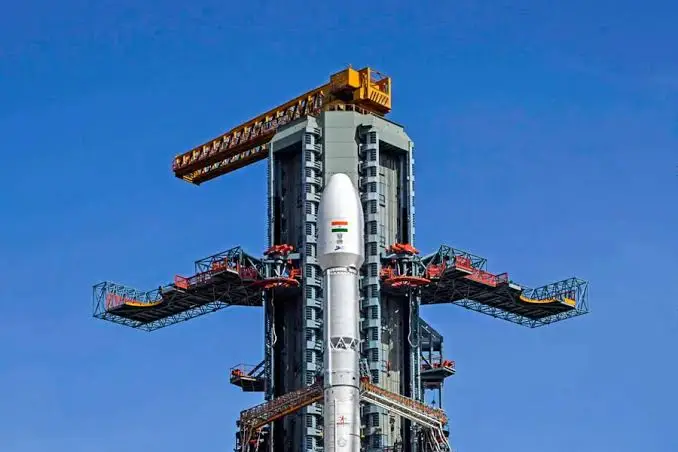
ISRO Chairman V Narayanan has hailed the successful launch of the GSLV-F17 mission, which placed the 2,367 kg EOS-05 satellite into geosynchronous orbit. Dubbed an orbital "eye in the sky," the healthy spacecraft will provide continuous real-time imaging and strategic environmental monitoring across India.
SRIHARIKOTA — Indian Space Research Organisation (ISRO) Chairman V Narayanan announced the successful execution of the GSLV-F17 mission on Friday, confirming that the advanced Earth Observation Satellite (EOS-05) was precisely injected into its intended orbit.
Liftoff occurred at 2:55 AM from the second launch pad at the Satish Dhawan Space Centre in Sriharikota following a 27.5-hour countdown. Weighing 2,367 kg, EOS-05 is the heaviest satellite ever lifted by the Geosynchronous Satellite Launch Vehicle (GSLV). Operating from an altitude of roughly 36,000 kilometers, the satellite will function as a high-altitude "eye in the sky," delivering continuous monitoring data and frequent regional imaging.
Mission Milestones and Geo-Imaging Capabilities
The GSLV-F17 flight marks the 19th operational deployment of India’s Geosynchronous Satellite Launch Vehicle. The three-stage vehicle powered through its ascent, successfully separating the spacecraft into a sub-geosynchronous transfer orbit after a 19-minute flight sequence.
ISRO officials confirmed that telemetry data indicates the spacecraft's solar panels have deployed smoothly and its onboard systems remain in optimal health. Over the coming days, mission controllers will execute orbit-raising maneuvers to lock the satellite into its permanent geo-platform position. As India's first dedicated geo-imaging observation satellite, EOS-05 is equipped with advanced visible, infrared, multi-spectral, and hyperspectral imaging payloads designed to track weather patterns, monitor cyclones, and provide rapid inputs for disaster management and agricultural planning.
According to mission disclosures, space agency briefings, and official updates:
Payload Weight: 2,367 kg, marking the highest payload capacity achieved by a GSLV mission.
Orbital Altitude: Deployed initially via Sub-GTO, heading toward a final geostationary synchronisation altitude of ~36,000 km.
Imaging Frequency: Designed to provide continuous monitoring and repeated scans of India and neighboring regions.
Future Launch Pipeline: ISRO has targeted six additional missions through the remainder of the current financial year.
Official Sources Section
Quote Section
"According to ISRO Chairman V Narayanan, 'I am very happy to announce that the GSLV-F17 vehicle has successfully and precisely injected the advanced earth observation satellite EOS-05 into the intended and required orbit, and the health of the satellite is perfectly alright.'"
Why It Matters
For strategic resource management, meteorological forecasting, and disaster mitigation, EOS-05 provides uninterrupted, real-time data streams previously unattainable from low-earth orbit constraints. The mission's success also validates India's heavy-lift indigenous propulsion capabilities, reinforcing commercial and scientific trust in the GSLV platform.
Key Facts at a Glance
Launch Vehicle: GSLV-F17 (19th flight).
Payload: EOS-05 Earth Observation Satellite.
Launch Site: Satish Dhawan Space Centre, Sriharikota.
Significance: India's first dedicated imaging satellite stationed in geosynchronous orbit.
FAQ Section
What makes the EOS-05 satellite unique for India's space program?
EOS-05 is India's first dedicated Earth observation satellite placed directly into geosynchronous orbit, enabling continuous regional monitoring from an altitude of 36,000 km.
How heavy was the payload carried by the GSLV-F17 rocket?
The rocket successfully lifted 2,367 kg, establishing a new benchmark for payload capacity on this vehicle class.
What are the primary applications of the EOS-05 mission?
The satellite supports rapid weather tracking, disaster warning, cyclone and cloudburst monitoring, and agricultural and forestry resource evaluation.
Where can space enthusiasts track future ISRO mission updates?
Official launch schedules and technical write-ups are regularly published through the ISRO Official Portal.
Source: Indian Space Research Organisation, Press Information Bureau, Hindustan Times Space Desk, ANI News