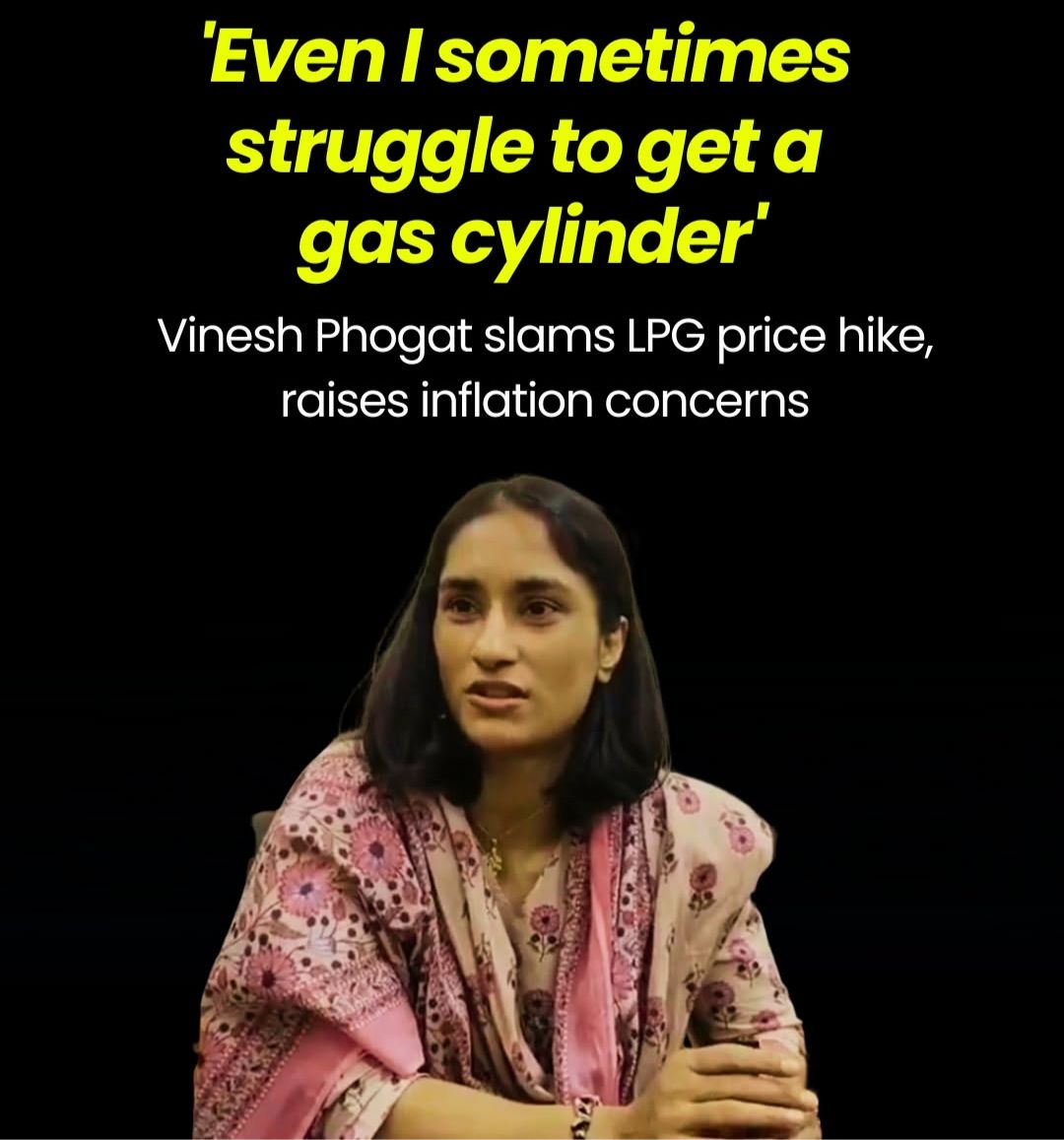
Congress MLA and former Olympian Vinesh Phogat publicly criticized the central government following a ₹29 hike in domestic LPG cylinder prices on June 7, 2026. Phogat warned of intensifying inflation impacting households. Meanwhile, the Petroleum Ministry defended the pricing, citing persistent ₹700 under-recoveries and global market volatility.
NEW DELHI — In a direct challenge to central economic policies, newly elected Congress MLA and celebrated former Olympian Vinesh Phogat publicly condemned the recent surge in domestic LPG cylinder prices on Sunday. Speaking in New Delhi following her participation in the wrestling selection trials for the 2026 Asian Games, Phogat raised deep concerns regarding escalating inflation rates and their immediate economic pressure on common Indian households. Her remarks arrived on the precise day state-run oil marketing companies instituted a fresh price hike on domestic fuel containers nationwide.
Phogat Highlights Everyday Household Burden
Expressing solidarity with ordinary citizens, Phogat emphasized that the rising cost of essential commodities is becoming unmanageable for the middle and lower-income classes. She remarked on the systemic difficulty of securing basic utilities under the current economic climate, drawing attention to the broader national impact.
"Gas prices have been hiked for the third time, and they are set to rise further," Phogat told reporters during her media address. "Rahul Gandhi is highlighting this to the entire nation; it is evident to everyone. The inflation has just started. In the coming time, is it going to become more intense? Even I sometimes struggle to get a gas cylinder."
Beyond macroeconomic critiques, Phogat, who recently won her assembly seat in Jind, Haryana, shifted focus to upcoming local governance processes. She explicitly referenced the upcoming Special Intensive Revision (SIR) of electoral rolls in Haryana, cautioning administrative authorities against systemic discrepancies. "SIR is starting in Haryana. Fake voters shouldn't be included, and real voters shouldn't be excluded," she stated.
Government Defends Price Structural Mechanics
Data issued by state-run oil entities confirmed that the retail price of a standard 14.2-kilogram domestic LPG cylinder escalated by ₹29 effective Sunday, June 7, 2026. In the national capital of Delhi, this adjustment pushes consumer costs up to ₹942 from the previous baseline of ₹913. This marks the third structural upward revision observed this year, following an extensive ₹60 hike implemented on March 7, which arose from global supply line disruptions linked to ongoing West Asia conflicts.
In response to growing public friction, representatives from the Ministry of Petroleum and Natural Gas clarified the underlying subsidy frameworks that shield the lowest-earning demographics. According to official ministerial releases, the state continues to absorb massive under-recoveries to prevent retail prices from mirroring raw international supply metrics.
Joint Secretary Sujata Sharma, during an inter-ministerial briefing held in New Delhi, outlined that the government faces persistent under-recovery margins hovering in the range of nearly ₹700 per domestic cylinder. Sharma attributed recent demand fluctuations to enhanced domestic administrative checks, such as the implementation of strict 25-day and 45-day booking cycles alongside the deployment of Delivery Authentication Code (DAC) verifications to prevent retail diversion to unauthorized commercial channels.
Official Sources Section
Statements and financial metrics contained in this report are compiled from official press releases by the Press Information Bureau (PIB), public transcripts of the Ministry of Petroleum and Natural Gas briefings, and formal spot-rate declarations published by Indian Oil Corporation Limited (IOCL).
Quote Section
"As far as the under recovery on LPG domestic cooking cylinder is concerned, it is still in the range of almost 700 rupees... [The government has] taken several steps to ensure adequate LPG availability, including increasing domestic production and securing imports."
— Sujata Sharma, Joint Secretary, Ministry of Petroleum and Natural Gas
Why It Matters
The persistent climbing cost of domestic cooking gas carries severe practical implications for consumer disposable income across India. Because cooking fuel represents an inelastic necessity for everyday sustenance, continuous retail price hikes force lower-income and fixed-salary families to cut back expenditures on health, education, and nutrition. For investors and market analysts, rising domestic fuel costs amplify core retail inflation fears, potentially influencing future central bank interest rate interventions.
Key Facts at a Glance
Price Adjustment: Domestic LPG cylinder retail prices increased by ₹29, moving Delhi retail rates from ₹913 to ₹942.
Political Criticism: Congress MLA Vinesh Phogat utilized the 2026 Asian Games wrestling trials platform to highlight growing public distress over multi-stage fuel hikes.
Under-Recovery Gaps: The central government reports spending roughly ₹700 in subsidies per domestic cylinder to offset true market supply costs exceeding ₹1,600.
Subsidy Protection: Enrolled beneficiaries of the Pradhan Mantri Ujjwala Yojana (PMUY) remain insulated, paying a concessionary rate of ₹642.
FAQ Section
Why did domestic LPG cylinder prices increase again?
State-run oil marketing companies adjusted the domestic retail rate by ₹29 due to shifting international energy supply benchmarks and high import costs tied to geopolitical frictions in West Asia.
What is the exact price of a domestic gas cylinder now?
As of June 7, 2026, a standard 14.2-kg domestic LPG cylinder costs ₹942 in Delhi. Prices vary marginally across different states based on local freight and taxation policies.
Do Ujjwala Yojana beneficiaries have to pay the new rate?
Beneficiaries under the Pradhan Mantri Ujjwala Yojana receive targeted direct financial support, meaning they pay an effective price of ₹642 per cylinder refill.
What measures is the government taking to stabilize gas supplies?
The Ministry of Petroleum and Natural Gas has increased domestic production targets, secured long-term import pipelines, and restricted commercial diversion using Delivery Authentication Code (DAC) tracking.
Source: Press Information Bureau, Ministry of Petroleum and Natural Gas, All India Radio News / ANI