Prime Minister Narendra Modi has launched the "Modified UDAN" scheme, a ₹28,840-crore initiative to revitalize regional air connectivity in India. The policy introduces extended subsidies, direct government funding, and infrastructure development, including 100 new aerodromes, aimed at making air travel more accessible and sustainable for remote and underserved regions.
The newly inaugurated "Modified UDAN" scheme aims to expand India’s aviation network with a ₹28,840 crore outlay, targeting deeper reach into remote and underserved regions.
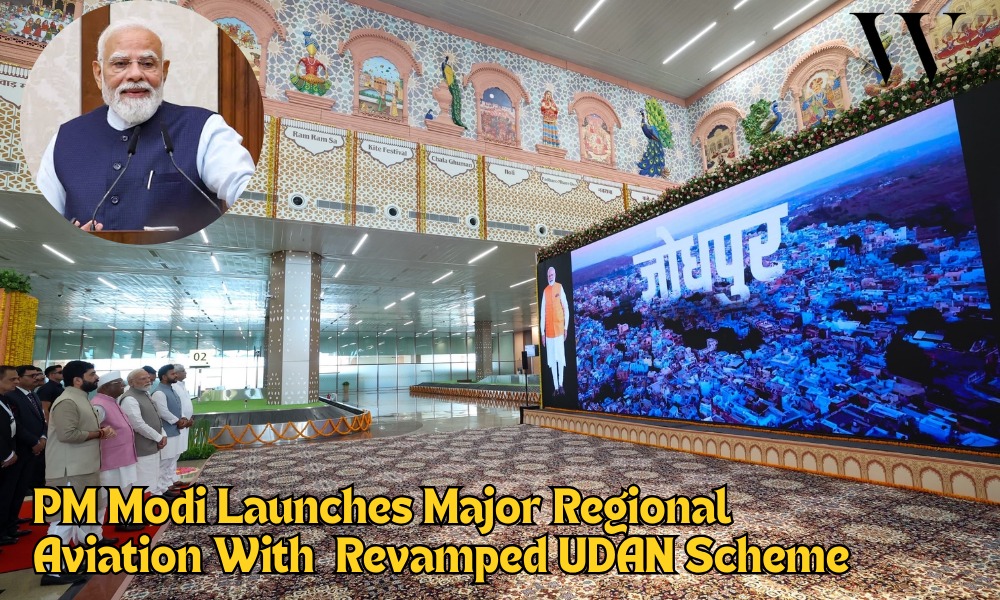
JODHPUR — Prime Minister Narendra Modi officially launched the next phase of the Regional Connectivity Scheme (RCS), known as "Modified UDAN," on Saturday, July 4, 2026. The launch, held in Jodhpur, Rajasthan, marks a strategic pivot in the government’s efforts to democratize air travel and integrate Tier-2 and Tier-3 cities into the national economic mainstream.
The revamped initiative, which replaces the original 2016-era framework, is backed by a historic budgetary commitment of ₹28,840 crore over the next ten years. During his visit, the Prime Minister also inaugurated a state-of-the-art New Terminal Building at Jodhpur Airport, further signaling the government’s commitment to world-class aviation infrastructure.
Transforming Regional Air Connectivity
The Modified UDAN scheme is designed to address sustainability challenges that hindered the success of earlier phases. According to the Ministry of Civil Aviation, the new framework shifts the funding model directly to the central government exchequer, ending the previous reliance on levies imposed on commercial air tickets.
"The launch of the Modified UDAN scheme with a historic outlay marks the beginning of a new chapter in India’s aviation journey," said Union Minister of Civil Aviation Ram Mohan Naidu Kinjarapu. The scheme’s primary focus includes the development of 100 new aerodromes from currently unserved airstrips and the construction of 200 modern helipads, aimed at enhancing last-mile connectivity in hilly, remote, and island regions.
Strategic Components of the New Policy
The Modified UDAN Scheme focuses on four key strategic pillars to ensure long-term viability and operational stability:
Extended Viability Gap Funding (VGF): The subsidy window for airline operators has been extended from three to five years, providing a longer runway for routes to achieve market self-sufficiency.
Infrastructure Expansion: A dedicated allocation of ₹12,159 crore is set for capital expenditure on regional aerodromes, alongside ₹3,661 crore for helipad development.
Operations & Maintenance (O&M) Support: To prevent the abandonment of low-traffic airports, the government will now subsidize recurring O&M costs for regional aerodromes.
Indigenous Procurement: In alignment with the Atmanirbhar Bharat initiative, the scheme includes provisions to procure locally manufactured aircraft, such as HAL Dhruv helicopters and HAL Dornier planes, to navigate India’s diverse and difficult terrains.
Impact on Passengers and Economy
The expansion of the regional connectivity scheme is expected to benefit approximately 4 crore passengers over the next decade. By lowering barriers to entry for airlines and reducing operational risks, the policy aims to make air travel more affordable for a broader demographic, ranging from farmers and entrepreneurs to students and tourists.
The new Jodhpur airport terminal, built at a cost of ₹480 crore, serves as a model for the future of Indian aviation infrastructure. Spanning over 23,000 square meters, it is designed to handle 20 lakh passengers annually and features modern baggage handling, advanced security screening, and aerobridges—setting a benchmark for regional hubs across the country.
Official Sources
Information regarding the scheme’s rollout and fiscal allocation was provided by the Press Information Bureau (PIB) and the Ministry of Civil Aviation. Technical details on airport infrastructure were confirmed by the Airports Authority of India (AAI).
Why It Matters
The launch of the Modified UDAN scheme represents a critical evolution in India’s infrastructure planning. By providing sustained operational support and prioritizing indigenous manufacturing, the government is moving toward a more resilient, technology-driven aviation ecosystem. This ensures that regional connectivity is no longer just a pilot project but a permanent feature of the Indian growth story as it advances toward its 2047 development goals.
Key Facts at a Glance
Budgetary Outlay: ₹28,840 crore allocated for the period 2026–2036.
Infrastructure Target: Development of 100 new aerodromes and 200 modern helipads.
Subsidy Reform: VGF support for airlines extended from 3 to 5 years.
Focus Areas: Emphasis on hilly, remote, and aspirational districts for improved last-mile connectivity.
Terminal Milestone: New Jodhpur terminal capable of handling 1,500 passengers per peak hour.
FAQ
What is the primary goal of the Modified UDAN scheme?
The scheme aims to enhance regional air connectivity, making air travel affordable and accessible to Tier-2 and Tier-3 cities while ensuring the long-term operational viability of regional routes.
How does this version differ from the original 2016 scheme?
The revamped policy extends subsidies to five years, shifts funding from ticket levies to direct government budgetary support, and includes dedicated O&M subsidies for regional airports.
What is the impact on local infrastructure?
The scheme mandates the development of 100 new aerodromes and 200 helipads, aiming to modernize aviation access in underserved districts.
Source: Ministry of Civil Aviation, Press Information Bureau, Airports Authority of India