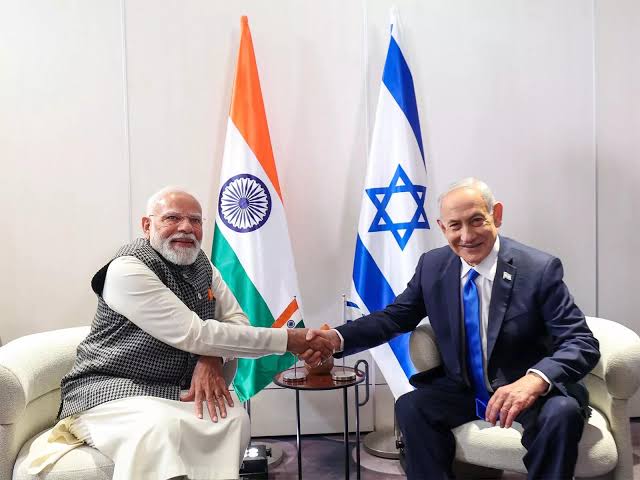
Prime Minister Narendra Modi and Israeli Prime Minister Benjamin Netanyahu held a phone conversation on August 6, 2026, reviewing the India-Israel Special Strategic Partnership. The leaders discussed security developments in West Asia, reaffirmed commitments to expand trade, defense, and technology ties, and agreed to maintain continuous diplomatic communication.
NEW DELHI — Indian Prime Minister Narendra Modi and Israeli Prime Minister Benjamin Netanyahu engaged in a high-level telephonic conversation on August 6, 2026, to review the sustained progress of the India-Israel Special Strategic Partnership and assess evolving security developments across West Asia. The dialogue between the two heads of government underscores New Delhi's proactive diplomatic engagement in maintaining regional stability while accelerating long-term bilateral economic and defense commitments.
High-Level Engagement Directs West Asia Diplomacy
During the call initiated by Tel Aviv, both leaders conducted a comprehensive assessment of recent regional developments in West Asia, where maritime supply channels and regional security remain subject to close international monitoring. Prime Minister Modi reaffirmed India's diplomatic posture emphasizing dialogue, de-escalation, and the preservation of international shipping routes vital for global energy security and supply chain continuity.
The conversation reflects established diplomatic channels between New Delhi and Tel Aviv amid wider regional volatility. Both leaders noted that stability in West Asia is essential not only for regional peace but also for global economic resilience, particularly given the importance of commercial navigation across key maritime transit corridors.
India-Israel Strategic Framework Advances Economic Integration
Beyond security assessments, the telephonic discussion focused on consolidating the India-Israel Special Strategic Partnership across defense, agriculture, water management, innovation, and cybersecurity. The dialogue follows recent milestones in economic cooperation, including progress on the proposed India-Israel Free Trade Agreement (FTA) and the operational enforcement of the updated Bilateral Investment Agreement designed to protect international investments and expedite dispute resolution.
Bilateral Investment: Enhanced regulatory protections under the new bilateral treaty aim to boost mutual capital flows beyond the current $1 billion mark.
Technology Transfer: Joint initiatives in artificial intelligence, semiconductors, and cybersecurity remain core pillars of bilateral technological integration.
Agricultural Innovation: Expansion of joint Centers of Excellence across Indian states continues to improve local water management and crop yield techniques.
Official Sources Section
According to official releases from the Prime Minister’s Office (PMO) in New Delhi and public communications issued by the Ministry of External Affairs (MEA), the two leaders reviewed the sustained progress under the bilateral framework and reaffirmed their commitment to expanding cooperation for mutual benefit across multiple industrial and defense sectors.
Quote Section
According to officials at the Prime Minister's Office, "The two leaders reviewed sustained progress in the India-Israel Special Strategic Partnership and reaffirmed their commitment to further strengthening bilateral cooperation across various sectors for the mutual benefit of both countries. PM Netanyahu and PM Modi exchanged views on recent developments in West Asia and agreed to remain in touch."
Why It Matters
The direct communication between Prime Minister Modi and Prime Minister Netanyahu highlights India's strategic balancing act in West Asia. By keeping diplomatic channels open with key regional partners, India protects its strategic energy interests, safeguards millions of Indian expatriates working across the Gulf region, and secures critical technological partnerships essential for national defense modernization.
Key Facts at a Glance
Bilateral Review: Leaders evaluated the India-Israel Special Strategic Partnership spanning defense, agriculture, and high technology.
Regional Context: Discussions addressed security developments in West Asia and the protection of international commercial shipping lanes.
Economic Milestones: Follows ongoing negotiations for a comprehensive Free Trade Agreement and implementation of a bilateral investment framework.
Diplomatic Consensus: PM Modi and PM Netanyahu agreed to maintain ongoing communication as regional conditions evolve.
Frequently Asked Questions
What was the main outcome of the phone call between PM Modi and Benjamin Netanyahu?
The two leaders reviewed the progress of the India-Israel Special Strategic Partnership, discussed security developments across West Asia, and agreed to maintain close contact.
How does India benefit from its strategic partnership with Israel?
India gains access to advanced defense technology, agricultural water management systems, cybersecurity expertise, and growing bilateral trade and investment opportunities.
Why is the West Asia situation critical to Indian economic interests?
West Asia is a primary supplier of crude oil and natural gas to India, home to over eight million Indian overseas workers, and a key corridor for international commercial shipping.
Source: Prime Minister's Office (PMO) India, Ministry of External Affairs (MEA), Press Information Bureau (PIB).