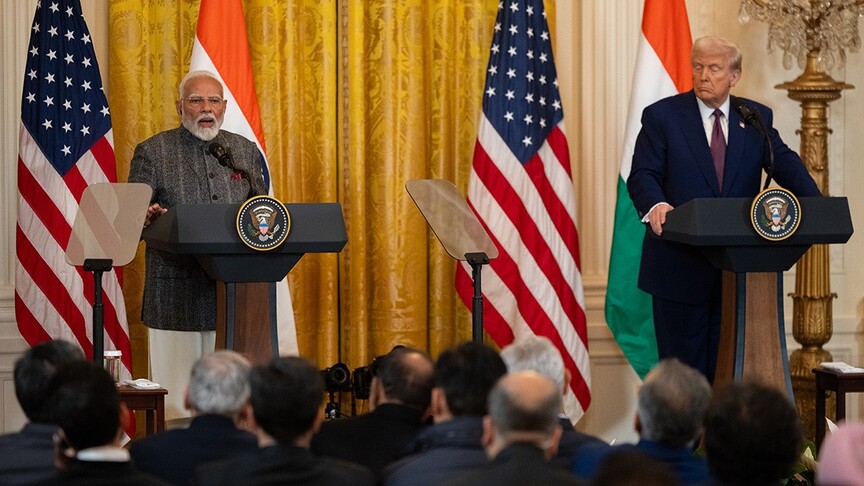
Indian Prime Minister Narendra Modi used the G7 Summit in France to directly confront U.S. President Donald Trump regarding the safety of seafarers. The discussion follows the tragic killing of three Indian sailors during U.S. naval operations, with Modi demanding strict protection protocols in strategic shipping corridors.
EVIAN-LES-BAINS, FRANCE — June 17, 2026 — Indian Prime Minister Narendra Modi raised critical concerns regarding the safety of seafarers during high-level talks with United States President Donald Trump on Wednesday. The direct diplomatic engagement occurred on the sidelines of the Group of Seven (G7) Summit in Evian-les-Bains, France.
The intervention follows the tragic deaths of three Indian mariners last week during U.S. military operations off the coast of Oman, amid an intense maritime blockade linked to the broader West Asia conflict. With Washington and Tehran concurrently finalizing a comprehensive regional peace deal, Modi emphasized that protecting international commercial shipping crews must remain an absolute priority for global superpowers.
Diplomatic Friction Over Maritime Blockade Casualties
The bilateral interaction between the two world leaders took place under a visible shift in tone compared to their historic February 2025 working session in Washington. Bilateral ties have faced recent friction over steep industrial trade tariffs and conflicting geopolitical claims. However, the immediate catalyst for India's sharp diplomatic intervention was the June 10 military strike executed by U.S. naval forces in the Gulf of Oman.
According to official briefings, the U.S. Navy targeted three commercial vessels suspected of violating Washington's strict blockade on Iranian ports. The merchant ships, which carried extensive Indian crew complements, sustained severe damage, resulting in three confirmed Indian civilian fatalities.
The incident sparked immediate political outcry within India. Opposition leaders pressured the administration to secure accountability from the White House, pointing out that India had no direct involvement in the conflict yet suffered preventable civilian losses.
Collective Responsibility and Global Shipping Security
Addressing G7 leaders and guest nations during the formal outreach session themed "Forging New Partnerships and Rebuilding International Solidarity," Prime Minister Modi explicitly raised the systemic economic dangers posed by maritime disruptions. With President Trump seated directly beside him, Modi detailed the practical implications that shipping lane vulnerabilities inflict on developing countries.
Modi asserted that the recurring closure or restriction of the strategic Strait of Hormuz—a bottleneck controlling approximately 20 percent of global oil transitions—directly threatens international economic stability. The Prime Minister argued that while India broadly welcomes the ongoing diplomatic breakthroughs between the U.S. and Iranian officials to ease the blockade, any long-term peace framework is incomplete without robust, non-negotiable protections for civilian transport workers.
Impact on Global Maritime Commerce and Investors
The explicit focus on the safety of seafarers at an international forum underscores the vulnerabilities confronting the global maritime labor market. India supplies a substantial percentage of the global seafaring workforce, with hundreds of thousands of its citizens operating critical logistics routes worldwide.
For commercial shipping lines, international insurers, and global supply chain investors, localized military blockades introduce severe financial and operational volatility. Elevated insurance premiums, mandatory route diversions around Africa, and heightening crew recruitment shortages have raised overall shipping overheads. By forcing maritime safety into G7 bilateral frameworks, India aims to ensure that superpowers utilize strict identification protocols before deploying lethal force against merchant hulls.
Official Sources Section
The material details concerning this bilateral engagement are drawn from official press briefings, diplomatic readouts, and ministerial statements issued by the Ministry of External Affairs (MEA), India and the [suspicious link removed]. Operational context regarding the maritime strikes was cross-verified through official military operational briefings published by U.S. Central Command (CENTCOM).
Quote Section
In his direct remarks delivered following the G7 sideline session, Prime Minister Modi focused heavily on the humanitarian dimensions of the trade routes:
"You are aware that across the world, Indian seafarers and hundreds of thousands are working and performing their duties across global maritime trade routes, including the Strait of Hormuz, and their safety is of utmost importance to us. I am confident that the issue of seafarers will receive the highest priority in the implementation of this agreement."
Prior to the summit, India's External Affairs Minister, Subrahmanyam Jaishankar, recorded the administration's strong stance during a formal diplomatic protest to U.S. Secretary of State Marco Rubio:
"According to officials, such lethal actions against commercial shipping are not justified. The Ministry of External Affairs reiterated India's strong protest at the attacks by the U.S. Navy in the Gulf that killed three Indian mariners."
Why It Matters
For global logistics firms and corporate supply chains, this high-level exchange establishes a critical precedent. It signals that emerging economic powers will no longer accept collateral civilian casualties within international waters as an unavoidable consequence of localized superpower blockades, altering how maritime embargoes are enforced in the future.
Key Facts at a Glance
Event Location: G7 Summit Outreach Session held in Evian-les-Bains, France.
Core Incident: Three Indian seafarers killed during a U.S. Navy maritime strike in the Gulf of Oman on June 10.
Primary Lane Affected: The Strait of Hormuz, which facilitates 20% of global oil shipments.
Diplomatic Action: Prime Minister Modi formally requested that seafarer protections be integrated into the upcoming U.S.-Iran peace deal.
Bilateral Context: Follows an intense period of tariff disputes and formal diplomatic summons in New Delhi.
FAQ Section
What caused the deaths of the Indian seafarers in the Gulf?
Three Indian mariners were killed when U.S. naval forces targeted commercial tankers in the Gulf of Oman as part of a military blockade enforcement operation against non-compliant shipping routes.
What was the official position taken by the United States regarding the strikes?
The U.S. Department of State and Secretary Marco Rubio defended the operations, stating that commercial vessels must strictly comply with orders from American forces and that violations of the blockade would not be tolerated.
Where is the upcoming U.S.-Iran peace agreement expected to be signed?
According to regional mediators, Pakistan is scheduled to host the official signing ceremony for the initial peace agreement between the U.S. and Iran in Geneva.
Why is the safety of seafarers an acute issue for the Indian government?
India is one of the largest providers of professional maritime labor globally, with hundreds of thousands of its citizens working aboard commercial cargo vessels traversing high-risk trade lanes.
Source: Press Briefing: Ministry of External Affairs, Government of India