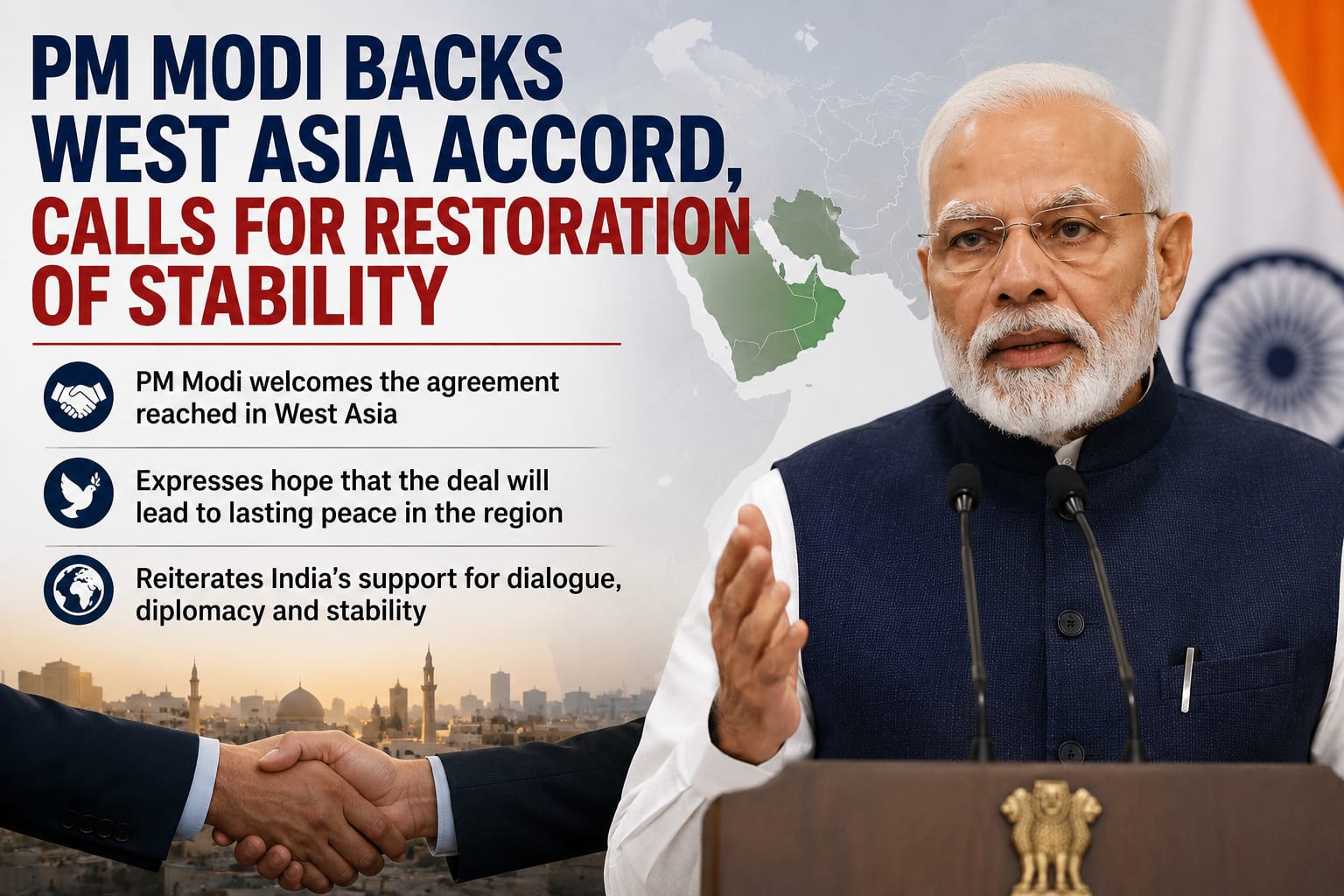
Prime Minister Narendra Modi has formally welcomed the breakthrough peace understanding between the United States and Iran, ending a disruptive 107-day West Asia conflict. Highlighting its vital role in reversing global economic turmoil, Modi stated that India hopes the agreement successfully guarantees freedom of navigation, regional stability, and uninterrupted maritime commerce.
NEW DELHI — Indian Prime Minister Narendra Modi on Monday officially welcomed the breakthrough diplomatic understanding achieved between the United States and Iran aimed at terminating the 107-day military conflict in West Asia. Speaking from Bratislava, Slovakia, on June 15, 2026, Prime Minister Modi emphasized that the de-escalation framework holds vital importance for global markets, noting that the protracted maritime hostilities have caused severe economic disruption worldwide and a tragic loss of lives across multiple nations. India’s strategic interest focuses heavily on the immediate stabilization of global energy corridors and the complete restoration of unhindered commercial shipping channels through critical maritime choke points.
India Signals Strategic Support for the West Asia Agreement
The formal statement from New Delhi marks a vital diplomatic endorsement from one of West Asia's primary economic and energy partners. Prime Minister Modi detailed India’s official stance via a public declaration on the social media platform X, highlighting the deep structural impacts the 107-day war has exacted on international transit.
According to the official communication released by the Prime Minister's Office, India views the cessation of hostilities as an essential prerequisite to rectifying the current global energy crisis. The conflict, which triggered extensive naval blockades and high-risk commercial shipping conditions, severely impacted domestic import costs and delayed supply chains across Asia and Europe.
Indian administrative officials indicated that New Delhi has maintained close communication with regional stakeholders throughout the crisis, consistently advocating for a peaceful resolution via institutional dialogue and structured diplomacy.
Impact on Global Commerce and Freedom of Navigation
A central pillar of the West Asia agreement involves the immediate lifting of the United States naval blockade and the simultaneous, verified reopening of the Strait of Hormuz. For India, which relies heavily on the Persian Gulf region for more than 60 percent of its crude oil imports, the security of this specific passage is paramount.
The implementation phase of the understanding explicitly demands the systematic removal of naval mines from the waterway to secure the passage of international cargo ships and oil supertankers. Economists note that the stabilization of the Strait of Hormuz will exert immediate downward pressure on global Brent crude prices, providing much-needed relief to Indian consumer markets and maritime insurance firms that faced surging risk premiums during the conflict.
Furthermore, the pact re-establishes foundational security frameworks for the thousands of Indian expatriates working across Gulf Cooperation Council (GCC) nations, whose financial remittances form a major pillar of India's capital inflows.
Official Sources Section
The details surrounding the diplomatic breakthrough were corroborated through separate official announcements issued by the respective governments involved:
The Government of India: An official press statement was distributed by the Press Information Bureau (PIB) under Release ID 2272900, detailing the Prime Minister's policy endorsement.
The United States Executive Branch: Statements published via official presidential communications channels confirmed the finalization of the baseline terms with the Islamic Republic of Iran to end the 107-day war.
International Partners: Pakistan Prime Minister Shehbaz Sharif confirmed via an institutional brief that the formal, binding signing ceremony for the comprehensive West Asia agreement is scheduled to take place in Switzerland on Friday, June 19, 2026.
Quote Section
In his definitive statement addressing the international diplomatic breakthrough, Prime Minister Narendra Modi stated:
"I welcome the understanding reached between the United States and Iran on ending the conflict in West Asia, which has caused serious economic disruption across the world and led to loss of life in many countries. India hopes that the implementation of this understanding will help restore peace and stability in the region and ensure the freedom of navigation and commerce. We look forward to deliberations on the remaining issues reaching a sustainable final agreement."
According to officials from the Ministry of External Affairs, Indian diplomatic missions are prepared to support subsequent multilateral phases of the treaty to ensure that the initial cessation of military operations matures into a permanent regional security framework.
Why It Matters
The practical implications of the West Asia agreement span across macro-economics, defense logistics, and consumer energy retail:
Energy Security: Stable maritime channels mean Indian public sector oil refineries can normalize procurement schedules without mapping costly alternative routes or incurring prohibitive war-risk insurance fees.
Inflation Control: A reduction in global oil prices directly dampens retail fuel prices, lowering logistics costs for manufacturing, transport, and agricultural sectors inside India.
Diplomatic Precedent: The agreement reinforces the effectiveness of back-channel diplomacy over prolonged military containment, creating a potential template for resolving peripheral disputes regarding nuclear monitoring and economic sanctions.
Key Facts at a Glance
Conflict Duration: The intensive military conflict in West Asia lasted exactly 107 days prior to the breakthrough announcement.
Formal Treaty Signing: The official execution of the peace pact is scheduled for Friday, June 19, 2026, in Switzerland.
Core Maritime Action: The agreement guarantees the immediate removal of the United States naval blockade and initiates cooperative mine clearance inside the critical Strait of Hormuz.
India's Position: Prime Minister Modi has officially committed India's diplomatic support, explicitly linking the West Asia agreement to global economic stability and freedom of navigation.
FAQ Section
What is the primary focus of the new West Asia agreement?
The immediate focus of the understanding is the cessation of active military operations between the United States and Iran, the total removal of the US naval blockade, and the secure reopening of the Strait of Hormuz for commercial shipping and global energy transit.
When and where will the West Asia peace agreement be formally signed?
According to international state officials, the diplomatic agreement is scheduled to be formally signed during a diplomatic summit in Switzerland on Friday, June 19, 2026.
Why is freedom of navigation in West Asia critical to India?
India imports a vast majority of its crude oil and liquefied natural gas (LNG) through the Persian Gulf and the Strait of Hormuz. Any conflict or naval blockade in this geographic zone directly jeopardizes India’s national energy security, elevates inflation, and disrupts maritime trade lines.
Does this agreement resolve all outstanding disputes between the US and Iran?
No, the current understanding primarily targets the de-escalation of the recent 107-day war and commercial shipping security. As noted by Prime Minister Modi, international stakeholders are looking forward to subsequent deliberations to address remaining long-term issues, such as comprehensive sanctions and nuclear protocols.
Source: Press Information Bureau (PIB) - Government of India; Official Social Media Statement of the Prime Minister of India; Institutional Syndicated Reports from the Press Trust of India (PTI).