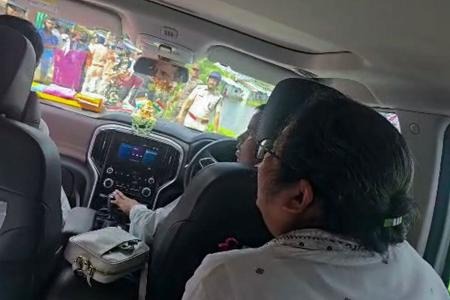
Former West Bengal Chief Minister Mamata Banerjee's convoy was targeted with stones, shoes, and mud by hostile protesters in Halisahar, North 24 Parganas, on Sunday. The violence erupted while she was traveling to visit the family of a deceased Trinamool Congress worker. Banerjee blamed the ruling administration and police for inaction, while opposition leaders denied involvement.
Overview of the Incident in North 24 Parganas
On Sunday, August 9, 2026, former West Bengal Chief Minister and All India Trinamool Congress (TMC) president Mamata Banerjee faced intense protests and a physical assault on her motorcade in Halisahar, located within the North 24 Parganas district of West Bengal.
The confrontation occurred as Banerjee traveled through the Bijpur and Halisahar areas to visit the grieving family of Birju Keot, a local TMC worker. Keot had recently died under disputed circumstances while in police custody, sparking localized political friction and public outrage. As the motorcade navigated the route, crowds intercepted the vehicles, shouting hostile slogans, throwing water bottles, and hurling mud, footwear, and large stones directly at Banerjee’s car.
Background: Custodial Death Controversy
The underlying tension stemmed from the death of Birju Keot, the husband of a former TMC municipal councillor from Kanchrapara. Keot had been arrested on extortion and corruption allegations and reportedly fell ill before being pronounced dead at a hospital.
While local police maintained that Keot suffered a sudden medical emergency, his family and party affiliates alleged that he succumbed to severe custodial torture. Seeking to capitalize on political momentum and offer solidarity, Banerjee planned a personal condolence visit to the family. However, local residents and counter-protesters gathered to block the convoy, claiming the opposition visit was intended to stoke community unrest.
Official Sources Section
According to official statements released by senior law enforcement and political figures:
Mamata Banerjee's Account: Speaking directly to reporters after escaping the immediate threat zone, Banerjee asserted that anti-social elements hurled heavy stones with intent to cause lethal harm. She claimed, "Large stones were hurled at my car by anti-social elements, right in front of the police. The attack on the vehicle was so severe that if the windows had been open, my head would have been split open. We could have all been killed." Furthermore, she alleged complicity within the state security apparatus, stating that local law enforcement actively shielded disruptive groups.
Trinamool Congress Leadership: Accompanying party legislators, including Lok Sabha MP Kalyan Banerjee and Rajya Sabha MP Dola Sen, fiercely condemned the event. Kalyan Banerjee characterized the incident as a pre-planned attempt on the former chief minister's life, directly pointing fingers at the state administration.
Bharatiya Janata Party (BJP) Response: State BJP leadership firmly rejected any institutional or party-backed involvement in the stone-pelting. West Bengal BJP President Samik Bhattacharya and state minister Agnimitra Paul condemned the physical aggression against a senior political figure, clarifying that the party does not endorse physical assaults or the throwing of objects at opponents. They maintained that the gathering was an organic expression of local citizen frustration rather than a coordinated party attack.
"The attack on the vehicle was so severe that if the windows had been open, my head would have been split open. We could have all been killed." — Mamata Banerjee, TMC President and Former Chief Minister
Why It Matters
The violent disruption of a former chief minister's convoy marks a dangerous escalation in West Bengal's already volatile political landscape. For citizens and local businesses, the recurring clashes between political factions raise serious concerns regarding public safety, freedom of movement, and law enforcement neutrality.
The incident also places heightened scrutiny on custodial accountability and institutional transparency regarding deaths in police custody. For investors and travelers, recurring street-level confrontations underscore the risk of sudden localized civil unrest, prompting calls from civil society for calm and restraint from all major political stakeholders.
Key Facts at a Glance
Date of Incident: Sunday, August 9, 2026.
Location: Halisahar and Bijpur areas, North 24 Parganas district, West Bengal.
Catalyst: A scheduled visit by Mamata Banerjee to the family of deceased TMC worker Birju Keot.
Nature of Assault: Protesters hurled large stones, mud, shoes, and water bottles at the motorcade.
Official Stance: TMC accused the state administration of a murder conspiracy, while the BJP condemned the violence and denied party involvement.
FAQ Section
What triggered the protests in North 24 Parganas?
The protests were sparked by public anger surrounding the death of local TMC worker Birju Keot while in police custody, with his family alleging torture.
Was anyone injured during the convoy attack?
While Mamata Banerjee and her accompanying MPs escaped physical injury, the vehicle sustained considerable damage from thrown stones, bricks, and mud.
What was the police response to the security breach?
Police personnel deployed extra cordons to manage the agitated crowd and safely escorted the former chief minister's convoy out of the affected sector.
How did political parties react to the violence?
The TMC accused the ruling state government and local police of enabling the attackers, whereas the BJP condemned the vandalism while denying any organizational involvement.
Source: Times of India, Rediff News, India Today, Hindustan Times, The Week