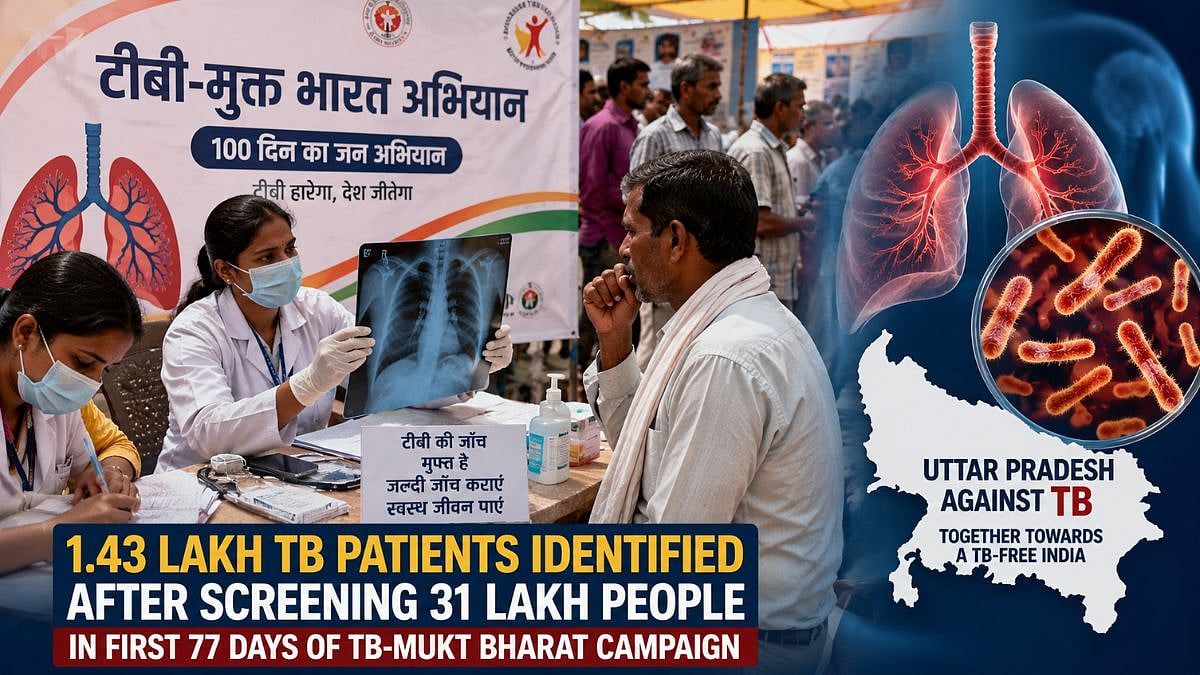
The Government of Uttar Pradesh has identified 1.43 lakh tuberculosis patients after screening over 31 lakh people during the initial 77 days of its TB-Mukt Bharat Campaign. All confirmed cases are now linked to free medical care and monthly nutritional financial grants to ensure long-term treatment success.
LUCKNOW — The Government of Uttar Pradesh has issued a statewide public health alert following the mandatory clinical identification of 1.43 lakh tuberculosis (TB) patients across its 75 districts. According to official data boards released by the state's National Health Mission desk on Monday, June 22, 2026, the high volume of confirmed infections was successfully mapped after specialized medical teams conducted field diagnostic screenings of more than 31 lakh individuals. Executed during the initial 77 days of the ongoing, accelerated TB-Mukt Bharat Campaign, this massive tracking deployment represents one of the largest localized respiratory screening drives ever managed in northern India. The development is highly critical today as state healthcare ministries work to locate hidden community transmission pools and place active patients under immediate, government-funded pharmaceutical care.
Deploying the 77-Day Blitz: Active Case Finding Techniques
The identification of 1.43 lakh TB patients within an 11-week runway highlights a fundamental shift away from passive hospital reporting toward active, community-wide detection. According to regional tracking blueprints managed by the Uttar Pradesh Department of Health and Family Welfare, thousands of accredited social health activists (ASHAs) and auxiliary nurse midwives (ANMs) were deployed into high-density urban slums, rural agricultural blocks, and mining settlements.
Out of the 31 lakh individuals selected for physical screening based on preliminary risk indicators, field operators collected and processed multiple sputum samples and directed high-risk suspects toward digital chest X-ray units. The intensive search successfully uncovered individuals suffering from active pulmonary infections who had not previously sought formal clinical evaluation, effectively cutting off ongoing transmission chains within dense households.
Systemic Integration of the Ni-kshay Poshan Yojana
A primary structural challenge following the discovery of 1.43 lakh new infections is keeping patients compliant with their long-term drug regimens. To address this risk, the state administration has linked all newly registered individuals directly to the central government's Ministry of Health and Family Welfare tracking portal to activate continuous nutritional financial support.
Under the operational guidelines of the Ni-kshay Poshan Yojana, each confirmed patient receives a monthly Direct Benefit Transfer (DBT) of ₹500 directly into their verified bank accounts. This specialized funding is legally structured to help patients offset the cost of essential high-protein foods, micro-nutrients, and dietary supplements. Medical researchers consistently emphasize that proper caloric intake is vital to prevent drug-induced liver stress and lower clinical drop-out rates during the standard six-month medication course.
Community Mobilization Through Corporate and Private Sponsors
To expand support past standard state funding limits, Uttar Pradesh is scaling up its local corporate integration under the Pradhan Mantri TB Mukt Bharat Abhiyaan. The initiative encourages private businesses, non-governmental organizations, and individual citizens to register formally as Ni-kshay Mitras (health sponsors).
These private sponsors adopt confirmed patients or entire local blocks, providing monthly nutritional baskets packed with essential grains, roasted grams, proteins, and cooking oils. This combined approach reduces food insecurity for vulnerable families, allowing low-income workers to focus entirely on their clinical recovery without facing severe financial strain.
Official Sources Section
The diagnostic statistics, field screening tallies, regional transmission profiles, and nutritional transfer ledgers detailed across this health alert are compiled from administrative updates published by the Central TB Division, regulatory data boards issued by the National Health Mission (UP), and health infrastructure briefs maintained by the federal Ministry of Health and Family Welfare.
Quote Section
"Finding 1.43 lakh patients in just 77 days is a major step forward for our public health infrastructure," stated senior district health administrators in a joint campaign briefing. "According to officials, screening 31 lakh individuals allowed state medical teams to locate hundreds of asymptomatic or marginalized patients who were quietly suffering without access to diagnostic tools. Organizers stated that every newly identified patient has been successfully mapped to a localized DOTS center to receive completely free anti-tubercular medication and continuous nutritional financial transfers."
Why It Matters
The rapid identification of 1.43 lakh TB patients carries massive practical implications for the containment of airborne infectious diseases across South Asia. Tuberculosis spreads through fine respiratory droplets generated when an untreated individual coughs or sneezes. By actively tracking down and treating 1.43 lakh infected individuals, public health teams prevent millions of secondary exposures across local public transport networks, factories, and schools. This aggressive containment strategy is essential to protect local workforces and reduce the long-term economic burden associated with chronic respiratory illness.
Key Facts at a Glance
The Screening Matrix: State health teams successfully evaluated more than 31 lakh citizens across Uttar Pradesh within the initial 77 days of the campaign.
Case Identification: Aggressive lab and field diagnostics confirmed 1.43 lakh active tuberculosis cases, placing them under immediate clinical surveillance.
Nutritional Welfare Flow: Every registered patient receives a monthly ₹500 state grant via direct bank transfers to fund high-protein nutrition during recovery.
Community Sponsorship: The ongoing drive utilizes private Ni-kshay Mitras to distribute physical food baskets to vulnerable families.
Eradication Timeline: The campaign operates as part of India's national goal to eliminate tuberculosis completely ahead of global health timelines.
FAQ Section
What primary symptoms should trigger an immediate tuberculosis screening test?
According to standard medical guidelines published by the Central TB Division, individuals experiencing a persistent cough lasting more than two weeks, unexplained weight loss, recurring night sweats, or a continuous low-grade fever should immediately visit their nearest public health center for a free sputum test.
Is tuberculosis treatment completely free under the TB-Mukt Bharat Campaign?
Yes. All diagnostic screenings, chest X-rays, sputum cultures, and daily fixed-dose combination medications are provided completely free of charge to all citizens at every government hospital and primary health center nationwide.
What happens if a patient stops taking their TB medication before finishing the course?
Abruptly halting your prescribed medication allows the surviving bacteria to adapt and mutate, leading to the development of Drug-Resistant TB (DR-TB). This specialized variant requires a much longer, more expensive treatment course with stronger pharmaceuticals that carry higher risks of clinical side effects.
Source: Official field epidemiology reports managed by the Central TB Division and community health databases tracking the campaign across the Ministry of Health and Family Welfare.