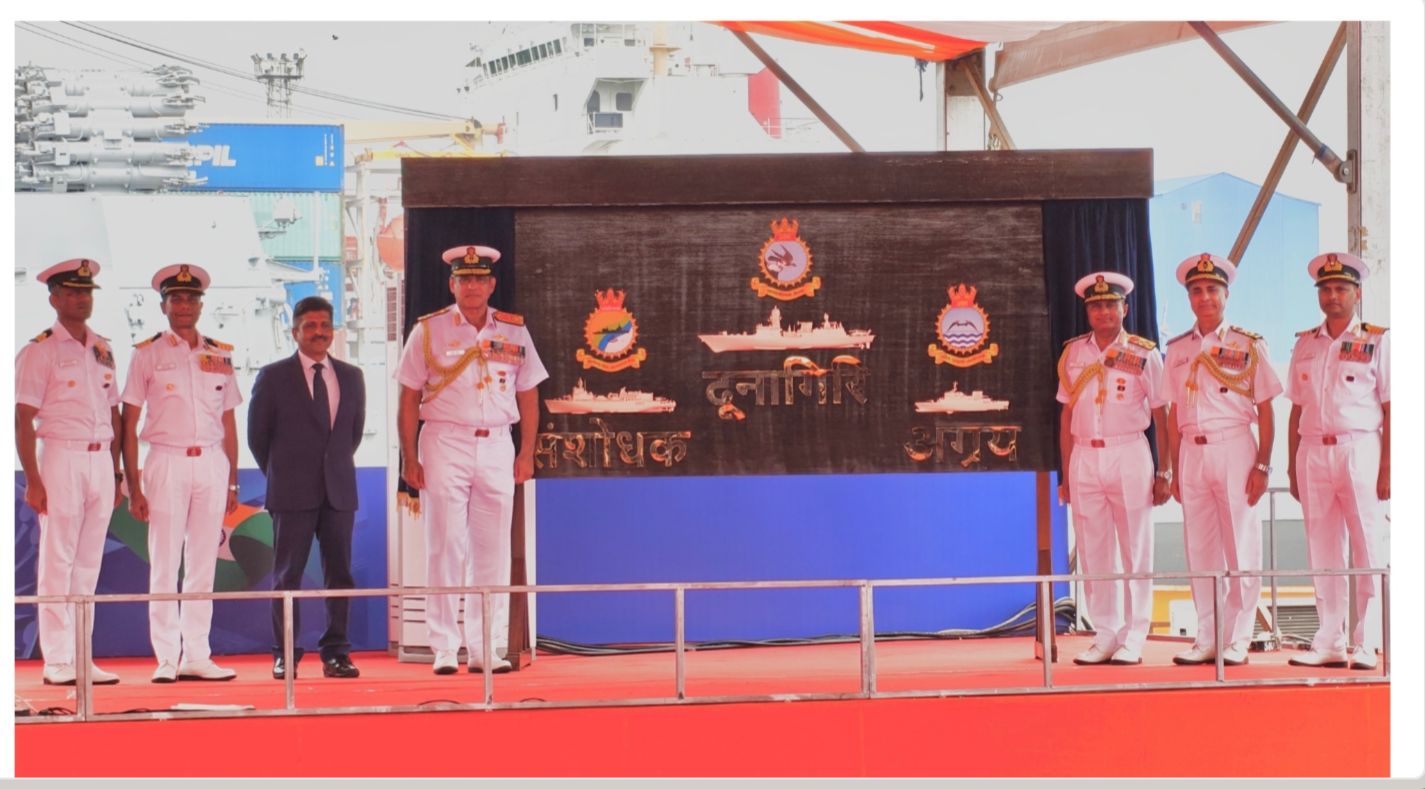
Prime Minister Narendra Modi commissioned three GRSE-built warships—INS Dunagiri, INS Sanshodhak, and INS Agray—into the Indian Navy in Kolkata. This historic single-day triple induction significantly boosts India's coastal strike, anti-submarine defense, and deep-sea hydrographic capabilities while demonstrating the country's accelerating domestic defense manufacturing strength.
KOLKATA — Indian Prime Minister Narendra Modi officially commissioned three newly constructed domestic warships into the Indian Navy at a high-profile military ceremony in Kolkata on Sunday, June 21, 2026. The formal induction of INS Dunagiri, INS Sanshodhak, and INS Agray represents a significant moment in the country's defense modernization. Built entirely by the state-backed defense enterprise Garden Reach Shipbuilders & Engineers (GRSE) Ltd, this multi-vessel commissioning is the first time a single Indian shipyard has delivered three distinct major surface combatants on the exact same day.
This rapid naval expansion carries immense defense and economic importance today. As strategic rivalries intensify across the Indian Ocean Region (IOR), boosting the domestic manufacturing rate of frontline warships directly insulates India's maritime trade boundaries. Furthermore, achieving high levels of localized engineering content advances the government's long-term target of total industrial self-reliance under the Aatmanirbhar Bharat defense framework.
Technical Breakdown of the Inducted Fleet Tranches
The three newly commissioned surface vessels bring unique specialized capabilities to the Indian Navy's eastern and western commands, significantly expanding the fleet's tactical footprint across multiple operational sectors.
The first vessel, INS Dunagiri, is the second Advanced Guided Missile Frigate designed and developed under the stealth parameters of Project 17A. This heavy warship features advanced Radar Cross Section (RCS) reduction layouts and comes equipped with supersonic BrahMos anti-ship and land-attack cruise missile arrays. This setup gives the fleet a major long-range surface warfare capability.
The second platform, INS Sanshodhak, represents the final vessel in the Navy's modern four-ship Survey Vessel (Large) program. Designed primarily for extensive deep-sea hydrographic mapping, the ship will chart complex port approaches, identify shipping lane hazards, and collect oceanographic data. Additionally, its spacious design allows it to pivot quickly as a secondary operational platform for Humanitarian Assistance and Disaster Relief (HADR) missions across regional littoral zones.
The third combatant, INS Agray, is a high-speed Anti-Submarine Warfare Shallow Water Craft (ASW-SWC). Built with an impressive 88 percent indigenous material content, the vessel is optimized for scanning and neutralizing subsurface threats in shallow coastal waters. To achieve this, it integrates modern digital Combat Management Systems, lightweight acoustic torpedo launchers, anti-submarine rocket batteries, and a stabilized 30 mm Naval Surface Gun.
Industrial Scale of India's Top Defense Shipbuilder
The double delivery of INS Dunagiri, INS Sanshodhak, and INS Agray elevates GRSE's total production record to 118 finished warships. This count includes 80 major surface vessels engineered exclusively for the Indian Navy, representing the highest delivery volume achieved by any single domestic shipyard since independence.
The corporate history of the defense public sector undertaking (DPSU) shows an impressive evolution. Originally founded in 1884 as a small commercial riverboat maintenance workshop, the facility was taken over by the Government of India in 1960. Since then, the defense shipbuilder has maintained a steady series of domestic maritime engineering achievements:
It designed and delivered independent India's very first naval warship, the Seaward Defence Boat (SDB) INS Ajay, back in 1961.
It engineered the first-ever patrol boat utilized by the Indian Coast Guard.
It became the first domestic firm to construct a heavy Fleet Replenishment Tanker.
It established an international export record by shipping the specialized combat vessel CGS Barracuda to Mauritius, alongside defense platforms delivered to Seychelles and Guyana.
Operating four distinct shipyards across the region, the company has updated its manufacturing infrastructure to support the concurrent assembly of up to 28 vessels at any given time. The enterprise has also diversified its revenue streams, expanding into pre-fabricated steel bridge manufacturing, heavy deck machinery integration, and the assembly, testing, and overhaul of specialized marine diesel powertrains.
Quote Section
"Today, on this very soil, an important event linked to Aatmanirbhar Bharat, Surakshit Bharat, and Viksit Bharat is taking place," stated Prime Minister Narendra Modi during the commissioning ceremony. "Today, INS Agray, INS Dunagiri, and INS Sanshodhak are giving new momentum to that journey. These three vessels are also symbols of three important national commitments. They have been built in India, their designs were developed in India. The talent of Indian industries has gone into their construction. The skill of Indian engineers has gone into them. The hard work of Indian workers has gone into them. And this is the greatest strength of the new India."
Why It Matters
The successful deployment of these three combat platforms has major practical implications for maritime security and the domestic industrial economy. By integrating over 90 percent indigenous equipment on its modern frontline warships, the navy significantly limits its exposure to foreign supply chain delays during international crises. Economically, keeping these massive manufacturing contracts within the country channels capital directly into local MSMEs and specialized engineering sub-contractors, creating high-skill industrial jobs and expanding advanced software engineering capabilities within the domestic defense sector.
Key Facts at a Glance
Historical Milestone: Prime Minister Narendra Modi commissioned three major warships—INS Dunagiri, INS Sanshodhak, and INS Agray—on a single day in Kolkata.
Unparalleled Production: This event marks the first time any shipyard in India has completed and delivered three distinct major surface combatants simultaneously.
Stealth and Strike Power: INS Dunagiri enters the fleet as a Project 17A Advanced Guided Missile Frigate, carrying supersonic BrahMos anti-ship cruise missiles.
Subsurface Shield: INS Agray introduces specialized shallow-water anti-submarine capabilities, featuring an 88 percent indigenous component structure.
Deep Sea Intelligence: INS Sanshodhak completes the large survey vessel series, designed to expand the navy’s hydrographic and oceanographic intelligence networks.
FAQ Section
What makes the commissioning of these three warships historically unique in India?
This is the first time in Indian shipbuilding history that a single domestic shipyard has completed, delivered, and commissioned three distinct, frontline surface warships on the exact same day.
What specific weapons systems are installed on INS Dunagiri?
As a Project 17A Advanced Guided Missile Frigate, INS Dunagiri is equipped with state-of-the-art stealth technologies alongside supersonic BrahMos anti-ship and land-attack cruise missiles for long-range maritime strikes.
How do these newly commissioned ships impact India's localized manufacturing goals?
The vessels utilize up to 90 percent indigenous equipment fits. INS Agray, for example, features roughly 88 percent domestic components, helping reduce reliance on foreign defense suppliers.
Source: Official defense press releases issued by Garden Reach Shipbuilders & Engineers Ltd and military procurement data logs published by the Ministry of Defence.