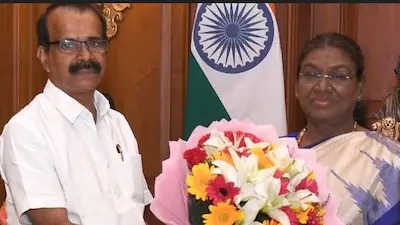
President Droupadi Murmu has accepted the resignation of Union Minister of State George Kurian after his Rajya Sabha term ended on June 21 without a fresh renomination. Kurian's exit creates key vacancies in minority affairs and fisheries, shifting political focus to the future of fellow minister Ravneet Singh Bittu.
NEW DELHI — President Droupadi Murmu formally accepted the resignation of Union Minister of State for Minority Affairs George Kurian from the Union Council of Ministers with immediate effect. The executive transition, confirmed by a Rashtrapati Bhavan communique on Tuesday, June 23, 2026, follows the official conclusion of Kurian's six-year term as a Rajya Sabha Member of Parliament from Madhya Pradesh on June 21. Acting on the explicit constitutional counsel of Prime Minister Narendra Modi under Article 75(2), the head of state finalized the exit. The move prompts intense strategic speculation over a possible mid-term cabinet reshuffle and raises immediate questions regarding the future status of fellow Union Minister Ravneet Singh Bittu.
The Constitutional Context Behind Kurian's Departure
According to official parliamentary protocols, an individual cannot continue to serve within the Union Council of Ministers for more than six consecutive months without holding a valid seat in either the Lok Sabha or the Rajya Sabha. Kurian, a senior Bharatiya Janata Party (BJP) organizational stalwart from Kerala who was inducted into the cabinet in June 2024, saw his legislative upper house tenure expire on June 21.
The ruling party's central election committee intentionally decided against renominating Kurian during the recently concluded June 18 Rajya Sabha elections, opting instead to field national general secretary Tarun Chugh from the Madhya Pradesh vacancy. Consequently, Kurian stepped down from his twin administrative responsibilities:
Ministry of Minority Affairs: Serving as the principal Minister of State overseeing community-specific welfare portfolios.
Ministry of Fisheries, Animal Husbandry & Dairying: Holding concurrent secondary operational charge as a Minister of State.
Political observers emphasize that Kurian's exit removes the most prominent Christian face from the current executive council. His initial selection in 2024 was seen as a central pillar of the ruling coalition's tactical minority outreach strategy across southern India.
All Eyes Pivot to Ravneet Singh Bittu
With Kurian’s resignation formally recorded, national attention has immediately shifted to Union Minister of State for Food Processing Industries and Railways, Ravneet Singh Bittu. Like Kurian, Bittu’s Rajya Sabha term from Rajasthan officially concluded on June 21, and he similarly did not figure on the BJP’s renomination list for the June 18 upper house ballots. The party chose to field senior leader Satish Poonia to occupy the Rajasthan upper house seat instead.
However, internal party strategists reveal that Bittu’s political trajectory remains fundamentally distinct from Kurian’s. While Kurian is expected to return to Kerala to focus purely on grassroots party organization ahead of local assembly cycles, Bittu remains a key player in the party's northern strategy. Having shifted allegiance from the Congress to the BJP ahead of the 2024 general elections, Bittu is being positioned as a central anchor for the party in Punjab, which goes to the polls early next year.
Because the strict six-month constitutional clock resets if a minister is re-appointed under a distinct legislative entry or if a casual house vacancy opens up later, analysts are tracking whether the prime minister will choose to retain Bittu via an alternative legislative route.
Broad Impact on Governance and Minority Representation
The administrative vacancies created by this standard legislative rotation directly affect the daily execution of central welfare schemes. The Ministry of Minority Affairs handles massive scholarship networks and multi-sectoral development programs tailored for recognized religious communities. A prolonged vacancy at the Minister of State level could slow down project clearances as the fiscal second quarter begins.
For everyday citizens, civic organizations, and agricultural exporters, the shifting configuration inside the Ministry of Fisheries and Animal Husbandry is equally vital. This department coordinates crucial sub-continental milk supply chains, cold-storage grants, and deep-sea fishing subsidies. Corporate investors and industry trade groups are watching closely to see if Prime Minister Modi will distribute these vacant portfolios among existing cabinet members or utilize the moment to orchestrate a wider, performance-driven Cabinet reshuffle before the upcoming monsoon session of Parliament.
Official Sources Section
The details concerning the resignation clearances, constitutional filings, and Rajya Sabha seat distributions cited in this report correspond to formal press communiques distributed by the President's Secretariat (Rashtrapati Bhavan), regulatory listings from the Rajya Sabha Secretariat, and official announcements from the Central Election Committee of the Bharatiya Janata Party (BJP).
Quote Section
"According to officials from the Rashtrapati Bhavan, the President of India, acting under the constitutional guidance of Prime Minister Narendra Modi, accepted the resignation of George Kurian from the Union Council of Ministers with immediate effect."
Why It Matters
For citizens and regional political observers, this reshuffling reveals how closely legislative seat management is linked to executive power. The exit of a key minority representative highlights the constant challenge of maintaining diverse regional and cultural representation within the central cabinet, while the focus on upcoming state elections dictates how parliamentary seats are strategically distributed.
Key Facts at a Glance
Resignation Accepted: President Droupadi Murmu formally approved George Kurian's departure from the council of ministers on June 23.
Term Expiration: Kurian's formal tenure as a Rajya Sabha Member of Parliament from Madhya Pradesh officially concluded on June 21.
Portfolios Vacated: Vacated his roles as Minister of State for Minority Affairs and Minister of State for Fisheries, Animal Husbandry & Dairying.
Parallel Focus: Fellow Union Minister Ravneet Singh Bittu also saw his Rajya Sabha term expire on June 21 without immediate renomination.
FAQ Section
Why did Union Minister George Kurian resign from his post?
Kurian resigned because his official six-year term as a Rajya Sabha MP from Madhya Pradesh ended on June 21, and the BJP chose to nominate a new candidate rather than extending his tenure.
Who is replacing George Kurian in the Rajya Sabha?
The BJP selected national general secretary Tarun Chugh as its official candidate to contest and fill the Rajya Sabha vacancy from Madhya Pradesh.
What happens to Ravneet Singh Bittu's ministerial role now?
While Bittu's Rajya Sabha term has also expired, the Prime Minister can choose to retain him in the cabinet for up to six months, or find a different legislative seat, especially since he is a key figure for the upcoming Punjab assembly elections.
Source: Official operational circulars published via the press portal of the President of India and statutory candidate registries archived by the Election Commission of India (ECI).